#TLT16: Final keynote

Lindsay Skinner invites us to consider teacher presence in the classroom.

Think about what moves a lesson from a cover lesson to a lesson: the teacher. Focus on the voice, the body, the person. What is it that makes one person someone the kids want to listen to? Clear, fluent, emotionally engaging: eloquent.

Eloquence tends to be referred to in formal situations. Are our lessons formal, or everyday events when we forget about eloquence?

Attention span. Lower at the start, then rises as you become engaged with the speaker, then falls and rises again at the end, in anticipation of it. Use that: put something at the start to catch attention (an anecdote?) and recap the lesson content at the end. Break up the learning to re-engage attention.

Speed of speech. Conversational English is 5-6 syllables a second; newsreaders speak deliberately slower because they are transmitting important information.

Choose your words: go for a more formal phrase. Realise I do this: the difference between calling attention with, ‘Guys’ and, ‘Year 9’ is a big one. I use the latter when the former doesn’t work.

Give instructions in the correct order. ‘Use key words’ should come at the start, not the end, for example. Begin sentences with an imperative so your instructions are clearly to be follows: don’t give students the opportunity to opt out.

Beginning with a personal anecdote humanises you to your students and gets them on board.

This was engaging, funny and the perfect end to the day. Great conference.

Posted in CPD Notes, tlt16 | Leave a comment

#TLT16: Workshop 3

Toby French on “Marking and assessment are not the same”.

Why do we think marking is so important?

  • We care. Read what students are writing, but it isn’t always necessary to mark all of it.
  • CCTV for senior leaders – but like a CCTV camera, this shows only some things, not all.
  • We’re in a terrible marriage. Apparently Didau has now changed his opinion on his “Marking is an act of love” catchphrase (for the record, I haven’t) – it’s a loveless marriage. We are trapped by it.
  • We talk about marking: it is part of our everyday teaching chatter.

Marking takes a huge amount of time. It over-complicates teaching. It’s too much about making evidence for the teacher and often confused with feedback.

We discuss the different between marking and feedback amongst ourselves. I mention that I gave up marking classwork as a matter of course a few years ago, with no discernible negative impact, but that it feels odd to be doing this in my new school because the students are expecting it.

Other responses: it’s a territorial pissing contest. One says verbal feedback has to be recorded on the VLE for parents to see it. Toby shares details of a marking scrutiny that he has experienced, that was followed up with a league table of staff, published to all staff.

Who are we marking for?

Toby asks us to discuss what we should do before to ensure students do the work better to start with:
1. Add comments from a piece of work to a spreadsheet and display next time you set the task.
2. Set success criteria with the students (very TEEP).
3. Have a checklist of the key things needed in a piece of work and have them tick them off as they do them.
4. Have pre-agreed expectations and refuse to mark a piece until those are met.
5. ‘What’s wrong with this?’ – write WWWT? next to the work: students have to figure out the answer.
6. Live modelling an answer.

(I missed a couple of these, sorry).

Toby suggests:

  • Modelling
  • Scaffolding – ask a series of questions to help students move themselves on; occasional sentence starters or key words (thinking of Rich Kennet’s ‘This is not surprising’ in sourcework)
  • Common misconceptions
  • Pre-editing
  • Pre-highlighting – ‘I hope you’ve mentioned xyz…’ before they hand it in.

What does Toby mean by feedback? It’s teaching: wandering the room and giving them prompts and help; asking the right questions; facilitating their discussion.

A practical tip: if you start with a lesson question have three colour coded answers on the board at the end of the lesson and ask students to choose one and display the corresponding page in their planner.

Another one: Toby’s take on dot marking – a red dot means you do the blue target, a blue dot means you do the green target and so on. At the top of the ladder you get a written target. This would solve the problem I have with coloured dot marking: once students (think they have) finished their target, they don’t know how to improve further. My coloured dots are a bit more bespoke because they cover content and skill but it would be good to think of a way to combine these things.

Whole class marking: there are several people writing about this at the moment.

How can you promote this? Show its efficacy in your own subject: build a system and show how well it works.
Don’t …

  • Create a whole school marking policy (wince…my successful trial of doing DIRT with a purple pen led to a whole school policy that was firmly laid at my  door when my old HoD did my leaving speech in July. In my defence, I never advocated it for outside of Hums. Sometimes these things just seem to take on a life of their own.)
  • Create more work for anyone.
  • Ask students about marking.
  • Think you care more than others.
  • Think you don’t care as much as others.
Posted in CPD Notes, tlt16 | Leave a comment

#TLT16: Workshop 2

Stephanie Keenan on wider reading: the 7 year plan.

What do we want the ideal A-level student to look like? This needs to be built from year 7. We discuss what our ideal students would look like. Do we agree with Stephanie’s list? Is it any different between y7 and y13? Should staff be teaching these skills?

At Stephanie’s school they made it a whole school, all years focus and gave staff CPD time for the development. Time is given to departments to develop their own literacy focused booklets to encourage wider reading. There is a focus on three things:
1. Speak like an expert: staff correct small speaking errors like ‘I done it’
2. Write like an expert: subject specific language
3. Aim high: DIRT time
It’s reinforced verbally in class and visually through posters.

The three main areas of focus is to:
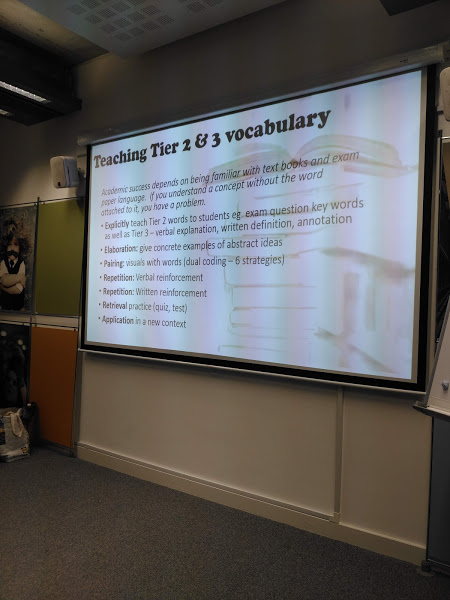
1. explicitly teach tier 2 and 3 vocabulary (2 is words that are common in written texts but rare in speech; 3 is specialised vocab: key words)
2. improving subject knowledge through wider reading
3. SPAG: “think pink” – all teachers highlight spag marks that are then corrected in dirt time; also grammar workshops for staff.

Put reading ages on seating plans (reading age is one of my favourite strategies for differentiation in group work) and encourage staff to set wider reading texts.

Apparently, we need to know 95% of a text’s vocabulary to understand it. This means students often give up if they are struggling with the text.

We discuss strategies for teaching key words. Stephanie questions whether staff are teaching both tier 2 and tier 3 vocabulary: I think 3 is easier than 2. Is it possible to ask departments to provide a list of all the tier 2/3 language necessary in their subject? Somebody makes the point that there might be significant crossover in command words among departments, so sharing the load for this might be possible.

Stephanie suggests some strategies.

stephkeenan2

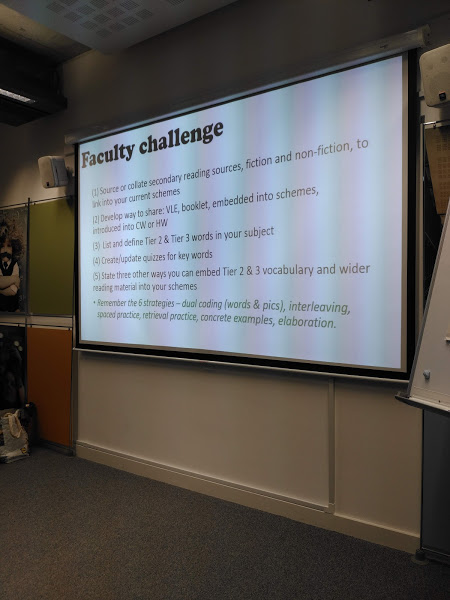
Wider reading: focus on core knowledge, cultural capital and key/threshold concepts. All English homeworks are spg or wider reading based: recommendation is to alternate wider reading homeworks with subject specific homeworks. Reading a secondary text increases absorption of the primary text – try pairing fiction with nonfiction. Faculty challenge:

stephkeenan1

Posted in CPD Notes, tlt16 | Leave a comment

#TLT16: Workshop 1

Kamil Trzebiatowski is talking about EAL students and using academic language.

As competent language users, we don’t see the language: it is like a window through which we look at the content. For children who struggle with it, the glass is frosted.

The Prism Model helps students catch up with their native speaking peers. The triple focus must be language, academic AND cognitive development. So, withdrawal doesn’t necessarily work because it removes them from the school.

Children will develop BICS on their own, just more quickly with school intervention. CALP takes much longer – 5-7 years to reach the same level as their peers. Students need CALP to get at least a C in English.

EAL students have to learn English, plus the curriculum content, plus social language, plus culturally-embedded social practicrs: following the teacher’s gaze, knocking on the door etc. They have to make MORE progress just to keep up.

Strategies. If you use pictures, they can use the context to understand the words: no need to lower the language level (also promotes high expectations: Ofsted approved!)

Kamil talks us through the A-E EAL grading that has come in this year. At C, many students flat line: this is the area where academic language should begin to come in. He talks us through some examples from each level. This is extremely helpful: it gives me some ideas about what to look out for in my students’ written work.

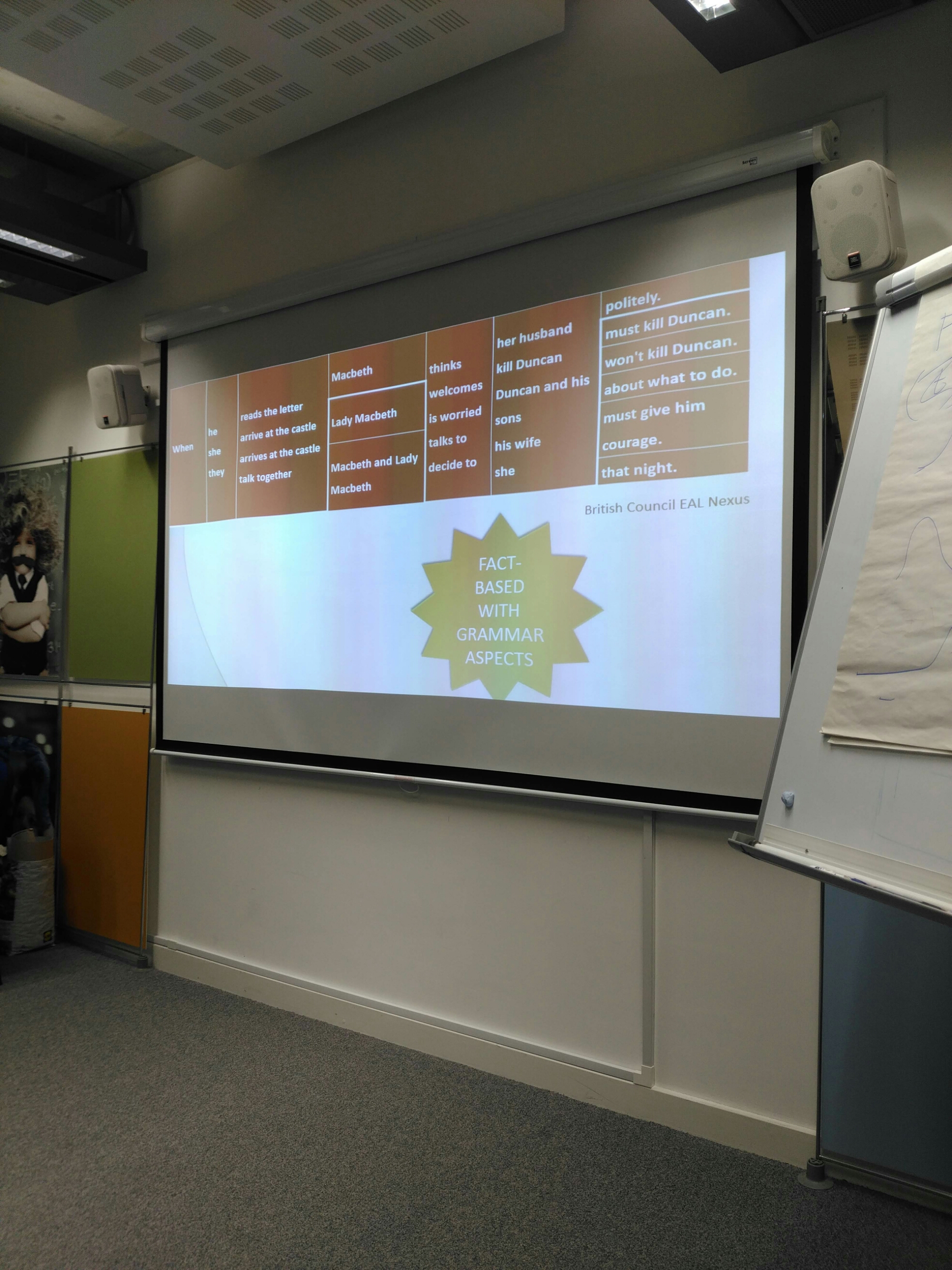
Kamil sometimes records himself explaining something before a lesson so he can check his use of language ahead of time. Using substitution tables to show how sentences are built up assists EAL students when you’re checking content knowledge:

There was more to this, but the WordPress app ate it. I am no longer trusting the WordPress app with my conference notes. Google Keep FTW.

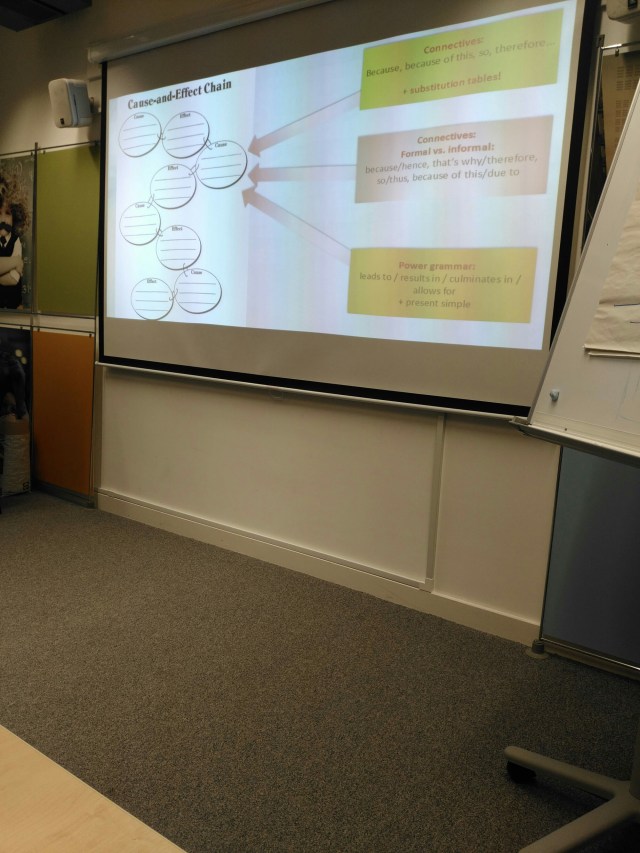
Trying to piece it together, I know Kamil also talked about using graphic organisers to help students sort out their work, building on the work of (I think) Malbec. Here is one that I thought would work in History, that I photographed:

wp-image-300922540jpg.jpg

Here is a link I have found to more of them.

Posted in CPD Notes, tlt16 | Leave a comment

#TLT16: Opening Keynote

John Tomsett begins by recommending Better by Atul Gawande:

tomsett1

…memories of teachers taking something and applying it without thought, out of desperation for a quick fix. There isn’t a quick fix.

Dylan Wiliam clip: “Sharing good practice” is a bad idea. It is a fundamental distraction because teachers are like magpies. “I used to do that: it was good!” – so why did you stop? Focus on consolidating and embedding.

Metacognition: thinking about your learning; we need to model these mental processes involved in learning which we take for granted. Illuminate students’ minds with how you produce work or learn something. John shares his work writing an A-level answer on a visualiser (I have done this: it was good!) – to begin with he just wrote down what he was thinking when he saw the questions. John had successfully modelled how to apply what he had learned.

tomsett2

Rob Coe reminds us that you have to see strategies through and evaluate how they work. Plan something and use it before Christmas.


Posted in CPD Notes, tlt16 | Leave a comment

#SHP16: My workshop

This year at SHP my workshop was titled Stickability and it was all about classroom practice that helps to embed knowledge across the two year GCSE course. I’ve been dipping into Make It Stick all year and most of what I shared was focused on interleaving and spaced practice. As I write my new schemes of work for GCSE I am going to embed a few things right from the very beginning: a benefit of having to rework an entire qualification is the opportunity to do this.

My focus for next year is going to be on core knowledge tests, 5-a-day sheets and flashcards for the units we’re teaching. Meanwhile, I’ll be rewriting the KS3 programme of study for my new school to reflect the change in GCSE units, and creating the generic core knowledge competition that I have been thinking about for the latter half of this year.

Here are my slides from the workshop, as a pdf – sorry, no PowerPoint this time but if you want my Smartnotes slides, please email me.

SHP16 Sally Thorne slides

Most of the handouts are available on this blog somewhere – American West/Crime and Punishment flashcards, Three Truths and a Lie, all my Crime and Punishment 5-a-day sheets. I’m afraid if I wait to add links to these, this post will languish unpublished for months, so please do a search but get in touch if you want something and can’t find it.

Posted in Stickability | 1 Comment

Resources for revising Crime and Punishment

Just reading back over my last blog post. “Less busy”, haha.

Anyway, I have a couple of helpful things to share. The first is a set of Crime and Punishment flashcards I made for my Y11s. These are modelled on the American West ones I made a couple of years ago and are pitched at the Edexcel B specification. They are wildly popular; a couple of my girls asked me if I would create some for the Protests unit too. Unfortunately the clock might have run down for that one.

This is an Excel file and the definitions are back to front, so that when you print them double sided they match up with the correct term.

Crime Revision Flashcards

Secondly, a set of starter/revision/homework sheets. Before half term I saw Matt (@26mxw) tweeting about a 5-a-day starter sheet he read about in this blog post. I very much appreciated the uniformity of this approach and thought it might be a good way to help my Y10s to prepare for their mock. I had a bit of free time in the following school day so I set about creating a few for the following term.

I must confess that I was not thinking of these as quick 5-10 minute starter tasks; this was more about tackling the particular issues I have found Y10 struggling with, to wit:

  • Differentiating among the strands of the topic, eg the difference between law enforcement and punishment (I knew I should have gone back to teaching it thematically)
  • Treating sources as evidence
  • That tricky “how useful?” source Q3
  • Correctly ordering the chronology, particularly in the 50-1350 section

In addition, since I see my Y10s for a double every week and a single every other week, I created these with that double lesson in mind. It will make a good starter that we can revisit twice later in the lesson: once to complete, once to mark. Then I can collect and mark the bits they can’t. If I’ve got a particularly packed lesson planned, I can set as a homework.

The first three are pegged quite closely to last summer’s Crime paper, since that will be their mock. I haven’t tried it yet, so if you try it and like it, please let me know; likewise if you try it and have suggestions for improvements.

5-a-day starter 6-6

5-a-day starter 13-6

5-a-day starter 20-6

5-a-day starter 27-6

5-a-day starter 4-7

Matt has been working on something a lot snappier for Medicine so please tweet him if you’d like to see what he’s been doing.

Posted in History, Stickability | Tagged , , | Leave a comment

2015: That was the year that was

2015 was an exceptionally busy work year, even for me.

At school, I completed my first calendar year as Head of History. I oversaw a rise in the number of students opting for History GCSE, nearly launched a new A-level (maybe this year) and brought home GCSE results that bucked the school trend in terms of A*/A grades and 4 levels of progress. We introduced new A-level units, changing board from AQA to OCR. I reworked the program of study at KS3 to reflect the increase in curriculum time from three hours a fortnight to four. I wrote a new KS3 assessment model which I presented to a senior leader panel as part of the school’s Aspiring Leaders in Education program. I interviewed and welcomed an NQT, and an observer in the department who is now going to train with us under Schools Direct next year. I organised a WW1-themed off-timetable day for year 8.

At the exam board, I completed my sixth series as an assistant principal. I completed and passed the three written assignments for the Chartered Institute of Educational Assessors’ Excellence in Assessment course I was doing; in October, I sat and passed the exam, so I am now (MCIEA). I also completed the six-module senior examiner training run by the exam board.

I presented at four points this year. Firstly, I reprised my role as the expert examiner for Keynote, at their Medicine Through Time student conferences in the spring. Secondly, I spoke as part of our local Bristol history pizza group (#BristHist, as I like to call it) on assessment after levels at the Historical Association conference in May. Thirdly, I ran a very popular workshop at the SHP summer conference, which I titled “Assessment for the Bewildered.” It was originally aimed at NQTs so I was daunted when a lot of experienced people turned up, but hopefully everybody took away something new to use in the classroom. Finally, I led a training day on preparing to teach the new Edexcel GCSE in London in October, for Philip Allan. I think presenting to my peers is always going to be the thing I find most nerve-wracking and this was no different; but it was a supportive crowd and I really enjoyed the experience. It was also very helpful to have to dig through the rationale for the new GCSE so thoroughly.

There have been some other bits that don’t fit in elsewhere: I am really proud to have been made regional adviser for SHP for the southwest, and taken over as SHP’s web manager. As part of SHP’s new GCSE, I am consulting editor for the team writing the Dynamic Learning package for Hodder, which will support the textbooks that are being written. This is a really exciting set of resources. I’ll be writing the exam advice for them in the coming months.

And finally, the writing. I wrote up my assessment after levels work for Teaching History; this was published in December 2015. And, since the summer, I have been working on Pearson’s Medicine Through Time textbook, for the new specification. I’m currently in the process of completing the chapter edits. This has been really fascinating and I have really enjoyed the opportunity to immerse myself in history books for the past few months.

There was some inset – TLAB in March was a notable highlight. I also managed to squeeze in holidays to Wales, Devon, Budapest and Berlin, an epic road trip around California, and a school ski trip to Italy (the 8th I have organised). It’s a good job I like keeping busy.

For 2016? There are a couple of exciting things on the horizon. We’re focusing on sources at #BristHist for the year. I’m speaking at the SHP day conference in March, delivering a keynote on stickability; I’m likely to reprise my Philip Allan conference in June. I’m going on three foreign visits with school in the next 12 weeks.

Realistically, I’d like to work a bit less. I do enjoy working hard, but it makes the time pass so quickly. I can’t believe how quickly 2015 whizzed by. Now the textbook is done, though, I think that should help me to achieve this goal. I mean, look! – blogging on a Saturday night instead of looking up medieval remedies for the Black Death. Progress!

Posted in Reflections | 2 Comments

Adventures in Assessments: Life After Levels

During the holiday, I came across Alex Ford’s advice to a new HoD whose school is introducing GCSE criteria to grade KS3 students. I think I have mentioned before that I am also in that boat; it was comforting to see that Alex had mentioned many of the arguments I presented to SLT when they ran the consultation on this. Unfortunately, I was the lone voice of dissent among the middle leaders, and so the model was adopted. I can understand why: as a data manager it is important to know exactly where students are and if staff can forecast how they will do at GCSE even better.

I’m pretty grumpy, love getting my own way and mostly think I know everything so I did not take this well and had to go away to think about it for a great deal of time before I was able to come to terms with it. Luckily I was attending the course with the CIEA that I’ve mentioned before; I was completing an Aspiring Leaders in Education course at school; I had the pizza group to commiserate and discuss with; and I have an extremely supportive line manager who was willing to chew the fat with me extensively, particularly in the later stages of the year. All of these things helped to prod me into creating what will hopefully be a workable model. I’m still not quite there, but I need to put it into practice now so that I can see where the holes are.

Here’s my advice, then:

1. Read everything you can get your hands on. This document from the DfE, all about the way that the new standards are being set, is a good place to start. A couple of interesting points from this – level 9 is not actually a thing; it is simply the top 20% of students achieving L7 and above. Secondly, the model chosen was the one that the exam boards most favoured. By its very nature, this is going to be the best model best suited to taking a snapshot of progress, not assessing it over time. Keep that in mind.

The Teaching History from December 2014, all about assessment, is also a must-read. Don’t feel wistful about all the spectacular, mould-breaking, new-wheel models people are coming up with: you can pick the best bits of theirs and incorporate it.

I didn’t read this before I created my model, but Daisy Christodoulu has written extensively about assessment design on her blog recently. She mentions the No More Marking website which I want to use next year for making A-level essays.

2. Consider your context. Do you have non-specialist teachers? Are you a combined Hums department and, if so, does your model need to be similar to other Hums subjects? What sort of units and assessments work best for your students? Do you offer an A-level, or a fringe qualification (like Classical Civilisation)? Factor this in when building your model.

3. Remember that you are the specialist in this. Your model needs to work to show progress in history over time and adequately prepare students for GCSE. It’s unlikely, unless your SLT is all history specialists, that anybody will ask too many questions as long as it is fit for this purpose.

4. Pick a GCSE. This was really quite straightforward for me: I’ve been examining for so long that it was sensible to go with the exam board for whom I work. Once you’ve done this, you can pick the spec apart to find out how the exam board have met the assessment objectives, and this will help you write your model.

5. Make sure your assessments work for the new model. We’re cutting right back on the amount of extended writing that students will be doing, since there is no requirement for extended writing at GCSE anymore. If we’re assessing to GCSE criteria, we should be completing GCSE-style assessments, is the argument. It feels seventeen shades of wrong; thankfully I’m long enough in the tooth now to have had times when something that felt counter-intuitive actually worked out quite well, so we’re giving it a go.

6. Don’t forget your content. There was a suggestion, during the introduction of the model, that the content taught at KS3 should be what students need for GCSE. We are not going to do that. However, we have tweaked our KS3 PoS to make sure there is a good foundation of knowledge on which to build the GCSE topics.

I wrote Assessing Progress in History, a briefing document, for the other history staff on how the new model will work. It picks up the threshold concept work I blogged about in May. This was completed some time ago now so things have moved on a little since then. I am in the process of constructing a ladder for progression through the levels (1-9 and, to fit the school model, B1-5 which sit below level 1…with pluses and minuses this presents us with 42 different levels at which a pupil can be working) so I will share that when it is fit to be seen.

Posted in Assessment | Tagged , | 5 Comments

What’s still good about SOLO

I recently read this blog by Toby French, in which he shares the tale of his adventures with SOLO in the classroom and how he came to decide, at the end of it, that it was all castles in the air and, actually, nothing is a good substitute for knowledge.

Long-time readers might recall that I have form on SOLO. I heard Didau enthuse about its virtues at TMClevedon. I attended an excellent mastery learning session with John Stanier at SHP, which set out how to ensure students build layers of knowledge through a GCSE course. This was the final push to investigate and I spent a lot of time reading about and working with it over the following year; this culminated in the workshop Lesley Anne McDermott and I ran at SHP the following year. Since then I have had a lot of questions and comments, mostly through this blog, about implementing SOLO in the classroom. Most recently somebody approached me at SHP last weekend for advice.

Unfortunately, I have none to give, since I don’t share the SOLO specifics with my students. In that respect French and I may agree. However, it was then, and continues to be, an extremely useful planning tool that helps me build knowledge across my lessons and schemes of work, and better differentiate my activities. Thus, I write in defence of SOLO: remember it’s a taxomony, not magic.

This year’s CIEA course has prompted a new respect for it, as we considered stuctures of learning and how students acquire knowledge. The lecturers went through SOLO in a comparison with Bloom’s (the updated A&K version); as you might expect from taxonomies of learning, I found there to be similarities across the ideas and I was reminded of how much I liked the simplicity of SOLO compared to the bulkiness of Bloom’s (personal choice).

Using it as a long-term planning tool has been extremely useful as I have rewritten the KS3 PoS in preparation for the new GCSE: I have considered the knowledge that students will acquire in a multi-structural way and how it should all start to fit together on a relational level as they move through years 7, 8 and 9, providing a solid foundation on which to build their GCSE studies and sending them into KS4 already prepared with enough baseline knowledge to start having a crack at the extended abstract. Having just completed my 15th exam series as an examiner, I am reminded of how powerful that extended abstract can be when deployed with carefully selected knowledge to answer a question. There is a clear case here for making sure students hone this skill from day 1 of the GCSE course, so considering how they will build up the necessary knowledge before year 10 is really important.

It has also been useful as a shorter-term planning tool when putting together schemes of work, particularly because it has forced me to consider opportunities for wider reading and learning, and to seek out cross-overs elsewhere in the curriculum. It has helped to smooth the inclusion of RE in our History lessons next year, for example, as I consider the relational links between the SACR-suggested content and our own.

Aspects of it have also been really helpful when producing revision resources. I use hexagons for revision without talking too much about the rubric, because the students love fitting them together way more than rectangular cards, which means I don’t have to fight to get them to interact. I’ve heard some very meaningful conversations going on around those little tessellations.

The other way that SOLO has been invaluable to me is as a tool for planning questioning in the classroom. What started as a method of displaying good differentiation has become something I work on like some kind of demented artist seeking the masterpiece, because I’ve seen well-planned questioning, with different questions aimed at different students, have a measurable impact on their understanding. This type of verbal rehearsal reminds them of facts they might have forgotten or not written down and helps them to make links between them; I often have a couple of students minuting the questioning who make generalisations about the comments at the end, leading them towards the extended abstract.

So, I continue to favour SOLO. It isn’t all hexagons and fancy rubric. When you get down to brass tacks it is a structure to help us track and measure learning; so suggesting it is at odds with a love of knowledge is slightly bizarre: a scale is only useful when you’ve got something to put on it. Like a markscheme, I don’t think it was ever intended to be used by students in its raw form. But for teachers, who should be in the business of working out how students acquire knowledge and seek understanding of it, I think it can be an incredibly powerful tool. It is no more a fad than any other taxonomy of learning; I don’t believe that students acquire historical knowledge in a different way to, say, mathematical or scientific knowledge, so attempting to have a separate taxonomy for each subject seems to be to be over-complicating things.

As with everything, though, this works for me, in my context: it might work in yours, too. It might not, in which case you’ll have your Bloom’s or your newly-invented wheel to track acquisition of knowledge among your students. I don’t think it would work for me to share the rubric and scaffolding with my students, because I don’t think that is what it is for; but if it works for you and your students then keep doing it. Pam Hook’s website is a great place to look for advice on doing this.

Posted in Reflections | Tagged , , , | Leave a comment