TLAB15: David Fawcett

David is talking us through creating a coherent curriculum that sticks. It rounds off a day of thinking about improving retention of knowledge and skills. We start by discussing some questions about how we prep students for their exams – do we work harder than them?

He worked with a colleague to identify the reasons why the results, though good, had plateaued. Was it to do with the structure of the curriculum? They came up with a few more questions to unpick this –
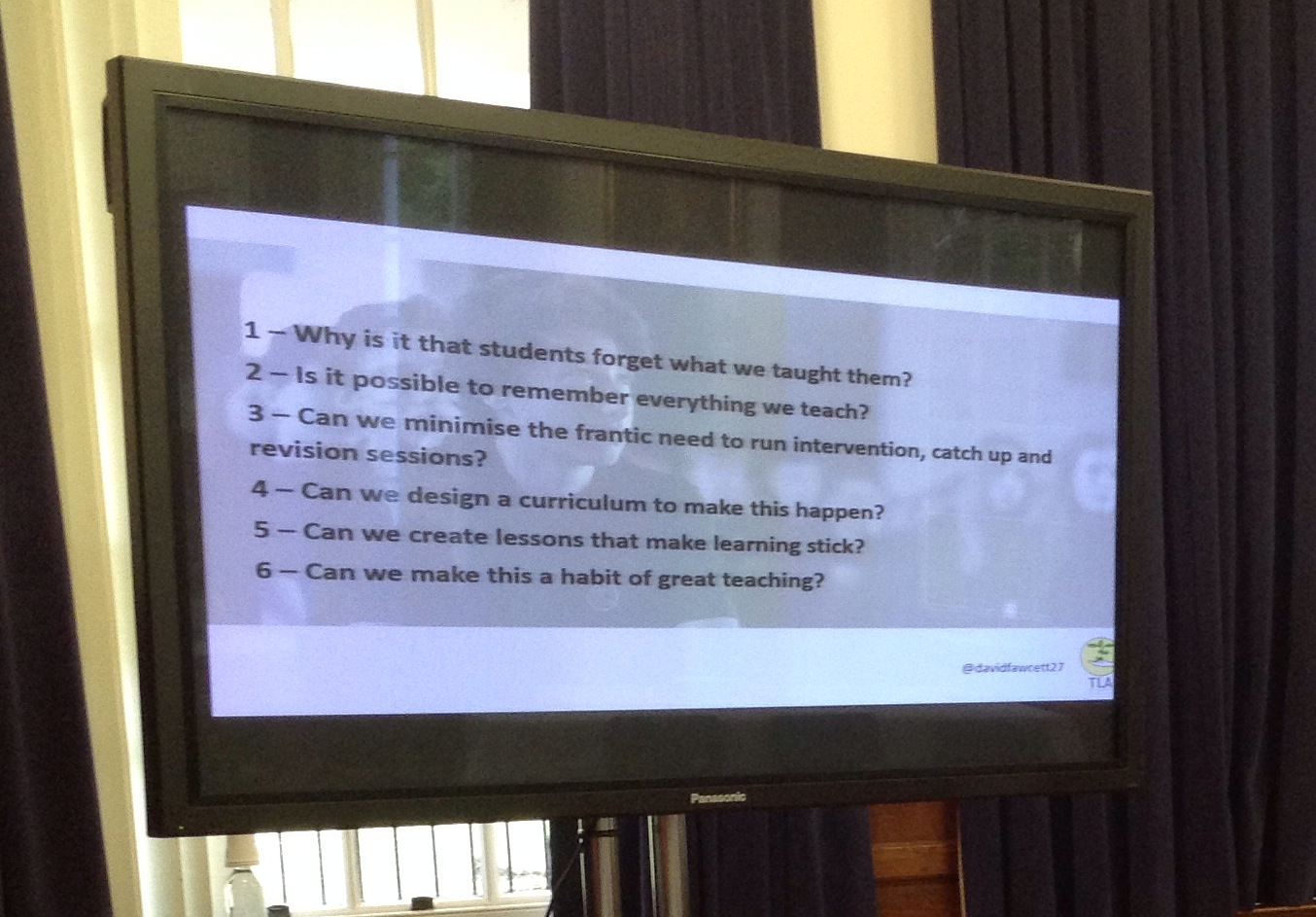
2015/03/img_0188.jpg

He is quick to stress that their process was about making learning stick better, rather than memorising for exams. This is important, because workload is increasing and the amount of time available for catch up and extra sessions is receding and we’re in danger of becoming a school with a school – one school finishes at 3 and another begins.

We look at schemes of work and learning that we’ve brought with us. Unfortunately I ran out of I time to print anything so have nothing to share. There’s some discussion about hammering threshold concepts in year 7 maths – threshold concepts again!

We hear about the work of Robert Bjork on memory – retrieval strength versus storage strength. We should be aiming for high storage, high retrieval in the classroom, but mapping that through our curriculum to ensure it is built in from the very start. David demonstrates this by getting us to demonstrate our schema on Hawaii – things we remember and have picked up about Hawaii.

Bjork talks of desirable difficulties which help people to develop these schema. Old knowledge creates foundation for new knowledge, but is that well mapped in our curriculum? We discuss this, with some consideration about whether Gove was right to reorganise the history curriculum chronologically from KS1 (not really – there’s too much in it, imo).

We think about testing knowledge retrieval. The act of testing improves retrieval strength which in turn improves storage strength. 61% remembered after retesting compared to 40% from relearning. Revising should not just be rereading! To ensure there’s not death by testing, questions must fit on one slide with answers on the next slide. Also use multiple choice questions – David’s department pre-test all their students to inform planning and give them a second chance at being successful on the test.

This testing and recapping was built into the curriculum so that students are constantly challenged to remember, which has hugely improved retrieval and retention.

We discuss unit tests vs cumulative tests. Unit tests help to show progress but don’t help them to recap prior learning. There’s a good case to be made here for mixing topics in a test, although this doesn’t really fit with how our GCSE works so will have to think about how it might look in practice.

David has added an extra column to the schemes of work to map back to prior learning. I’ve been reworking ours this year and I am really taken with this idea. We share ideas about how we can do these things in our own departments.

David finishes by explaining that instead of reteaching the content, they retest and use a spreadsheet with question level analysis to map where students are succeeding. This is shown by class as well as student, so that seas of best practice are easily visible and can be shared.
Posted in CPD Notes, tlab15 | Leave a comment

TLAB15: Neal Watkin

Watkin is taking about what makes good learning in History. He starts with some video clips of students sharing their knowledge. J knows loads and loads, but his written work isn’t good. R can structure a really good written answer but she doesn’t have that knowledge and framework. A has all the right bits, but it doesn’t seem to work – the written work doesn’t come out quite right: “broken clocks” who have all the right pieces but can’t assemble. And then L, whose literacy issues make history almost impossible.

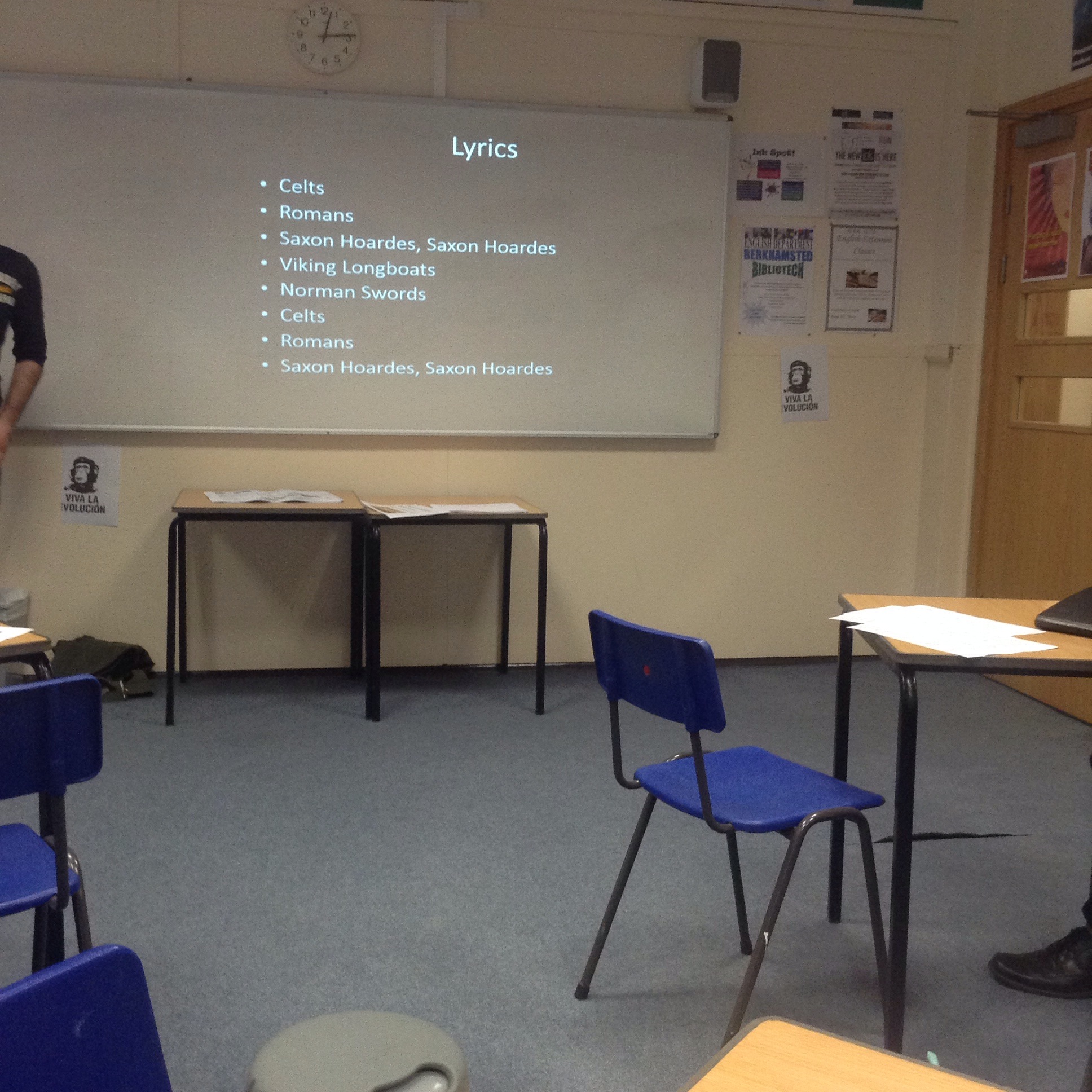
First – chronological framework. We create our own timeline: Neal gives this to students and puts it up, in their order, and then they adjust it as the acquire more knowledge. There’s a song to the tune of heads, shoulders etc, to help them to crack this chronological framework.

2015/03/img_0183.jpg

They also have monster questions that last for the whole year, which seems similar to the long survey units we’ve been working on in year 7 and 8. His big question for the Middle Ages is, if the Renaissance was a rebirth of Ancient ideas, was the Middle Ages a complete waste of time? Love this.

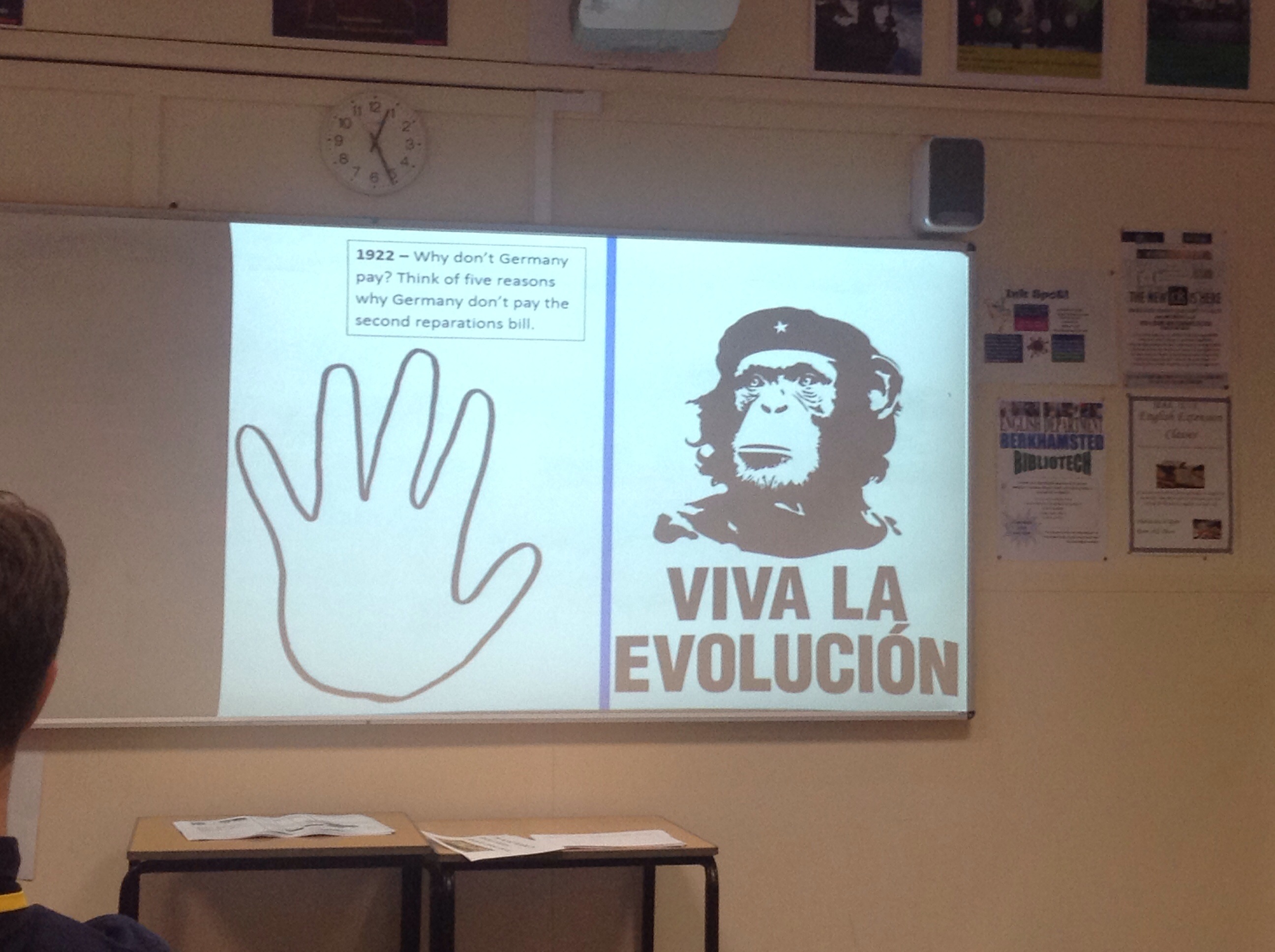
Secondly – keeping knowledge alive. This involves a lot of long term planning, connecting up different bits of knowledge through the course: marine corps knowledge – leave no topic behind. Neal has activities scattered around every so often, and when he says “Gorilla history” they have to grab an activity and do it. These are all short tasks that relate back to previous topics. Younger kids love it but GCSE students hate it because they think it interrupts their flow of learning. Neal has shared some of the research behind it with them to convince them that, thought counter intuitive, it is valuable.

2015/03/img_0184.jpg

Something else they use is a random epic poem plot line generator, which he made subject specific to Saxon leadership. This uses a dice to help students work through the poem lines. He refers back to it later on when they look at Harold preparing for the Battle of Hastings, creating an extra layer of context to help students understand the impact of Saxon culture.

Big history map: Neal thought about how to create the monster historian, and subject knowledge is at the core of it, with things like historiography and source skills hanging off this. He gives them a couple of different historians’ accounts on a timeline – traditional and modern – and has students consider how those historians came up with their opinions, showing that different evidence leads to different outcome. Students then predict what the opinions will be at the same times for a different question.

2015/03/img_0185.jpg

This helps with big history mapping.

Neal is also trying to do the same with skills.

2015/03/img_0186.jpg

Neal reminds us of the TOWER model, that I have been using to a greater or lesser degree, with much success, since TLAB13. We have a go at an argument tunnel for the walk part, which I have used for TOWER writing before, but haven’t used for far too long! It is fun to have a go at this myself. Resolving to do this again across at least ks3 by the end of the year.

We do some analogy analysis, which is about getting students to create an analogy for various things they are studying.

2015/03/img_0187.jpg

It is remarkably difficult to think of an analogy for good history! We start by thinking about what the topic is actually about in order to come up with a reasonable analogy, but time runs out too quickly for us to come up with much.

Posted in CPD Notes, tlab15 | Leave a comment

TLAB15: Elizabeth Carr

Carr is talking about the relationship between knowledge, progress and assessment in History.

She shares the department’s discussion on models of progression. The departmental vision: inspired by the past, learning by enquiry, winning the arguments. They have been reflecting on the role of knowledge: what do the students need to know, and why? Working memory and cognitive load. Whether second order concepts are a type of knowledge we draw on. What frameworks do history teachers have in their heads that students don’t? (This chimes in with a bit of recent reading I’ve been doing with threshold concepts).

We read a section of Paxman’s book on WW1 and consider what knowledge you need to understand it – government structures, geographical knowledge etc. We do the same with a Schama extract and consider how sense of period knowledge applies here.

We then look at some (excellent) student work and consider what wider knowledge students have needed to write these people – one has been able to make links between the British Empire and other empires she has studied, while a year 7 student has used some very detailed knowledge of Anglo-Saxon slavery and the finer points of feudalism to show change over time in Norman Britain. In our table discussion, Neal says that using historiography has forced students to look more closely at the evidence, to judge interpretations.

We think of our own enquiries and what knowledge is needed. Ericha shares details of her “Roosevelt: dictator?” scheme and we list the things students need to know to be successful. Then this activity –

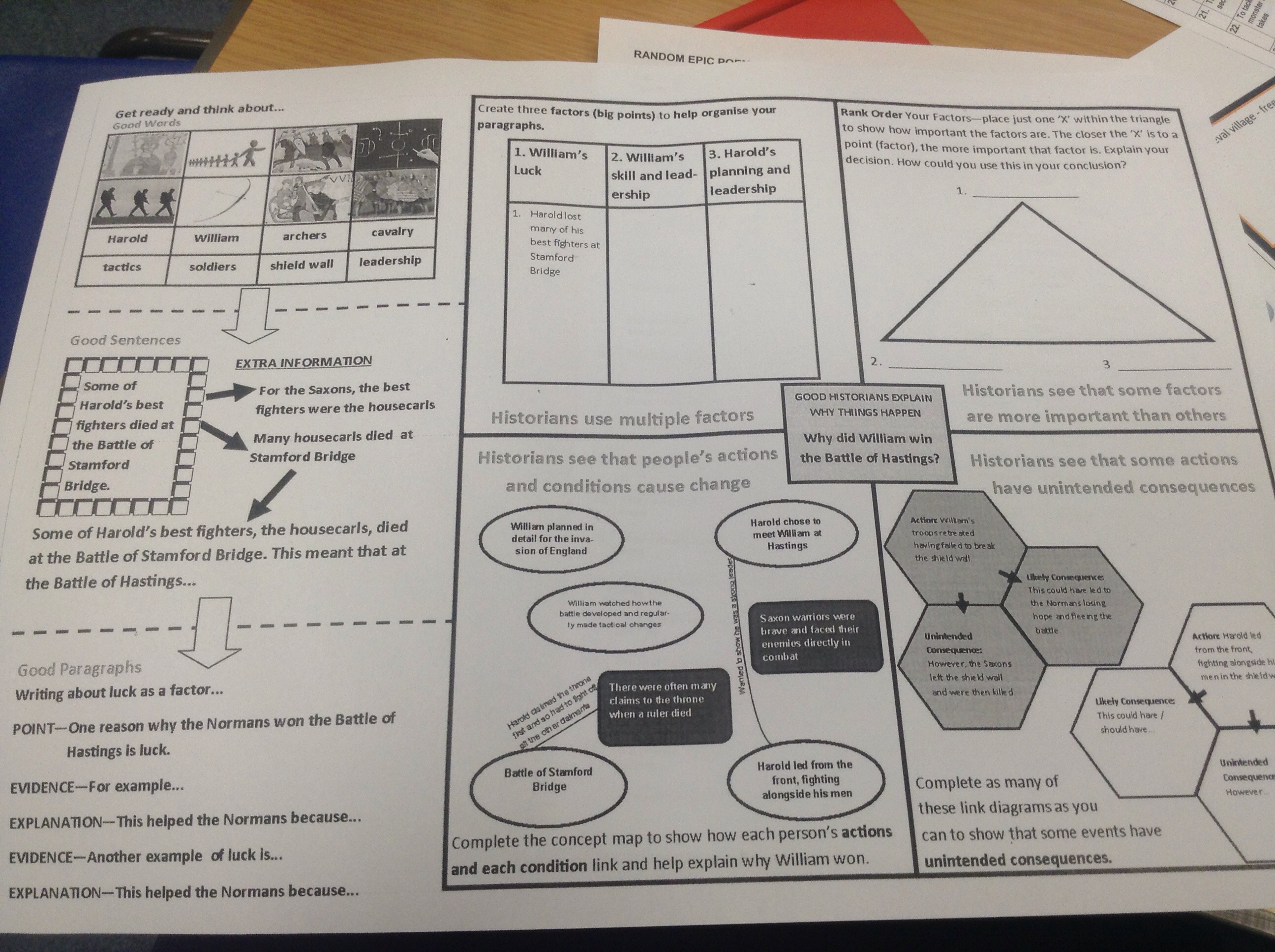
2015/03/img_0180.jpg

Carr then explains how they have tried to build more knowledge retention into their work – timelines, quizzes, overview and themes, revising and revisiting topics, themes, concepts etc. This is partly informed by neuroscience and books such as Make It Stick.

We look at some examples of timelines in helping students to fit together all the chronological knowledge they are acquiring. My favourite is for y8 starting a unit on Islamic Spain – they are given a timeline with key events from that study on it, and asked to add contemporary events from Britain.

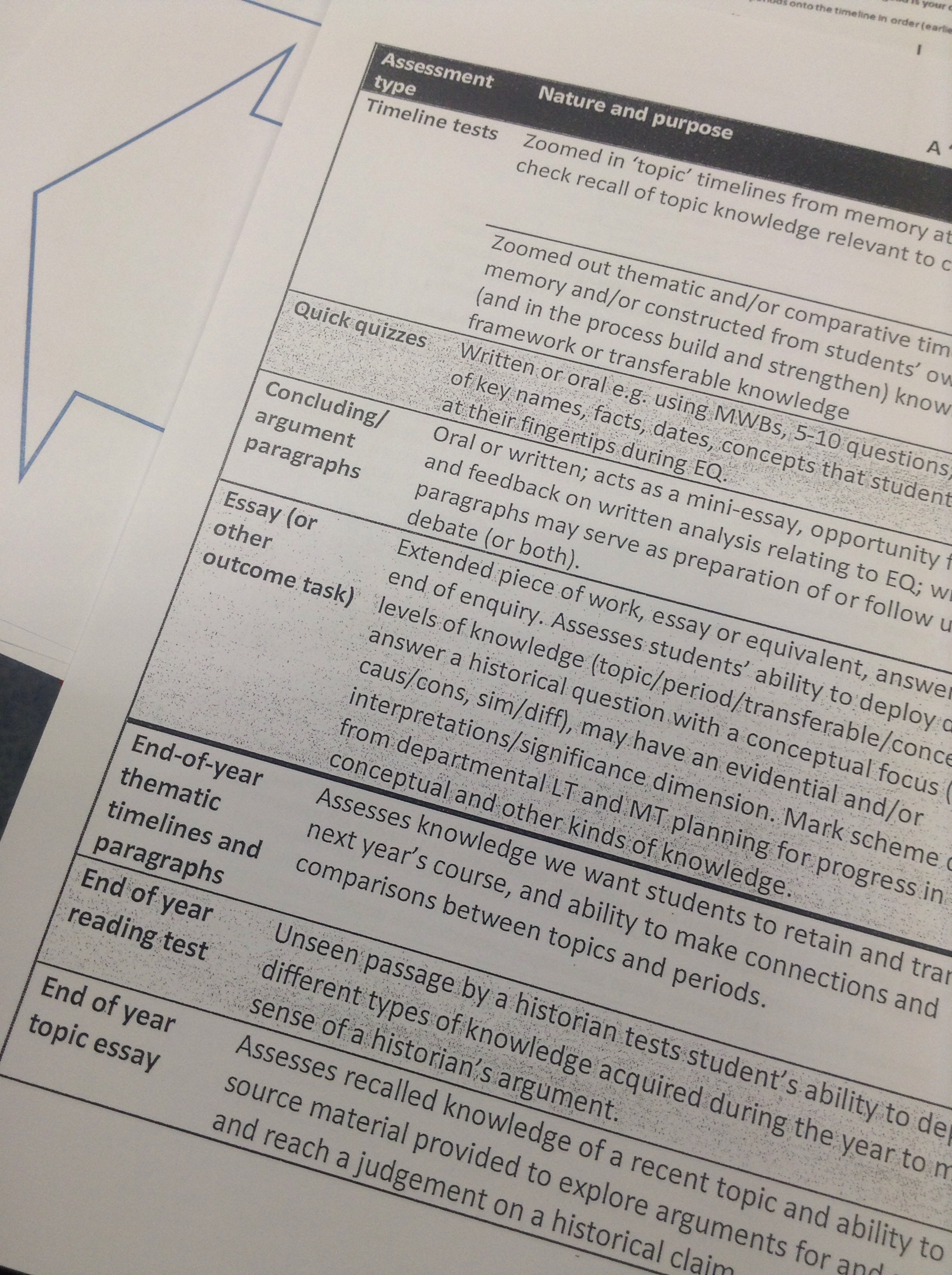
Carr says that the thinking continued – if knowledge is that important, how can we assess it? They’re aiming for a mixed constitution – assessing overall performance by taking a range of samples of what students know and can do.

2015/03/img_0181.jpg

These are backed up with extremely detailed mark schemes for the assessed pieces of work. They help to define the gold standard for very specific tasks, in a very task-specific way. We look at some examples of end of year tests and responses to them to wrap up a very thought-provoking session.

Posted in CPD Notes, tlab15 | Leave a comment

TLAB15: Keynote 1: Sarah Jayne Blakemore

I love Blakemore’s sessions! This year’s theme is “All in the mind” so she is ideal to open the conference.

She begins by talking about adolescence as a concept, suggesting that some people think it is a modern construct; however there is clearly adolescence in other species: for example, rats have a few days of adolescence during which they demonstrate other behaviours, like drinking more alcohol when with other adolescent rats.

Typical adolescent behaviour, like risk taking and per influence, has been the subject of many lab experiments over the years, partly because adolescents are more likely to die as a result of their own rims taking than any other age group, thanks to a peak in risk taking at this age. Blakemore shares Larry Steinberg’s work with a driving video simulation to show that peer influence has a significant impact on risk taking.

We look at the results of social exclusion lab experiments that show that adolescents have a significant mood drop when they are not included by their peers. We then hear about a study of how risk perception changes according to social influence, which showed that young adolescents are more heavily influenced by other teenagers than they are by adults, since they changed their risk rating more when presented with data from other teenagers than from adults. Blakemore tells us about studies in the US where researchers identified the coolest kid in the the class and bombarded them with negative press about smoking, etc, and tracked changing attitudes across the class, adjusting social norms. This is great, and something I think most secondary teachers would recognise from their own classrooms. GCSE classes often seem to pull towards the attitude and ability of the most popular students in it, I have observed.

We then look at details of grey matter development in the brain throughout adolescence. I have shared bits of this with a lot of students since hearing it first last year. Frontal grey matter decreases through adolescence, which suggests that the brain is being shaped and fine tuned by the environment that child is in. Children have vastly more synapses connecting their neurons until they reach adolescence. Synaptic pruning then takes place, and this is determined by what synapses are being used, which is influenced by environment, culture etc.

Blakemore shares the football match picture with the missed goal, pointing out that we can identify how these people feel just by looking at them (something I point out to my students when we do source inferences). This skill develops extremely early.

Blakemore finishes by sharing her Science23 website – more investigations needed here!

Posted in CPD Notes, tlab15 | Leave a comment

What I’m Teaching This Week

I read some blogs recently under the 28 days of blogging hashtag and it struck me that I quite often think a lot about blog posts, mentally compiling them during my commute, but very rarely put anything down. Now, I’m not committing to anything, but I thought I would try and be a bit more regular. For starters, here’s a snapshot of my week.

Year 7 – we’re about halfway through our 12-week romp through Ye Olde Medieval Realms, which is a collection of lessons under the question, “What was the biggest threat to Medieval Monarchs?” (I think dysentery, as I think I have mentioned before). This is my second teaching of it and I am getting more engrossed in the stories as I proceed, partly fueled by the impending reinterment of Richard III. We’ve got a History dept Padlet going on with lesson suggestions from all of us, so hopefully at the end we’ll be able to write a more coherent scheme of work up. I’ve been avoiding Magna Carta and the Peasants’ Revolt as that’s in our Democracy scheme, but I think that might be a mistake.

Year 8 – similar to year 7, we’re halfway through our new catch-all unit, covering the British Empire and the Industrial Revolution, with the working enquiry of, “What had the biggest impact on Britain by 1900?” We’re currently working through the abolition of slavery, considering whether this happened for reasons of humanity or economy. This is a bit of a side alley, but recaps their work on the Transatlantic Slave Trade from year 7, which they like – it’s a memory-sticker, that topic. This is partly why I think I might be wrong about leaving out Magna Carta etc in the Y7 scheme. I also now think we might have been short-sighted at dropping the Slave Trade of the Y7 programme of study. Luckily, it’s not too late.

Year 9 – Having their first go at their Holocaust assessment, “Who was to blame for the Holocaust?” I idly tried to garner views on a popular question-answering website, but the only response I got back was, “The Nazis of course. Why is this even a question?” That was surprisingly helpful as it formed my whole starter, and Y9 enjoyed pulling it to pieces. They’ll have a first try, and then we’ll move on to look at concentration camps and consider the question again. The aforementioned website had a great question on it, along the lines of, “Which was worse – the Holocaust or the Slave Trade?” which I might throw in at the end, since it’s going to encourage them to do some wider research and make links between this and prior learning.

Year 10 – a few weeks into Crime and Punishment, and relieved to be finished with the depth study. They always get a bit fatigued with doing the same topic for half the year. We switched boards for this September, to the board for which I examine, which seemed like a good idea at the time but, with a strengthened Y11 spec going on at the same time, my head is spinning. Yes, the content is roughly the same, but the focus is different, as are all the exam questions. Still, I’ve enjoyed learning a bit more about monarchic influence on law pre-1350.

Year 11 – Deep into revision now. We’re doing a paper 2 mock in the coming weeks. Numbers for after school revision were very high in the first week. I’m relying heavily on my Smart Response clickers, for both lessons and revision, which keeps them more interested than my voice alone. I’ve tried to give them as much revision support as possible, without being too prescriptive.

Year 12 – Just finishing unit 2 with the end of Mussolini, whilst also into a revision program after school on a Friday. This will be my last dance with Mussolini, at least for a while, as we have gone with mostly new topics for next year. I will miss the phenomenal rabbit. It’s a sad end, with him hiding out in the lakes and being forced out of retirement by the Nazis. Still, such are the trials and tribulations of being a Fascist dictator.

Year 13 – Drafting coursework on US Foreign Policy in the 20th century. They’re all very well-organised this year. I think I got the number and type of assignments leading up to writing the essay about right this year, and the spread of readings, too. They’re quite a proactive bunch, so haven’t done badly at finding their own readings, on the whole.

Posted in History, Planning | Leave a comment

American West revision: Three Truths and a Lie

I created these quizzes to use with my Y11s last year and have just got round to writing the answer sheets to go with them.

Each question has 4 facts, one of which is, in some way or another, not true. I print out the sheet and work through the quiz with the class – we use the Smartboard clickers for this so I have a question per slide for them. Then, at the end, we go through the answers; students highlight the incorrect response and write the connection. Sheets are then stuck into books for revision.

This is essentially a cunning way of telling the students forty different facts in a quiz-type setting. It works very well with my classes; this may be because of the added excitement of using the clickers for the quiz, though.

I attach my quizzes below. There are three: each one has the student sheet, the answer sheet and a PowerPoint version of my slides. As I think I’ve mentioned before, I am not a lover of PowerPoint and never use it: these are Smartnotes files converted into .ppts, so the formatting may well be dodgy, but at least it’s a starting point.

A final word of warning – an occasional untrue statement among these is personal to my class or my school, so it won’t make sense out of context and you’ll need to tweak it for your school.

Three Truths and a Lie 1

Three Truths and a Lie 1 – answers

Three Truths 1 (ppt)

Three Truths and a Lie 2

Three Truths and a Lie 2 – answers

Three Truths 2 (ppt)

Three Truths and a Lie 3

Three Truths and a Lie 3 – answers

Three Truths 3 (ppt)


Posted in History | Tagged , , , , | Leave a comment

Christmas History Lessons: William the Conqueror

williamcrowned

I’m following Richard Kennett’s quest to ensure there is no let up to the beautiful acquisition of history knowledge, in spite of the festive season being upon us.

As last year, Y12 have done their Fascist Christmas Dopolavoro program (this year one group included the very dark suggestion of a Matteotti-themed hide and seek competition) and Y9 are doing their WW1 Christmas Truce lesson, made all the more relevant by the Sainsbury’s Christmas advert this year. Y8, mired in the Civil War, have done the Puritanical Christmas lesson from Richard’s site, with the addition of a consideration of how successful the ban was, assisted by the GCSE Crime and Punishment textbook.

That left Y7, who are helpfully coming to the end of their Battle of Hastings unit. William the Conqueror provided history teachers everywhere with a great gift by being crowned on Christmas day, in my opinion. This lesson requires students to plan a coronation celebration, incorporating Christmas traditions from the 11th century (alright, some of them might be merely Medieval as opposed to century-specific, if we’re splitting hairs).

I’ve been quite careful to focus on the idea of it being a coronation party that makes use of the traditions that the English would have been used to. This is mainly because I have Y7 students who do not celebrate Christmas. It is also going to be really helpful in demonstrating that William wanted to ensure he was seen as the natural successor to the throne by preserving man aspects of Anglo-Saxon Britain, as they learn during the GCSE Crime and Punishment spec.

Also, I teach two top sets in Y7 so this may need some differentiation for mixed ability; you could probably get round it by carefully planning the groups in advance, though.

Lesson:

Starter – identify these key Christmas objects – holly, ivy, yule log, mistletoe, an apple, a kissing bough (a precursor to mistletoe). In the background, Medieval carols are playing. Anachronistic, but festive.

Annotate and consider the coronation scene from the Bayeux Tapestry. Read the chronicle description of the coronation – I have read this into the mic so I’m able to play that to the class as we read it together. We’re going to do a bit of source critique here and discuss whether the riot was really caused just by happy cheering.

Split into groups for the party-planning task. Provide information about winter traditions for the English in the 11th century, a big sheet of paper and some markers. You could set this up as a tendering task – whoever comes up with the best plan wins. Explain the importance of sticking with tradition as far as possible. You could allocate students within the groups to the task of writing the epic poem (we’ve looked at sections of the Carmen in class so that’s why we’re doing the poem).

Resources (now updated with the correct scene from the Bayeux Tapestry – awkward):
Here are my slides as a PPT – I hate PowerPoint so they are exported from Smartnotes, no apologies for the layout being poor!
Y7 – 1066 Christmas lesson

And here they are as a PDF.
1066 Christmas lesson

And here is the information about winter traditions.
Christmas in 1066

Happy 948th anniversary of William I being crowned, everyone.

Posted in History | Tagged | Leave a comment

#12JoysofTeaching – Day 2

There’s a nice thread of positivity going on Twitter at the moment, tagged the #12joysofteaching, and brainchild of Claire Lotriet. There are daily prompts; today’s is inspiring, memorable teachers. I couldn’t squeeze that into 140 characters, so here are mine.

It is impossible, of course, to choose just one. I was very fortunate to have a great set of teachers, almost all of whom I remember very fondly. Consequently I feel guilty just writing this post because they all deserve a mention, really. However, I can’t go on listing everyone who taught me from Kindergarten upwards because, really, I am very busy, so I have narrowed it down to four.

First of all, my Y4 and Y6 teacher, Alison Hills. She joined partway through Y4; I think she was newly qualified, and she picked up a class of snivelling girls who had adored their old Y4 teacher and really didn’t want her to leave, which must have been a mission. She was always very positive and kind but also firm, and she had a way about her that made you want to be good, just so she’d be proud. I think that’s quite a gift.

Secondly, my occasional secondary school PE teacher and sixth form tutor, Sarah Spender. I cannot ever imagine her being in a bad mood. She always had something positive to say, even when I was sneaking in late (I lived 10 minutes walk from school but was probably late 90% of the time). She just seemed to have boundless enthusiasm and she was still emanating this at our 10 year reunion. I do think of her when I am in one of my terminator moods, and try to find a little joy to spread.

Thirdly, my Latin teacher, Linda Watson (then Mrs Watson, now Dr Watson). She had very high expectations, and I did not regularly meet them. She was relentless in her demands and I was convinced she despised me, though I wonder now if I was just very frustrating because I wasn’t coming up with the goods. I was a very lazy sixth former. She taught me the value of hard work and plugging away: Latin ended up being my highest grade at A-level and that was because I worked harder for her than anybody else. She wouldn’t have had it any other way. Once she banned me from going on a history trip because I owed her a translation. That was a hard lesson but an extremely valuable one.

Finally, my A-level History teacher, Richard Wilkin. I loved all my History teachers (of course): Michael Vale, and Caron Chapman who taught me for GCSE and had the most awesome sarcastic sense of humour, but Mr Wilkin is the one I think of most often. I don’t think he was very impressed with me. I sometimes imagine the look of abject horror that I think would cross his face if he was to find out I was now teaching History, if he could remember me , anyway….I was not a good A-level student, in case that wasn’t already clear.

Yet, his are the phrases and metaphors and quirks that I most often see popping up in my own practice. He had this thing about Lenin as a surfer, riding to power on a massive wave of popular support. I really got this. I adapted it right through from Tito in my undergrad finals to Mussolini last week with Y12. He also once talked about guinea pig ranching: “Herds of guinea pigs,” he said, waving his hands expansively,”spreading out across the Plains.” I never quite got the point of that. But he taught me that quirks and weird metaphors stick in student brains (even the ones that aren’t useful). It was also his side of the A-level course that inspired me to choose history, and informed my choice of course at university. It is his method of marking essays that I still use today (at least I assume it was his…now I wonder if it might have just been departmental policy). I still remember the creeping dread when he set us that first essay in Y12 and it had the word “exacerbated” in it and he just left us to it and we were all worried we’d written about the wrong thing; I thought of it last week when I set my Y13s an essay title with the word “advocated” in it.

Google reveals that Mr Wilkin is enjoying his second headship at a Catholic school in Essex, but it isn’t turning up anything on any of the others. I hope they’re all well, anyway.

This is definitely over 140 characters! I love a bit of nostalgia, puts me right in the Christmas mood.

Edit. I can’t miss out Mr Downey. Used to knock 10% off our essay marks if we didn’t hand a plan in with the essay. I hated it until I got to uni and realised the invaluable skill he had taught me – none of my friends knew how to write an essay plan.

Posted in Reflections | Leave a comment

Fame at last!

It was a bit of a shock when I checked my phone at lunchtime on Wednesday, to find I had emails about my blog, a WordPress notification about a spike in stats, and a few dozen notifications from Twitter. I thought I must have been hacked but, no, I was instead featured on Guardian Teach as a top History teacher to follow on Twitter. Wow! I feel very honoured; I’m in illustrious company on that list.

Not much more to say than that, really – but things like this almost never happen so I wanted to mark it with a blog post, much like I might write it in a diary.

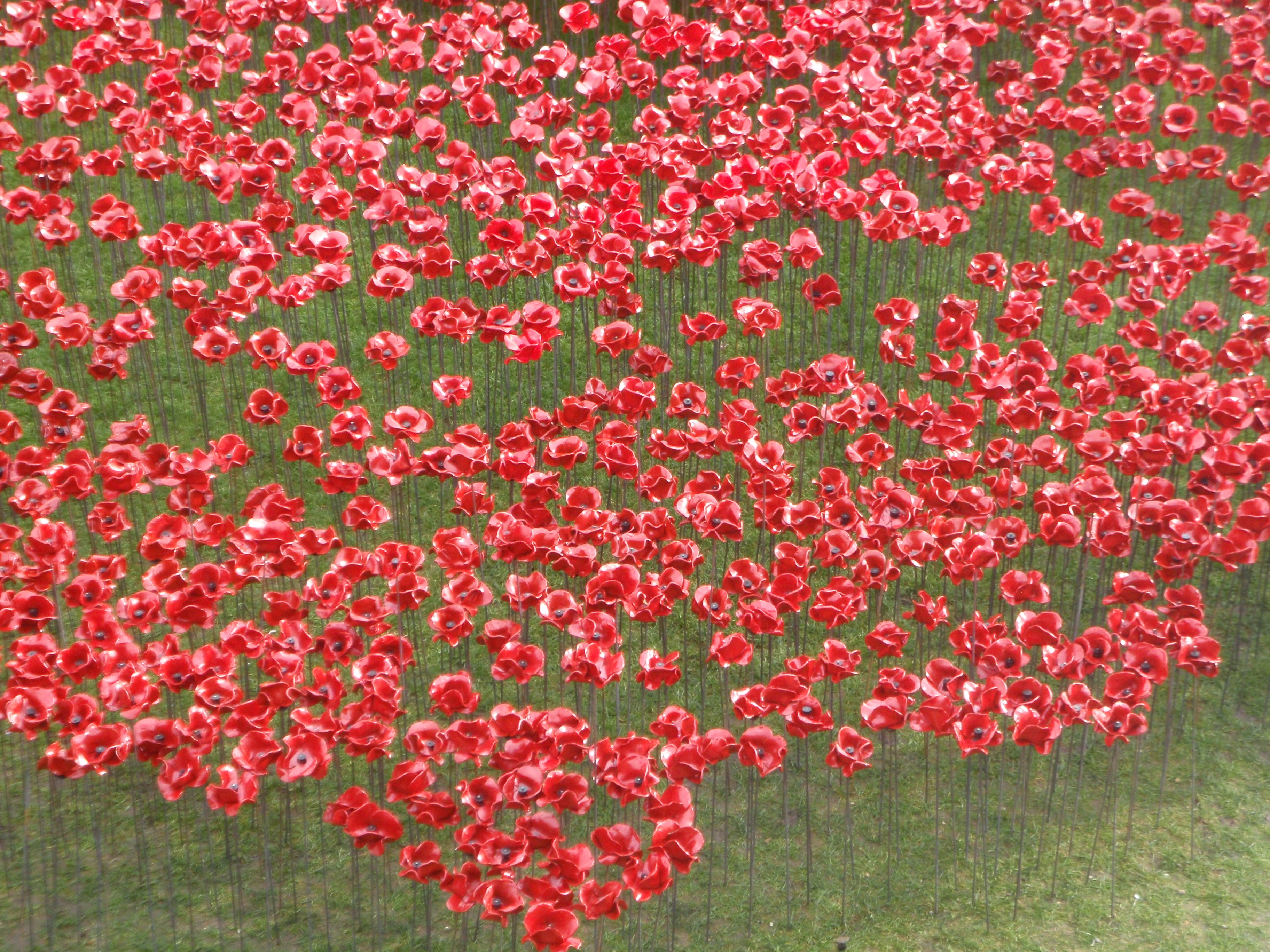
Here’s my favourite poppy picture by the way – I didn’t tweet this one.

OLYMPUS DIGITAL CAMERA


I know the point of the installation is really the scale but I thought they were very lovely close up.

Posted in wins | Leave a comment

Adventures in Assessment #1

I have developed a pathological hatred of timelines. My old colleague, an extremely bright and gifted historian who has since left teaching to pursue a slightly mysterious career path, loved a timeline. Our schemes of work are littered with them, and as we rework our KS3 program of study this year, I was looking forward to killing them off completely. He used to include them as a recap at the start of each year, placing various time periods and groups of people (eg, Saxons) on a 2000-year spread. I don’t know how he used to do it, but the whole business is just painful for me and I mostly avoided it.

In the interests for fairness, though, I decided to give it one last try this year before weeding it out. It was a shambles. Even my brightest students evenly spaced their events along the timeline, with complete disregard for timescale. “You have to bunch the last six things tightly at the end,” I warned. “I’ve finished Miss, and I didn’t have to bunch them up!!” came the reply from more than one student. *headdesk*

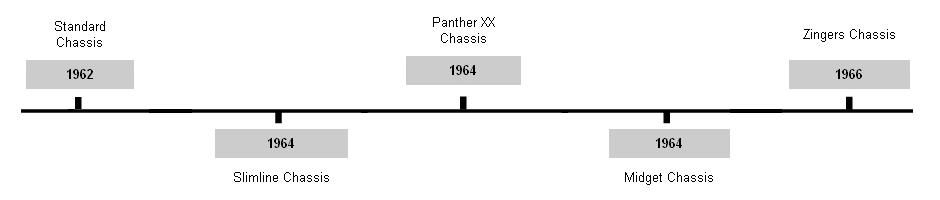
So, I started to wonder, what is the point of doing the timeline? What historical purpose does it serve? Thinking about Harry Fletcher-Wood’s blog about testing what you value, I wondered – do I value the skill of timelining? It clearly has a numeracy crossover, but what makes this

scaletimeline

better than this?

noscaletimeline

And if I don’t know the answer, why am I making them do it when it is so painful for all concerned?

In discussion with Rich Kennett, Alex Ford and Dave Stacey on Twitter, some ideas began to emerge. It’s helpful for identifying change and continuity over time. It can help with organising causation factors – long-term and short-term, chain of events and so on. Ryan Campbell, a History teacher in Jakarta, chipped in that the rise of digital history and big data require students to do more data analysis at secondary level. Dave said it was interesting and could unlock a whole new level of understanding; Alex agreed that those who completed his timeline of events of the French Revolution well were better able to explain change over time during the period.

With that in mind, I have done annotated timeline assessments for Y7 and Y8 as this term draws to a close. Both have been doing a development study: Y7 have been looking at why people migrated to Britain before 1000; Y8 have been looking at changes to the British diet since 1000. We’re only part-way through so far but, interestingly, they have all done better with plotting the events than on the first pass at the start of the unit when they plotted generic events I provided.

Posted in AfL, History | 1 Comment