SHP15: Thompson and Kitson

This session is about using one woman’s story to illuminate the recent past. We’re looking at Mavis Hyman, a lady born towards the end of the Raj.

We start with a card sort of the events of her life, annotating a map with important places in her life. We then look at the themes that emerge from the events of Mavis’s life: empire, migration, conflict, heritage and identity, discrimination; we match the events with their most relevant theme, having discussions about the interplay as we do.

Sarah then shares the rationale for using an individual story like Mavis’s in the classroom: she’s an ordinary person who can reveal a great deal of extraordinary experiences and events. The history of the 20th century can be so big and vast that students struggle to understand the scope and importance of events within it, events which had an impact on ordinary people like you and me.

Having recently met a local man who came to school for a WW1 reenactment and was able to tell me about building bits of the school, this is inspiring me to see who we can find locally to share their story of the 20th century. We are hoping to add a unit to year 9 considering the significance of Wiltshire across the time periods studied at key stage 3 and this would add an additional local dimension to that unit.

Inspired by Christine Counsell’s work on Josephine Butler and the 5 Rs of significance, Alison explains how they decided to use the interviews they did with Mavis and how they built on their knowledge of her life to create an enquiry unit.

We look specifically at the lesson pertaining to what Mavis’s life can tell us about migration and identity in the 20th century. Her family and the Jewish community in India considered themselves to be European and were very upset by independence. We do some tasting: chutneys and relishes, sweet things; we think about what the ingredients are and track Indian, Middle Eastern, Jewish and English influences.

2015/07/img_0205.jpg

The Jewish influences are particularly difficult to identify because these manifested more in what they wouldn’t cook, or things they did not combine. We look at a clip in which Mavis talks about her sense of identity and how it has shifted and stayed the same. The lesson is followed by a look at terrorism: Mavis’s daughter Miriam died in the 7/7 bombing. We look at the crossover with the materials produced for the Miriam’s Vision project referenced in Alison’s plenary yesterday.

Outcomes. Looking through a historical window. Give students an outline of a four pane window and ask students to write or draw what they think Mavis’s life has revealed about the recent past on one pane. On the other panes: what their own family story reveals about the recent past, what another students story reveals and any historical questions they have about the past. Consider the question, ‘Ordinary people are of no historical significance’ – how far do you agree? Deliberately provocative and should provoke some interesting responses from students.
Posted in CPD Notes, Shp15 | Leave a comment

SHP15: fifth plenary

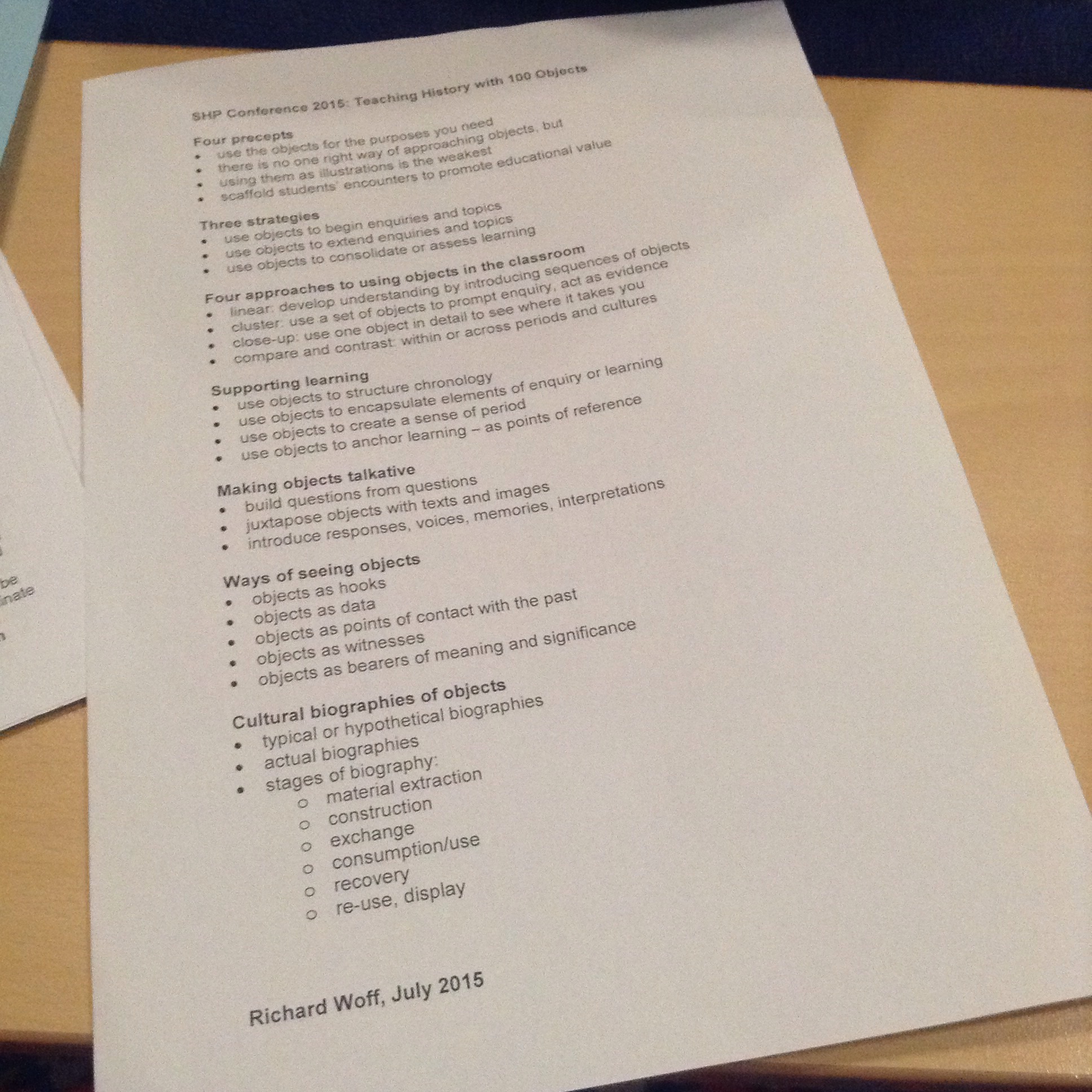
Richard Woff is talking about teaching history with 100 objects (40 of which were picked with KS3 in mind). He explains that it was funded by the DfE whilst at the same time focused on providing an alternative to their Britcentric history slant.

The project is pitched at providing teachers with the resources to use the objects in their classrooms, so although there are 40 specific for ks3, any object could be used in any phase. The website allows for sorting by theme or continent, for example.

Each object is accompanied by 6-800 words of background with lots of links to further information about the context. Bigger picture, Teaching ideas and For the classroom form the subsets that enrich the experience of each object.

Richard moves on the share some of the thinking about how objects can be helpful in the classroom. We look at extracts from writers about objects. Firstly, ASByatt in Possession, about Roland, an academic who finds a clutch of letters by the poet in a library book and, in spite of making copies, longs to keep them. Secondly, Hardy’s poem In the British Museum, which we think suggests objects provide a tangible link to the past as if they can hold echoes of what they have witnessed. Finally, McGuane’s Keep the Change, the extract of which suggests resonance across time and space.

2015/07/img_0200.jpg

Richard speaks very passionately about how valuable objects can be in helping students learn history.

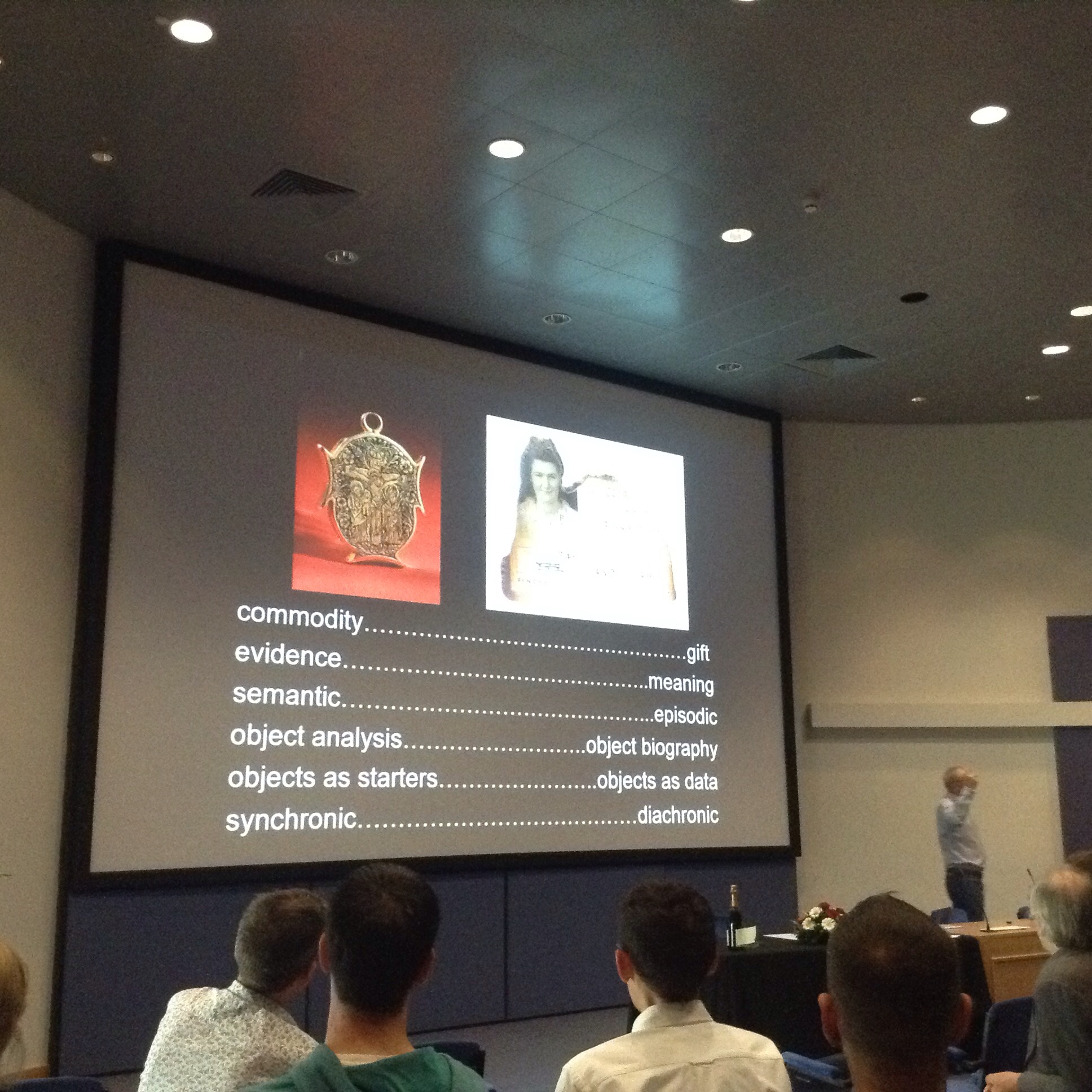
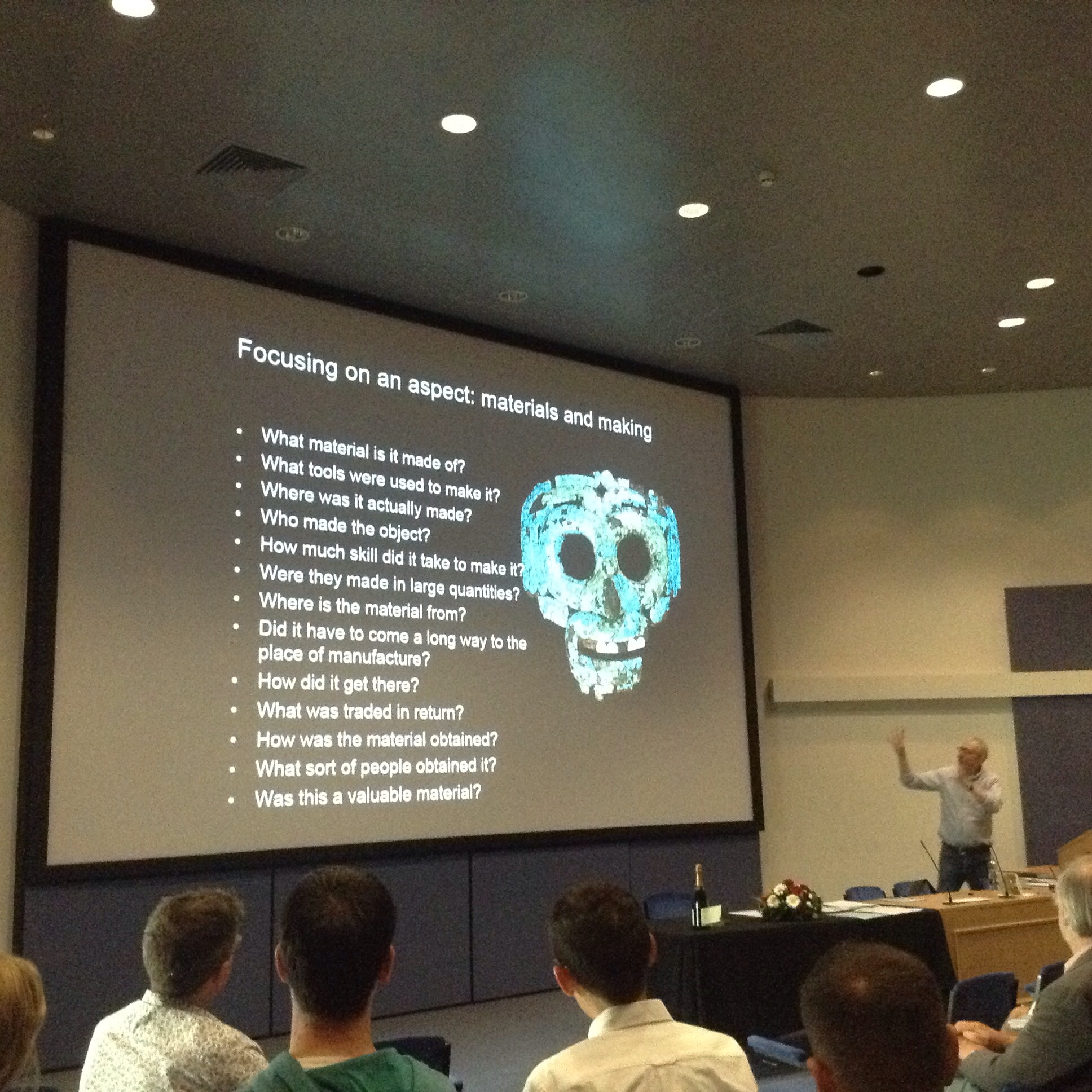
Objects are silent. We give them the voice when we teach them. Start with basic questions and then move on by drilling down, for example by only asking questions to begin with who. Focus on an aspect, such as materials and making:

2015/07/img_0201.jpg

This leads to enquiries that are object-driven: finding out about the context in which the object existed.

Richard talks about writing object biographies. The main stages of an object biography: material exploitation, construction, exchange, consumption/use, discovery and re-use. The biographies can be actual or hypothetical/typical. You can then add in people: material extractors, traders, transporters, makers, sellers, buyers, users, losers, finders, collectors, donors, curators, history teachers! What was it like to mine turquoise in the Arizona desert at the time of the Aztecs.

Use gaps as hooks:

2015/07/img_0202.jpg

How did this drum end up in Virginia? We look at another, a copper-alloy jug from Medieval Britain, found in Africa. Fill out the context by looking for pictures of how these sorts of objects were used at the time: pictures of jugs being used in the Middle Ages.

There were many other ideas for using objects but I got distracted thinking about what I would do with this in my own classroom! Sorry, readers. Go and visit the website, but give yourself a good hour or more to do it even a smidgen of the justice it deserves.

2015/07/img_0203-0.jpg

Posted in CPD Notes, Shp15 | Leave a comment

SHP15: third plenary

Alison Kitson is talking about the Black Death.

She starts with a side note to the presentation: information about a project called Miriam’s Vision which offers lessons and resources on the topic of 7/7 with reference to Miriam Hyman who was killed in the bombing.

Alison is focusing on using recent historical scholarship to challenge and engage all our students: today, year 7 and the Black Death. She feels that a lot of the lessons she sees on this don’t really communicate how horrific and terrifying the episode was.

2015/07/img_0196.jpg

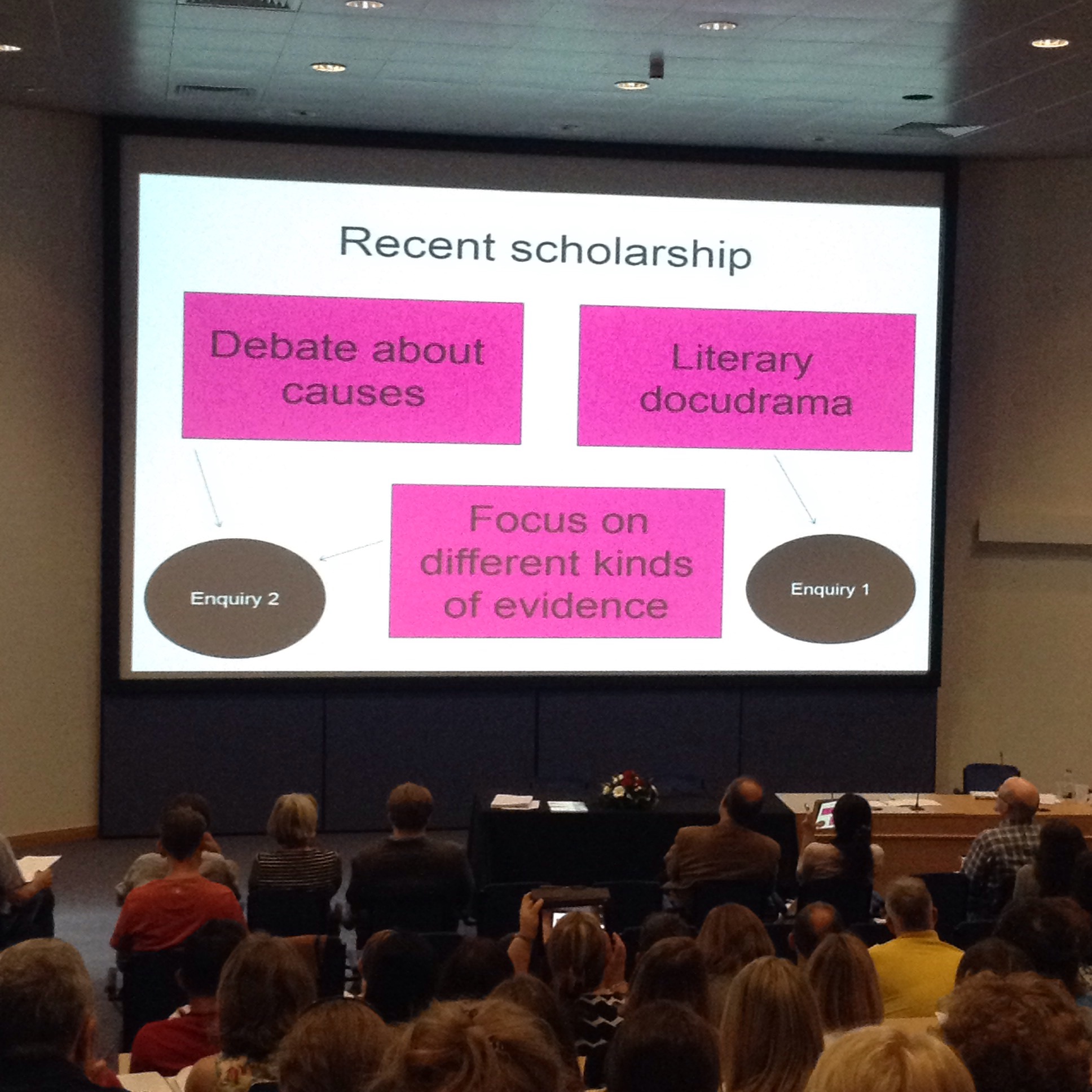
She begins by talking about John Hatcher’s book The Black Death. This book focuses on one small village in Cambridgeshire. He drew on the documentary evidence available to create “literary docudrama” – fiction, but as close to reality as it can be. His central character is Master John, the deputy parish priest; he is also fictional, though based on a wide variety of contemporary documents. Like a thriller, the tension builds in the book for half the text before the Black Death appears. This book inspired Rachel Foster to write a new scheme of work, details of which were published in Teaching History 151. This, in turn, inspired a PGCE student, Sophie Tutt, to use characters from the book to identify change and continuity through the story.

Secondly, new sources of evidence. Kitson references The Black Death In London by Barney Sloane, an archaeologist. He analysed the wills held at the Court of Hustings: these were usually drawn up when death was imminent and enrolled when death had occurred. This gives a powerful indication of death rate, allowing us to see how quickly it spread. It also gives real human insight: what was passed on, what family members were involved, etc. of course it is only the wealthier members of the population that did this (he estimates 4%) so he supplements with records from the court and account rolls of the Manor of Stepney. He also draws on archaeological findings. As well as providing a human aspect to the story, he provides really explicit evidence for what he is presenting – the opposite end of the spectrum to John Hatcher.

Sloane estimates that roughly 58% of the population of London died during the Black Death, and his evidence, when plotted, shows a concentration of deaths in a short space of time: Feb to July in 1349. DNA analysis of the bones suggests a lot of the victims found buried in London were not from London. Inspired by Sloane, Kitson planned the enquiry, “What do we think happened in London during the Black Death?”

She starts with a hint: Crossrail. This will involve some major digging, year 7. What might they have found? A body! They think it’s old because it was so deep, so who do they call? Thereafter they assume the role of the historian to take that call. We consider what questions we might ask when presented with the body. Unpicking the evidence, year 7 were able to conclude that they probably died of the Black Death. There are YouTube clips provided by Crossrail of this dig.

2015/07/img_0197.jpg

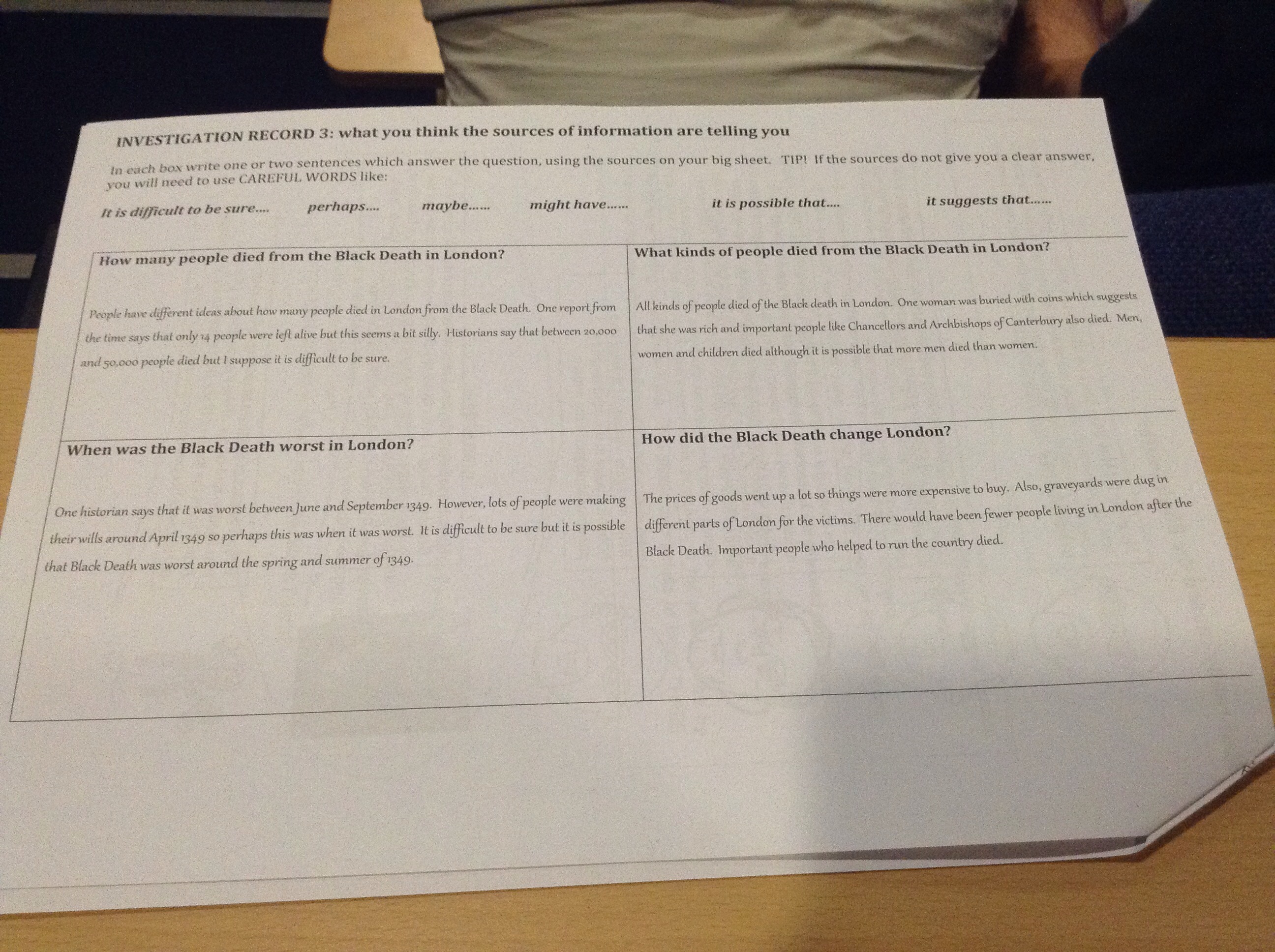
Students are provided with sources to match with the questions displayed above: two or three for each question and two or three red herrings.
Sloane’s work is introduced in lesson 4 (with his picture, to prove he is a regular person).

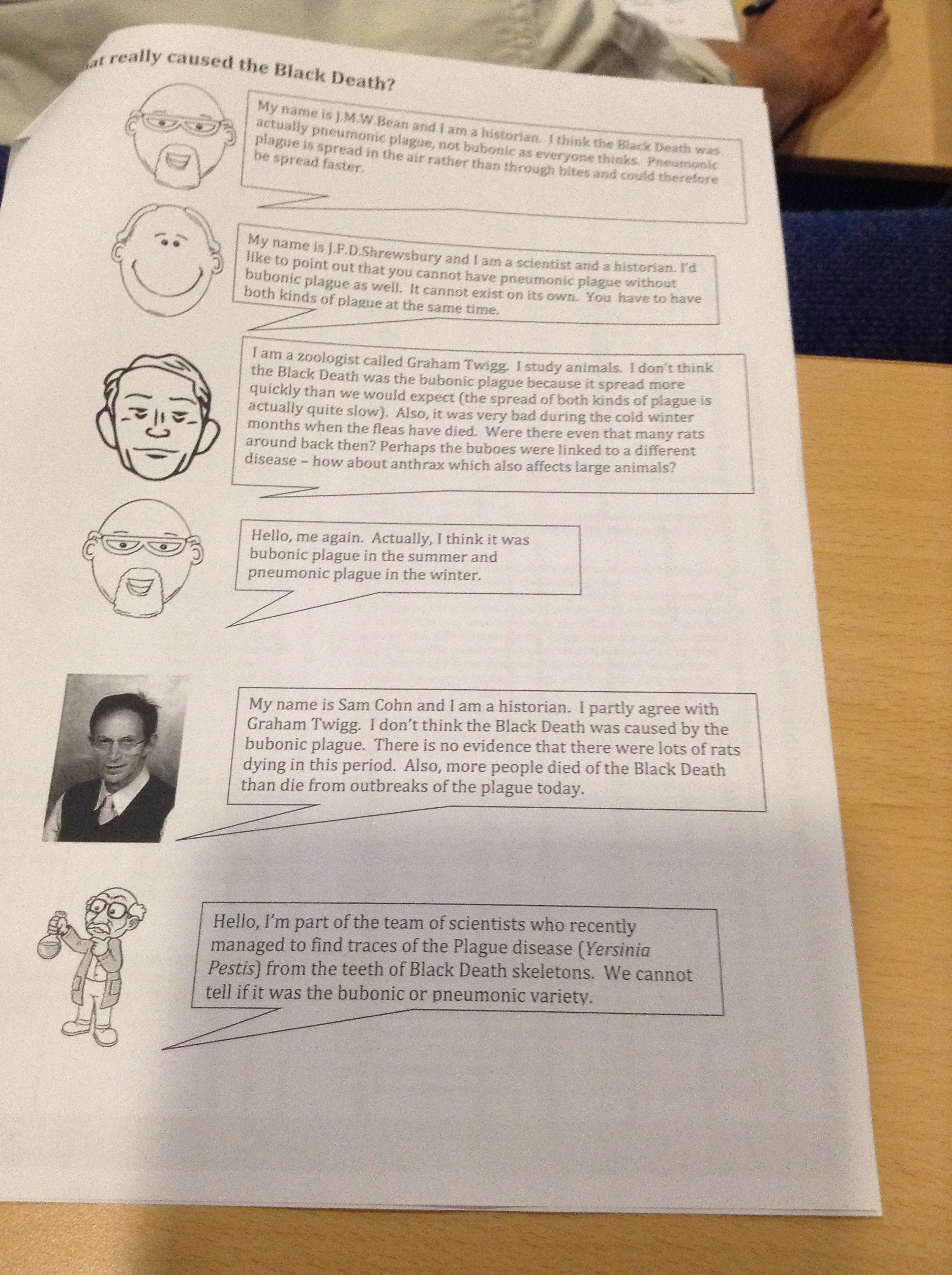
The third area that Kitson has been looking at is current debate: specifically, debate about causes.

2015/07/img_0198.jpg

The debates are read out by volunteers and then Barney, who looks suspiciously like Ian Dawson, responds to audience questions aimed at solving some of the puzzles that come out of them.

Now, students write their piece: a report for Crossrail. Kitson provides a terrible report and students are challenged to improve it, in the light of what they have learned about the Black Death. This helps them to think about using the evidence to support the conclusions they were making.

Aims of the unit:

2015/07/img_0199.jpg

Posted in Uncategorized | Leave a comment

SHP15: Ed Podesta

Ed is talking about teaching something new at GCSE. Following a move to Leeds he had to do this and decided to write it up as a case study for everybody else who will be going through this as the new GCSEs come in. We are planning for direction and destination, preparing for tricky situations.

Nobody likes change. We watch a great video clip of a dog being dragged on a walk to demonstrate this. If he just got up and walked the destination might be a pleasant one, and this is what we need to remember as teachers. It stops us getting stale: the better teachers know a topic, the less empathy they have for students who don’t understand (me, with American West). With new topics, it is easier to see the hurdles and it makes the process more reflective.

Scope out the spec. Read the points as well as the headings, and look at the AOs. We do this among our tables, discussing how the AOs have changed from old to new spec. We note that sources and interpretations are now separated out. Others point our an emphasis on substantiated judgement rather than demonstrating understanding. We talk about the mention of second order concepts instead of listing change, continuity etc. and briefly consider the difference between substantive and second order concepts.

Another part of the scoping needs to be looking at the content of the new course and doing the reading to prepare for it. We consider the course content for AQA’s Restoration England unit, thinking about where we would be confident in the knowledge (coffee houses, Royal Society, Great Plague) and where the trouble spots are (basically everything else, but particularly the Popish Plot and mercantilism. Discussions about the content should happen as part of the scoping, as should some kind of rudimentary planning about how long to spend on teaching each section.

Think of the preparation you need to do as a pie: Carb loading for the mountain climb. Chop it up into segments.
Logistics: when are the key dates to put in data, write reports etc and what will you need to have done by that time?
Answers: have a go at the sample papers so you have an idea about what the board wants.
Long term plan: no need for complicated schemes of work which are better matched when you have met your students. Instead…

2015/07/img_0194.jpg

…something like this.

Most of your time, though, is best spent reading history. Read related textbooks, undergrad overview texts, History Today; look at Radio 4, iTunesU and YouTube. An audience members suggests Massive Open Online Courses (MOOCs).
While you are reading…
Create tick sheets for kids on the course content – you can use this yourself to check your reading.

2015/07/img_0195.jpg

Unit branding. Come up with some pictures to summarise the unit.

Snow globes and mind palaces: places in your head that you file I,portent information. A mental snow globe shelf, containing a snow globe for each key individual. We draw Clemenceau snow globes based on a reading from Walsh’s GCSE textbook, unpicking the difficult points and how they might be expressed: in the case, the idea of him being a realist.

Chronology cards (Ed’s best tip for these is to put all card 1s on one sheet and do the same with the others, then when you guillotine them they’re presorted…genius) – it’s important to keep returning to these.

Knowledge organisers. Ed references Joe Kirby’s work on these and we look at an example for a South Africa course. It includes key words and individuals, as well a important quotes and facts.

The Big Bang lesson. Every so often we can produce a show stopper that achieves shock and awe, so pick the good bits from your reading and save them for these lessons next year.

Collect human stories where possible. Ed talks about the couple who inspired the book Alone in Berlin, Otto and Elise. They wrote postcards and left them around Berlin, saying negative things about Hitler. The Gestapo eventually found them. Helps students to understand that writing a postcard was an act of defiance that could get you arrested, let alone running away from a concentration camp. We read an extract and consider what questions students might ask about it, in terms of words and context. Ed found this book by asking Mr B’s Emporium on Twitter (amazing Bath bookshop that does reading salons to give you book recommendations).

Once the reading is done, think about the corners of your classroom. Have on ongoing pub quiz at the start of your lessons to help knowledge stick. Build up banks of model answers and write mark schemes using the responses of students as the examples. The routines of your classroom are there for you to fall back on when it all starts to go a bit pear shaped. Use shapes: ripple diagrams, targets, spider diagrams etc.

At the top, start the schemes of work based on what you have taught.

Ed’s presentation is going to be on his blog or ask him about it on Twitter – @ed_podesta.

Posted in Uncategorized | Leave a comment

SHP15: Jenner and Nightingale

The focus today is on how, and why, we should use extended original texts with all students. This is a topic I can fully support. We start by looking at an extract from the 1559 Act of Supremacy and discuss how it could be used with various classes:

2015/07/img_0191.jpg

They present the rationale for reading original texts: helps with sense of period, offers nuanced interpretations, diversity and connections to experience; and from a general point of view, it helps with engagement, independence, literacy and seeing texts as a construction. An audience member suggests it is also a good insight for pupils into what historians actually do. We should be encouraging students to find strategies for dealing with difficult texts because every student has a right to access them (YES YES!)

Long term planning – working the reading into schemes of work through the year – is important to ensure continuity across units and to help students to practise and refine their new tough-reading skills. It is also crucial to consider how you introduce the text because it makes a big difference to the enthusiasm and engagement among the class. It’s important to see it as a lesson activity as opposed to a bolt on before you get to the enquiry. Throwing a geeky, mushy love of reading in quite a sickly way is a good way in. They suggest a few ways of doing this: I like the point about presenting the text as an artefact about a period they already love.

Preparing to read:
Number the lines and add comments and questions to the text to help them access it quickly.
Stage directions. Ask students to create for a text. We have a look at Dulce et Decorum Est. Starting with a smaller moment helps them to really engage with it.
Context: provide cartoons (eg, post-Versailles) and give references they have to match the cartoons; then give specific sections of the treaty and they can start matching those to the inferences they’ve made from the cartoons. This has been particularly useful for weaker students at GCSE who are better able to quote specific articles of the treaty as opposed to just speaking in general. Magna Carta received the same treatment: all the things John allegedly did wrong are used to predict the clauses of Magna Carta and then matched with specific sections of the original.
Wordle: what can be inferred from a word cloud of a piece of text?
Text mapping: use various stationery to annotate features of a text: subheadings, sources, conclusions etc. allows students to build a picture of a whole text – photocopy a whole section of a textbook, sellotape it together and put it out on the floor to be worked on as a group.
Character cards: provide fictional characters from a time period and then give a text about really characters, eg people living in Germany in the 1920s and a text called “Enter the Nazis”.
Reading Age Check: both through Word and Google Advanced Search.
Reading directions: put in pauses, louder, softer, faster, slower., emphasise vowel or consonant sounds…gets students to really think about how the text should sound before they read it aloud, again encouraging them to engage with the meaning of it. Also helps students to understand the reading as a construct because they will be reading it in the author’s voice.

Text in the classroom:
Bingo: provide headings or features of a text – students pick out evidence for each from the reading. This one was to use with an extract from Equiano:

2015/07/img_0192.jpg

Reverse highlighting: give statements; students cross out anything on the reading that does not pertain to their statement.
Translation: look at texts where the words are too hard for everyone, like the Domesday book, and get them to apply what they already know, eg capital letters denote a place. Restructure a sentence with difficult syntax by cutting it out and reorganising: over time they will learn to do this mentally. Choices: give a few and ask students to identify what matches the text.
Context clues: go and search Pinterest for ideas! Look around for clues in the text to the words you don’t know. I did this last week looking at a Cruikshank cartoon of Peterloo, with the scales tipped in favour of the peculators. We didn’t know this word but the other side was reformers so we were able to work it out.
Word map: a more visual type of glossary.

So many good ideas here for new lesson activities! Was planning to look at the Declaration of Independence on Monday for freshers week so I can apply some of it to this.

Posted in CPD Notes, Shp15 | Tagged | Leave a comment

SHP15: first plenary

The first plenary is a presentation from the three English exam boards on their new GCSEs.

Firstly is Mike Charman from AQA. He stresses the importance of teachers in the development of the specification. AQA has developed a single specification with two papers, making them unique among the boards. The first component, understanding the modern world, includes the period study and the wider world depth study. The second component is focused on British history, with a thematic study and a British depth study. Thee are two new thematic units: power and the people, and migration, empires and people. The historic environment study is located within the depth study. The two papers are both an hour and 45 minutes. Resources are being produced by Hodder and OUP. Schemes of work, lesson plans, reading lists and SAMs will all be available from the board.

Next is Angela Leonard from Edexcel. They too have gone for one spec with no forbidden combinations, borne out of consultation with teachers. Edexcel however offers three exams; the four units cover thematic, pre-modern British, period and modern depth studies. The thematic studies have the same focus as the current offering, though with some adjustments to content. Historic environment is nested within the thematic studies: Whitechapel, Western front surgery and London in WW2. Topic booklets, course planners and additional SAMs will be available from Pearson with additional publishing of resources from Hodder, Pearson and the Zigzag website.

Ben Walsh speaks next about OCR A: Explaining the Modern World. OCR are unique on offering two different specs. He thinks the modern world needs explaining and difficult issues need to be addressed to ensure our next generation understand their context. He talks through the assessment objectives, advising caution on the interpretations focus particularly. He explains that the OCR A is aimed at embracing the change and future-proofing the spec. More information on the options available at the OCR A workshop taking place during the conference.

Finally, Jamie speaks about OCR B, the SHP spec. Designed around SHP principles, the aim was to provide a spec that is rich and diverse. One fifth of the marks are available for each one of the units: British thematic and depth, World period and depth and History around us. Two thematics remain the same but slimmer and more streamlined: a public health focus for medicine, for example. Strong encouragement to visit a historic environment for the third unit. Jamie stresses the focus on interplay of factors in the depth studies, unfolding narrative in the period studies. Jamie’s comments on assessment include an assurance that any relevant response is rewardable. Three exam papers cover the five aspects.

Posted in CPD Notes, Shp15 | Leave a comment

Development Study: The British Diet Through Time

I’ve written in brief about the development study we’ve taught in year 8 this year, here and here, where I explain my efforts to get students reading difficult sources.

Having explained the annotated timeline assessment as part of the HA presentation on Friday, a couple of people asked about the scheme of work, so I am now sharing it. It is a work in progress but, truthfully, I probably won’t work on it until it’s time to teach it again in the autumn, so I thought I would put up what I’ve got.

The focus is on events that changed the British diet from 1000 to present day. It picked up a couple of things that we don’t currently teach elsewhere, such as the Crusades and the Tudor explorers, and provided a good way in to the British Empire by looking at tea and sugar. As I mentioned during the workshop, it should extend forward into the 20th century and I really feel we missed a trick by not covering rationing, which would create a nice measure for how diet had changed since 1000 (what were we eating from overseas); but I got so carried away with looking at the potato that we ran out of time. That potato! Definitely now my favourite tuber.

Here are my resources:

Scheme of Work

Food Assessment Sheet

(I did try to put these in a .zip but WordPress wasn’t having any of it)

How the potato changed the world
Potato paragraph descriptors
Potato paragraph descriptors – correct order
Potato questions

Description of tobacco

Tea – Catherine of Braganza source
Tea – clippers source
Tea – Wikipedia source

Sugar info

Really glad I’ve looked over this again because it has reminded me that I wanted to do some reading on Braudel, who pops up in at least two of my sources. The summer reading pile grows…

Posted in History, Planning | Tagged , , | 1 Comment

Threshold Concepts in History, part 1

Threshold Concepts: Take Twice Daily I’ve been thinking a lot about progress in history and assessing it this year. There are lots of reasons for this. Firstly the demise of NC levels requires it, as we’re having to build a new model to assess progress at school. My senior team has decided to go with a system where we extrapolate from GCSE assessment criteria to build a model. I have Thoughts on this (and I capitalise purposefully) but, since it’s (thankfully) not my job to set whole-school policy, I have been getting on with it since November and I think I am approaching a workable system.

Secondly, I’ve been working alongside some really fantastic history teachers from Bristol, as part of something we affectionately call the History Pizza Group. These include Rich Kennett and Adele Fletcher from Redland Green, Philip Arkinstall from Hardenhuish, David Rawlings from Chepstow and Matthew Bryant from Malmesbury, as well as Kate Hawkey, PGCE tutor at Bristol University, who also plays our host and moderator. We’ve met three times this year to discuss what we’re doing in terms of assessment and presented our findings at the Historical Association conference this weekend.

Finally, I’ve been pursuing a qualification with the Chartered Institute of Educational Assessors, at the behest of the exam board for whom I toil every summer. This has involved four very full-on days of instruction with tutors from CEM and three assignments, the writing of which has once again brought home to me the importance of providing crystal-clear guidance and possibly exemplar answers to underconfident students. Nerves about the assignments aside, I have absolutely loved completing this course. We’ve looked in depth at theories of learning, whilst also looking at the setting of exams: how to do it and how to tell if you’ve done it well. There were some frankly terrifying pieces of maths for someone who never really “got” algebra (Cronbach’s Alpha, anyone?) but also some fascinating methods for analysing data that I think are going to make me a better test-setter at school, if nothing else.

Out of all of this, though, Threshold Concepts is the thing that has most tickled my fancy. It came up among the theories of learning presented on the CIEA course and I have revisited it in idle moments ever since. As we’re building a new assessment model and also rewriting our KS3 program of study to account for the increase in teaching hours we’ll have next year, I have been doing some reading about what threshold concepts in history might be. I’m still in the liminal space with it, to be honest (little insider joke there), but I wanted to share some reading that I have really found helpful today.

Firstly, for a basic explanation of Threshold Concepts, try Alex Quigley’s blog post. As there’s so much out there already I won’t go into it, other than to say they are difficult concepts that fundamentally change a student’s understanding of history, and my example would be, “All history is subjective.”

Secondly, here is some fantastic research done by some professors at the University of Indiana – Diaz, Middendorf, Pace and Shopkow. They polled their history professors and students to identify “bottlenecks”in learning, and this is the best thing I have yet come across in terms of subject-specific reading. There was lots of finger jabbing and shouting of, “Yes!” from me as I read this. To give you a taste, here is a quote from near the beginning:

[Students] believe that their job in history courses is to regurgitate the dates and events they have memorized. Students who hold such notions of history may be overwhelmed in a classroom where instruction revolves around such unfamiliar mental operations as analysis, interrogation, interpretation, subjectivity, and argumentation.

There. Doesn’t that sound like something you want to read more of?

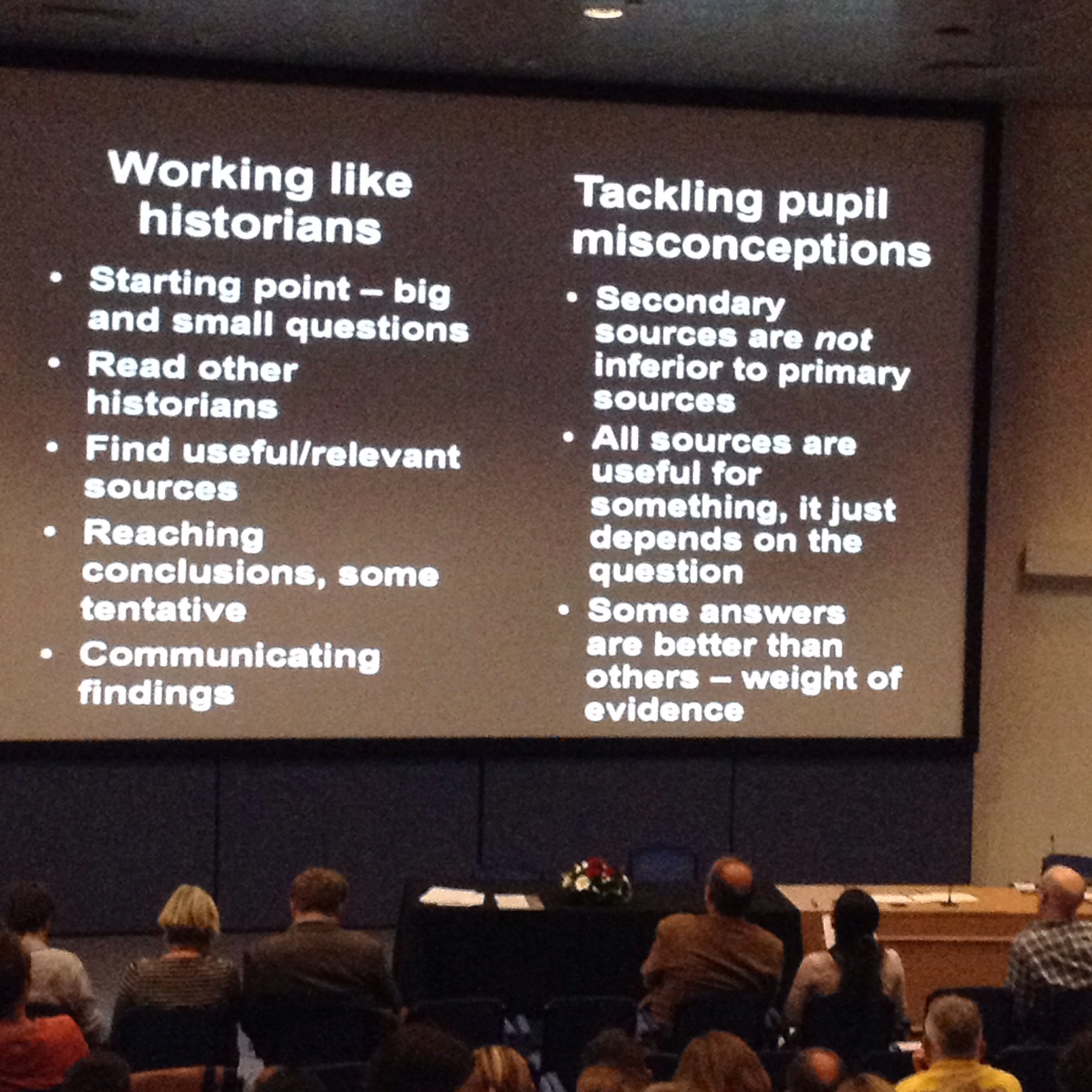
Initially, I have identified five threshold concepts in history that we’re going to be focusing on incorporating into our teaching going forward. These represent working concepts, rather than any sort of absolute list.

  1. All history is subjective
  2. Connected with the above, sources are pieces of evidence, not just pieces of information
  3. There is usually no single correct answer to historical questions
  4. History is infinitely interconnected – the “ripple effect”
  5. The “otherness” of different eras, which is to say, it’s important not to look at history through a modern lens.

I think that a grasp of these should equip our students who drop history at 14 for life (creating “citizen historians”, as suggested at our first pizza group meeting by John Cordle from Castle School) as well as better setting them up for success at GCSE and beyond. This is particularly salient at the moment as my students beg for a formula to answer the source questions on the GCSE, seemingly unable to cope with the idea that there isn’t one. Over the next term we’ll be rewriting our schemes of work and setting up the assessment model, so I will be back to share more.

Picture: Introducing Threshold by Ronaldo Quercia on Flickr. Amazing colour!
Posted in Assessment, History | Tagged , | 10 Comments

History revision for parents

Last night I invited the parents of our year 11 cohort to a workshop to give them some tips for helping their children revise for GCSE History. A couple of weeks ago I sent home a set of American West flashcards we made for parents to use to quiz our students at home, with a letter inviting them to the workshop. I was quite pleased with the turn out – nearly half the parents came along, mostly with their children.

The session lasted a bit less than an hour and I covered:

The two history papers and what was on each one – the exam entries form that they had home states that paper 1 is “Development Study with American West” – well, of course we well them that “Development Study” means “Crime and Punishment” but they don’t necessarily soak it up, so I wanted to make it really clear to parents what they need to revise for each exam.

Some generic revision techniques – mostly drawing on what I heard at TLAB15 from Barbara Oakley: I explained that regular testing is the best way to ensure the knowledge sticks, giving them some strategies for doing this at home that included our NQT’s suggestion of putting questions around the house on post its that need to be answered before being passed – so, a question on the fridge blocks the fridge and so on; and I told them a bit about the Pomodoro Technique, hoping that they will encourage students to work in short, focused bursts instead of revising for hours at a time.

Some History-specific revision techniques – I picked two things that I thought parents might best be able to help with – developing answers and generic source skills.

Firstly, we looked at developing explanation and how to build a good PEE paragraph. I modeled this with a paragraph on the board and then gave the parents time to discuss with their children how to extend a point about highway robbery that I included on my slide.

Secondly, I talked about some of the most common question stems for the sources paper and gave advice on how to best answer each one. I followed this up with a couple of examples from the news that they can use to get students to think critically about sources. The Sun did me an enormous favour yesterday with their opposing England/Scotland election covers; and the Heat magazine website provided some more fodder (“Calvin Harris posts pictures of Taylor Swift’s cats – THIS MEANS HE’S MET THEM” – how far do you agree with this interpretation? How useful is this source as evidence of a Harris/Swift relationship?)

In all I think I was speaking for about 45 minutes which seemed to be a good length of time. The feedback from parents on the way out was really positive, with several of them thanking me for giving up the time to do it, which was a nice bonus. Hopefully it will have an impact in the summer!

Here are my resources:

Y11 parent workshop – as always, these are converted from Smartnotes – no apologies for weird fonts/alignments!

AmWest Revision Flashcards – in Excel, for the OCR course.

Posted in History | Tagged , | 1 Comment

TLAB15: Keynote 2: Barbara Oakley

Oakley is a Professor of Engineering who is a visiting scholar in California and is speaking on the topic, learning how to learn.

She starts by explaining that a favourite hobby of hers is to watch people, and how important it is to get in touch with yourself and your students’ selves. She explains that having moved around a lot as a child, she resigned herself to never grasping maths. So, how did she change herself? She’d been a really not technical person as a child, and had aimed to learn a different language. Because she had no money for college, she joined the army, and learned Russian. She always loved having new perspectives and different adventures, but in some ways the path was always comfortable and familiar. She wondered if she could teach herself what the engineers and scientists she had met knew, and at 26, set out to do that.

How?

The brain has two different mode – focused, and diffuse.

2015/03/img_0189-0.jpg

In diffuse mode, it is easier for a new idea to get to the place where it needs to go to be solved. So, when you’re stuck on a problem, you need to stop and step away, to diffuse your attention.

Barbara talks about Salvador Dali, who used to sit in a chair and relax and relax until a key he was holding dropped from his hand, clattering and waking him up, which brought his ideas in from the diffuse mode back to the focused mode, where he could process them. Edison did something similar with ball bearings. These different modes of thinking are important in any kind of problem solving. Focusing intently in one session is not the best way to solve a problem. Trying to do this makes procrastination a habit, and procrastination is addictive. Instead, follow the pomodoro technique. Set a timer for 25 minutes and turn everything else off. Focus intently for 25 minutes. At the end, relax, for a few minutes or however long you can spare. This enhances your ability to focus. Learning continues at the end of the focus period, learning will continue, thought you may not know it. It’s important note to focus on finishing a task; make subtle changes – introduce it gradually, rather than doing it 15 times in a day or something.

Sleep is also really important. This reminds me of that excellent ted talk about how the brain is washed of the remains of the daily thoughts, which helps you think more clearly. New synapses form when you sleep after learning, thus proving that learning a bit every day instead of cramming is a more effective way of learning – she mentions spaced repetition, a good crossover from David Fawcett’s session. These new neurons need to be used, or they will die – but exercise also has a positive impact on neuron retention.

Working memory. Thinking of other things takes up slots in your working memory, so you can’t concentrate as hard or remember as much.

How do we transfer from working memory to long term memory? Practice. It helps build the synaptic connections so you can more easily retrieve it at the end. They need to be knit together which will allow you to better understand and remember the whole – like learning to reverse in a car, until you get used to doing several things at once, it is messy.

Swift thinkers vs slow thinkers. Race car drivers get there first, but hikers get to notice more – slow thinkers are less likely to jump to conclusions.

Students have illusions of competence in learning, so test frequently and test often. Flash cards are your friend. One of the most effective ways of learning is recall – read the page, look away and see what you can remember. This is more effective than re reading. Interleave – don’t do the same types of problems over and over again. Study with classmates – but judiciously.

We are often told to follow our passions, but they are a double edged sword. They develop around what we are good at, but some things take a long time to get good at, so passions don’t develop around them. Don’t follow your passions – broaden your passions.

She shares details of the mooc, on the UC San Diego website.

Here’s the advice as I see it, then:
Sleep.
Exercise.
Build in periods of focus and periods of relaxation.
Test, test, and test again.

She mentions knitting several times, by the way. All the best people knit.

Posted in CPD Notes, tlab15 | 1 Comment