SHP25: Planning your KS3 course

Ian Dawson and Richard McFahn giving us some advice for planning our new course based on the new NC. 75 minutes of gallop!

We start with the Corn Laws, which have disappeared from the draft NC (or “the February document”). We have a little role play, beginning with considering how important bread was in the 19th century. Ian likens it to electricity today and I half remember a statistic I heard, somewhere, that suggested 80% of what British people consumed was grain based at this time – bread, beer etc. French wheat is half the price of British wheat, but buying it will have a very negative impact on employment of farm labourers, who make up at least half the population at this time. British farmers voted, so British politicians made the Corn Laws, putting the price of French wheat up higher than British. Food prices went up, and in times of bad harvest this had a terrible impact on normal people, who felt angry, resentful, bitter – and hungry. But, without the vote, nothing could change – and here is the crux of it. It’s worth teaching about the Corn Laws as a lead in to explaining the emphasis put on getting the vote at this time: it was about feeding the family. We consider the impact of the various reform acts with people standing up to show increase in voters – from 1/25 in 1830 to 1.5/25 in 1832 to 2.5/25 in 1866 and 8/25 by 1884. The pace of change was extremely slow, and people were willing to fight and to die for it, because it boils down to needing to feed the family.

Don’t shy away from topics like political reform which you might consider difficult to teach. If it’s historically significant, don’t back off, but keep trying until you find the way in. If students care about the topic, eg by explaining that it was about food, they will be more engaged with things like the reform acts.

Richard McFahn now talks about longer term considerations. We discuss possible themes for reorganising the curriculum, and he suggests ideas and beliefs, power, people’s lives and warfare and empire. Like this idea because it could be the framework on which we tie each of the units we teach across key stage three and allow students to make links between them. Richard points out that we need to think about how we are going to ensure our students get better at historical thinking, or planning for progression in their conceptual understanding. Richard shares some work with Hants history teachers on progression in interpretation:
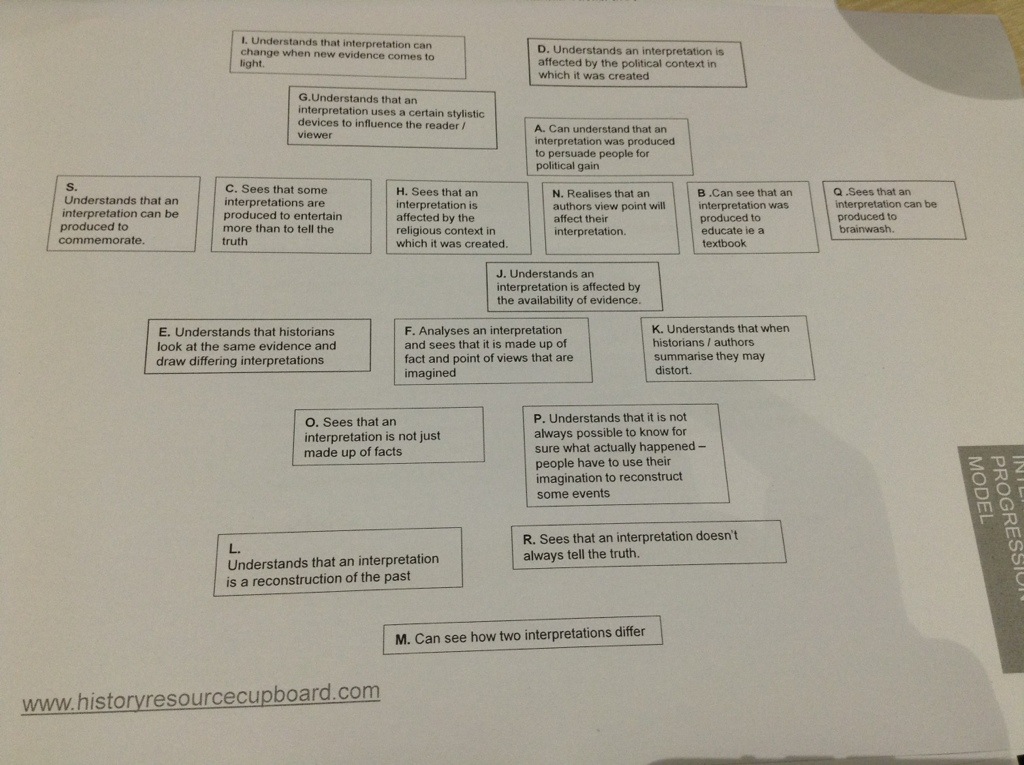
20131130-120109.jpg

These were then planned into the key stage three curriculum to show when skills will be revisited and introduced (italics show a revisit)

20131130-120252.jpg

We consider knowledge takeaways from key stage three studies, thinking about the key things that we want students to take away with them to help them think about the patterns that emerge from individual events. This is vital and can also help to take the pressure off history teachers to teach certain events in too much detail. Richard shares some documents suggesting content from each time period that might fit into the themes that he has suggested.

Ian comes back with heaven, hell and purgatory. He reminds us that in the 1300s people saw purgatory as a very real place. He references Helen Castor’s recent series on BBC4 which covered birth, marriage and death. We look at the various ways that people could shorten their time in purgatory and consider what various people might have done based on their experiences. A lot of townspeople left money for civic improvements – Dick Whittington, for example, bequeathed the money for a 200 seater toilet to be built in London after his death. The focus is on getting across the idea that most people would get to heaven but the time it took to get there varied depending on wealth, class, devoutness etc. Every Rose Has Its Thorn, after all. What impact did this have on society – were they more selfish, or more caring and sharing? This sort of role play helps students to care more about the topics.

Richard’s back to remind us of the importance of sticking to our principals as history teachers. He goes back over the SHP principals and invites us to consider the rationale of our course planning. This will vary from context to context. We discuss a variety of statements about planning the curriculum to help us come up with our rationale for doing this. SHP advocates an enquiry based approach, only partly because that is the advice from Michael Madison, History HMI. Richard goes through the stages:
1. Create curiosity. Perhaps get students to think about being on an archaeological dig and what they might want to ask about their findings (use a picture to show the dig) dripping in bits of background knowledge to help them consider what’s happening. Students then try to come up with their own enquiry question and this leads to…
2. Suggest a hypothesis. In this case we consider why 50,000 skeletons were found buried under Charterhouse Square. The first suggestion is Plague, though they were buried in neat rows so I’m not sure about this. Richard suggests a line of certainty, asking students to place themselves somewhere along it to show how sure they are. We look at some clues which indicate it was indeed the Black Death, but that doesn’t explain why there are so many of them. Tis generates another question and then the cycle begins again.

Ian reminds us that in history, it’s ok the be uncertain, but this is not a natural state for children so it needs to be reinforced. Ian then talks us through doing an overview of 1547-1700. Catholics on the left, Puritans on the right, “normal” people in the middle. What do they all fear? Purgatory again! He suggests a living happiness graph where students react to changes that took place in the church over the time period. There’d be very little information, because the idea is to give an overview. It’s not necessarily achievable to expect children, at the age of 12, to take away a great deal of detail about the religious reforms in the 16th century.

Posted in shp25 | Leave a comment

SHP25: British Library conference

We begin with a welcome from Ria, at the British Library, and details of the Georgians exhibition currently taking place here: Georgians Revealed: Life, Style and the Making of Modern Britain.

She hands over to Michael Riley who explains that the theme of the conference is Changing School History and that there are 130 delegates here today, including 40 trainee teachers and a number of primary colleagues preparing to teach the new NC. He talks about the importance of the 18th century, and the big changes that took place in that century, and how it’s quite exciting that its being taught again, as a preface to Alison Kitson’s keynote on this topic. Having been reading about the growth of the British Empire, particularly in the 17th and 19th century, this is very timely because I have been wondering what fits into the gap.

Alison’s title is Manners, Morality and the Middling Sort: why it’s valuable AND fun to teach about the 18th century in schools.

1. Why study the eighteenth century?
We begin with a quote from Amanda Vickery, considering the features of the 18th century that she is trying to express.

20131130-111617.jpg

When was the 18th century? Vickery expresses it as the period between the Glorious Revolution to the Great Reform Act. Others end it in 1801 or 1789 with the French Revolution. The new NC splits it in half, still. What to call it – the Georgians? The Hanoverians? The Century of Taste? More importantly, is it modern or early modern? Alison says she thinks it’s on the cusp of modernity. Is it taught in schools? Aspects, yes – Bolton and Watt, Wilberforce, canals and turnpikes…. But not as a whole.

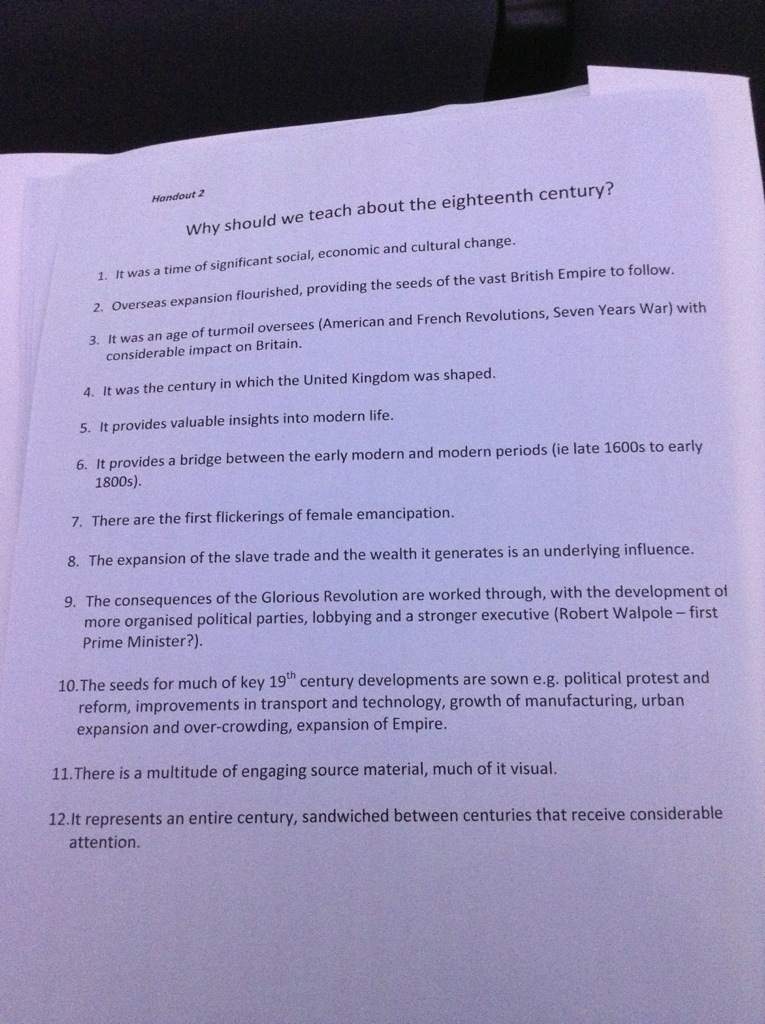
Alison makes a good case for why we should teach the 18th century:

20131130-102101.jpg

Personally, other than its place in the growth of the British Empire, I’m interested in the impact of revolutions abroad. What was Britain like for John Bull before the authorities lived in terror of being overthrown? Was it the same? I tend to think of the 19th century as rife with perceived sedition and excessive reaction to political agitation, and now I wonder whether that was the same in the 18th century.

2. Engaging with subject knowledge
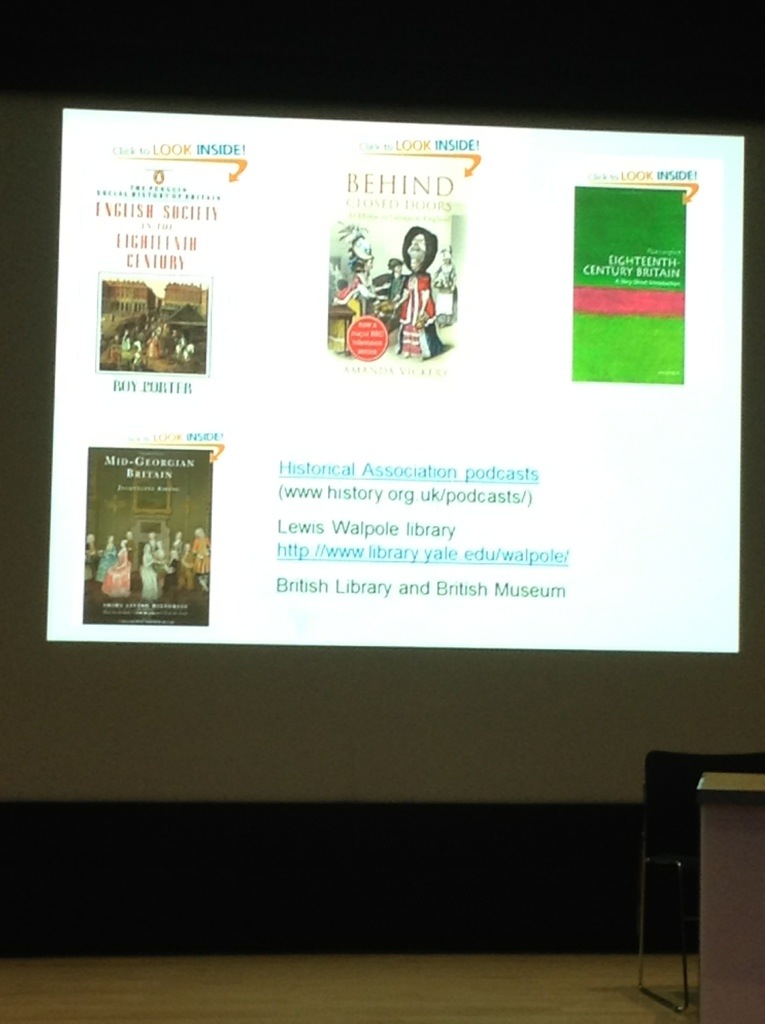
Alison recommends some background reading –

20131130-102557.jpg

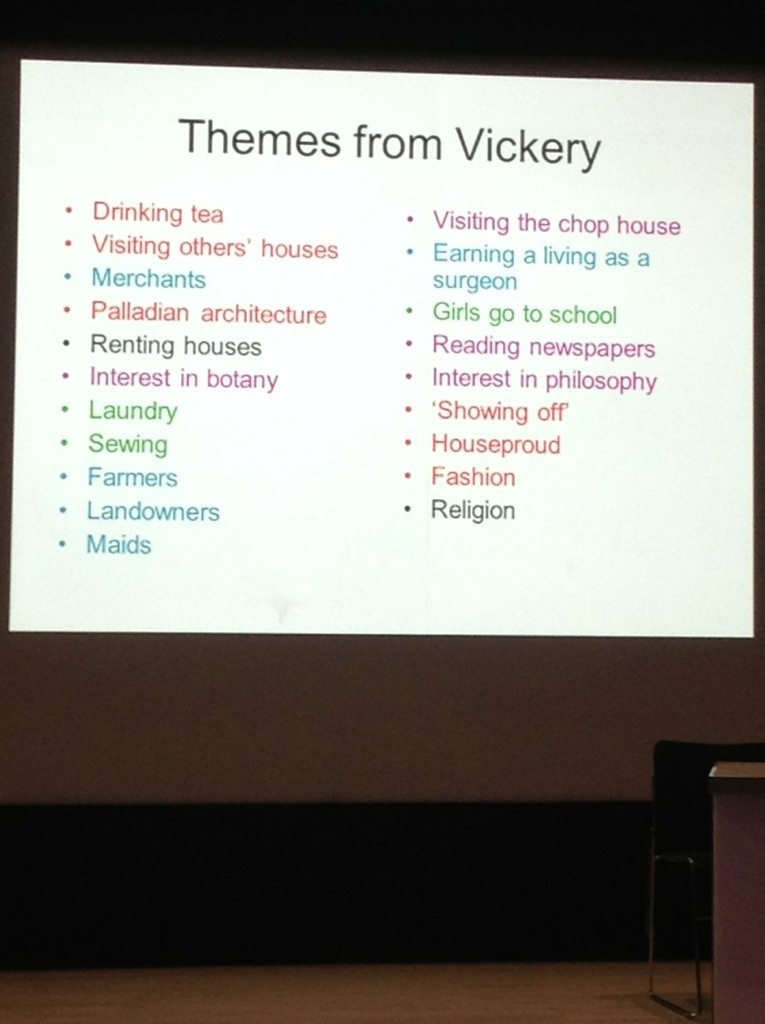
We consider themes from Vickery – leisure, change and continuity etc

20131130-102851.jpg

Nuggets! We are reminded of Jamie Byrom’s advice to look in the footnotes. Alison’s 18th century nugget is their obsession with roast beef. A song, The Roast Beef of Old England, was written at this time and is still played in army mess halls today.

3. Wrestling with the enquiry
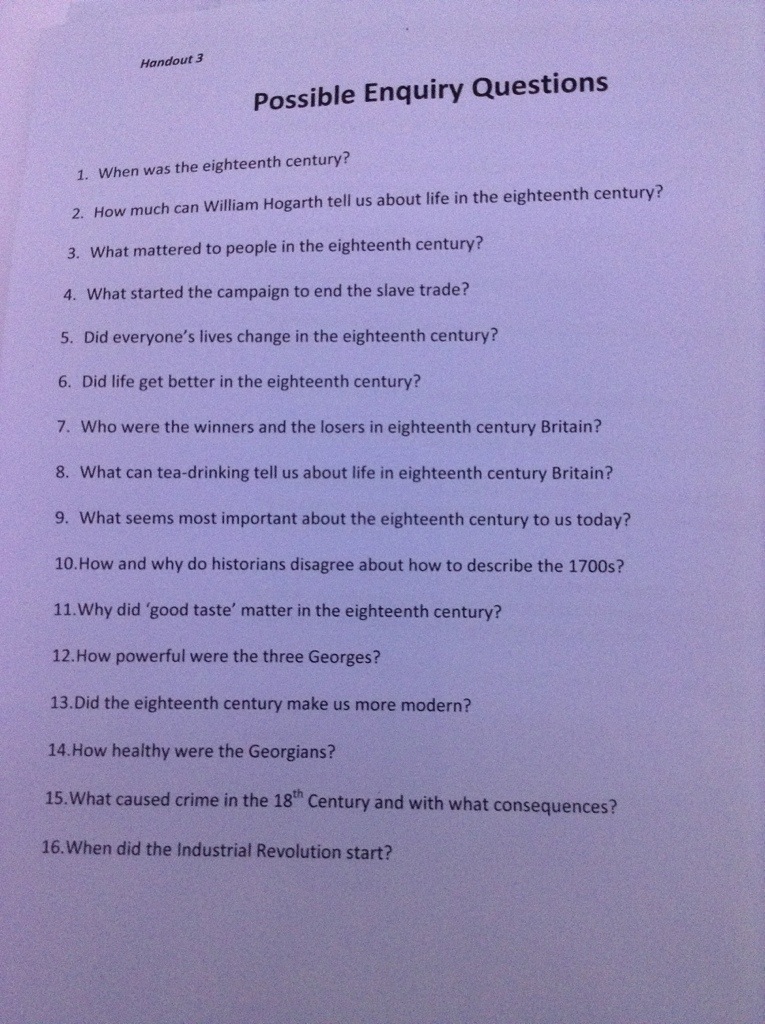
We consider possible questions.

20131130-103442.jpg

I like number 2 and think there would be a lot one could use with this; it would also be excellent training for students to prepare for that difficult “How useful is this source?” GCSE question in really glorious detail. I also like number 8 because it ties together several things – the acquisition of India and Hong Kong for the Empire, and the Great Reform Act (I serve Earl Grey when I teach this lesson). Ian Dawson suggests adjusting 14 to read “How sick were the Georgians?”

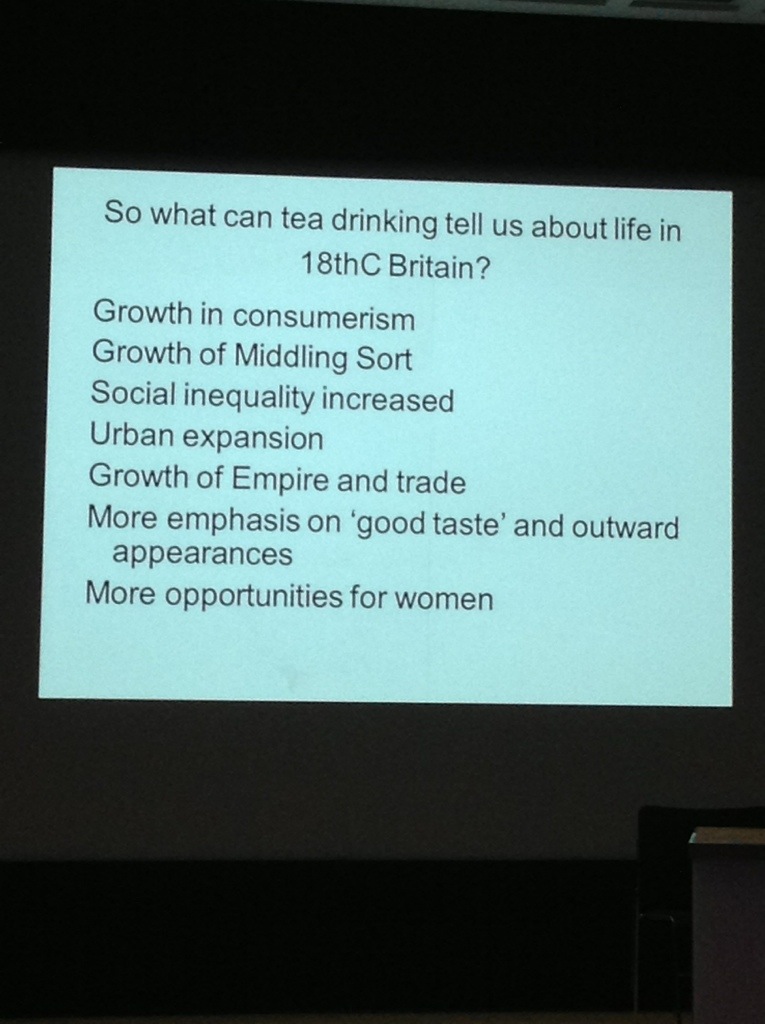
Alison has handily picked tea drinking as her focus for today.

20131130-110616.jpg

This is essentially a change and continuity focus.

4. Exploiting the particular
The particular here revolves around tea.

20131130-103921.jpg

Who? We consider a painting: An English Family at Tea. Catherine Briganza (no idea of the spelling or, indeed, accuracy of that name) introduced tea to Britain in the 17th century, mainly for the wealthy. By the 18th century the middle classes were growing and they would often drink tea and did go in for the taking tea ritual as a social construct, copying the paper classes.

The Middling Sort were definitely on the rise, thanks to huge wealth growth among financiers and merchants – the Bank of England was founded, food prices fell… A tripartite class system was developing and the lower classes didn’t drink tea. Women had a role within this and this gave them some power because most of that, for women, derived from social networking. Middle class women had a few more opportunities, in jobs as diverse as plumbing and cook book writing. There was some equality within marriage but attitudes were still very sexist.

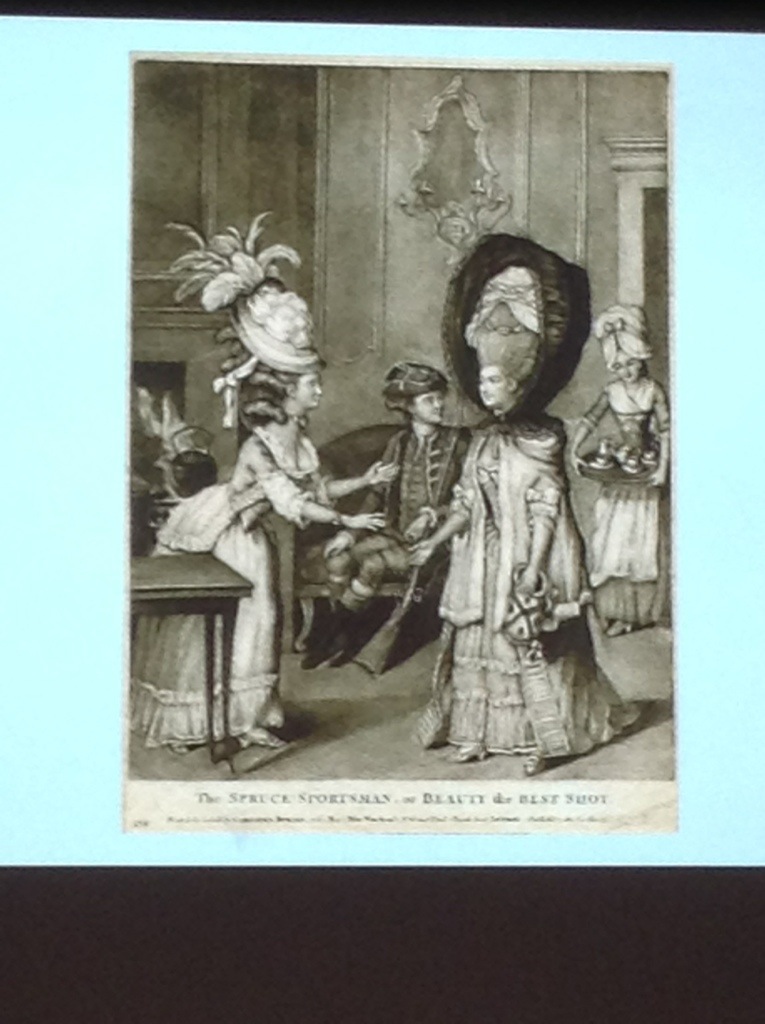
Where? The rapid growth of towns – the population of London doubles in this century, for example – brought new buildings and infrastructure, which made them pleasant places to live. To begin with tea leaves were not sold privately and so tea could only be drunk in public. We look at a Cruikshank painting of a coffee house (comparing Cruikshank with Hogarth sounds like something my year 8s would enjoy). As soon as the tea leaves became available at home the idea of “the visit” becomes important. We look at a picture of a morning tea visit which Alison got from the British Museum high-quality image service, which she recommends highly.

20131130-105249.jpg

Love the hats! Home visiting made one’s taste in decorating, clothing and possessions really important, as well as owning one’s own home. The tea ritual gave people an opportunity to show off.

How did it get here? Clear links available here with the British Empire growth, as well as the development of transportation in England. Roads were improved which had an enormous impact on consumerism and trade. A canal system was developed as well.

Who didn’t drink tea? We look at Hogarth’s Gin Lane. Tea, and sugar, were very expensive and so people without money didn’t drink it. Although the Middling Sort were becoming much wealthier thanks to all the trade, the wealth gap was growing because the lower classes didn’t share any of this new wealth – a phenomenon which led to huge growth in memberships of friendly societies and over 300 strikes. Gin was cheaper than tea and this led to problems of alcoholism. We also look at Beer Street, and a slave trade abolitionist token. Slaves were involved with tea at a distance and slavery underpinned the increase in wealth, but did not drink tea.

Tea taste? Alison explains again that taste among the Georgians was paramount. There was a lot of paraphernalia surrounding the tea ritual – china, tea pot, kettles, tea tables…

This was great! Totally enthused.

Posted in shp25 | 2 Comments

#TMHistorySW

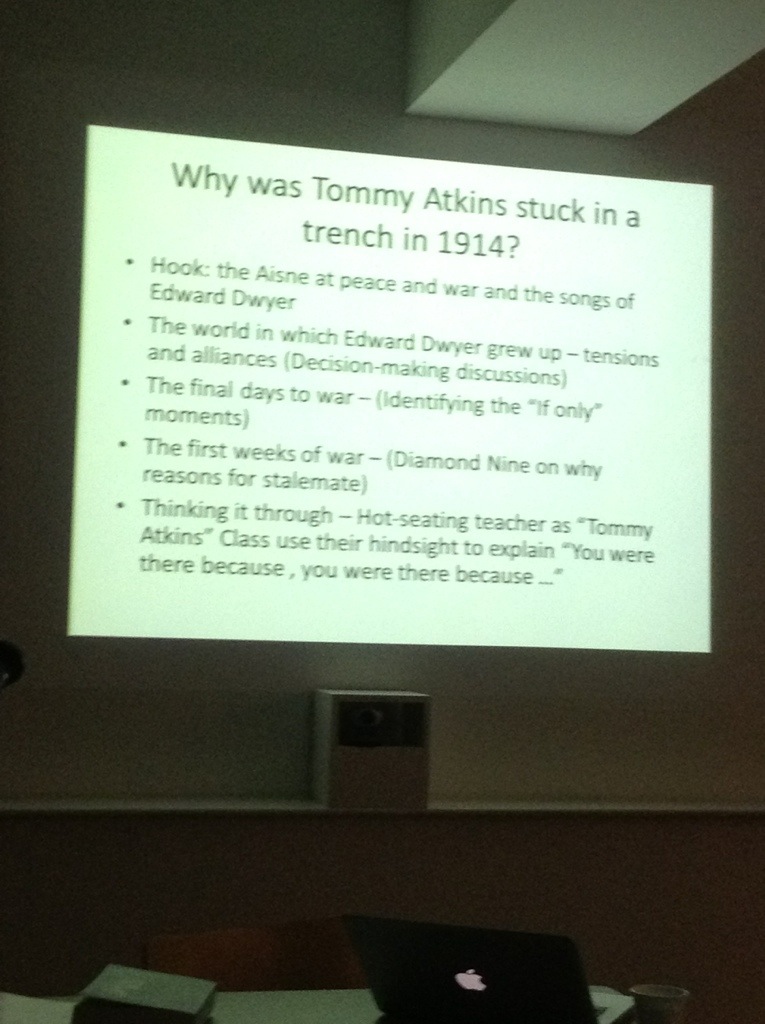
Jamie Byrom talks first about the principles of planning. He cites: teaching with a purpose (why study it?), engaging with subject knowledge, wrestling with the enquiry and exploiting the particular. We have a quick chat about the causes of WW1 and what Britain was actually fighting for, to demo the first point. Then, he breaks subject knowledge down into stuff, and issues, and nuggets. Look at exhibitions, documentaries, podcasts, book reviews, as well as books. He recommends The Sleepwalkers by Christopher Clark as a good background to WW1, and a recording of soldier Edward Dwyer.

20131115-135229.jpg

He suggests some possible enquiries to go with WW1 and ruminates on how best to exploit the power of the particular with a picture of the Aisne valley as it looks today.

Robert Massey from BGS on co-construction. He’s trialling it with a class: they have joint responsibility for the topics of lessons and home works, based on the work of Tom Sherrington, and the positives and pitfalls of this. His biggest concern is measuring progress in co-constructed lessons, or more importantly, learning.

Sophie Sullivan from Norton Hill on the Great Depression game. The start of the related GCSE unit was a bit dry, so she tweaked a game to cover the content in an engaging way, whilst encouraging them to think about how Hoover got it wrong and lost the election in 1932. Students take it in turns to play the president or his advisers. They’re given the content and a list of choices, all of which are Hoover’s actions, and asked to discuss what they think he did. Then they are given the real story, with the impact of it. They score on an American flag handout. The resources for the game are on the Bristol Schools History Forum website.

Will Lowndes from Taunton now, talking about local history. He says the local history down there is quite dull, with flashes of interest: the local museum provided some local context and artefacts to get the students engaged with their local story.

David Rawlings from Chepstow School next talking about Flipped Learning. The idea behind it is that content is done at home and skills are developed at school, essentially. Dave did some action research on this. It made use of student technology and made homework more engaging, as well as allowing more time in school focusing on higher order thinking skills. He used Edmodo and YouTube, and set up a blog; he also made some of his own videos, of which students watched one a week and then had to use that information to make presentations in class. Qualitative results look good: student voice showed that most were more engaged and better prepared, while many student made a whole level of progress on the assessment, with more than half making two sub levels.

Marie Sellars from the Church Conservation Trust next, sharing some ideas for using churches as learning experiences for pupils studying history. There are 114 CCT churches in the west, including one built by prisoners of war – French and American.

After the break we come back to Rich talking about teaching Christmas history, particularly Christmas during WW2 and the lesson he taught on this last year, including an austerity Christmas party.

Phil Arkinstall from Oldfield now talking about archaeology and digging deep for the truth. He wanted his students to engage with evidence and be able to question the past. He filled a box with sand and added a toy skeleton and laminates of artefacts around it for students to excavate. Students go through the box and interrogate the sources, recording what they have in there, why they think it is there and what they were for. They finish by writing an archaeological report.

Next, Michael Gorely from Heritage Schools Bristol, recruiting for the English Heritage Education partnership. Grants are available for spending on history projects and resources in school.

Paula Lobo now talking about historical interpretations and Gromits. She said a history teacher friend said, “It’s a bit Mr Men, isn’t it?!” – love that that’s become a thing now, well done Russell Tarr. She talks about the different Gromits and how they can be used to consider the purpose of the sources. She got students to think about who should be in the kennel of Bristol history Gromits. How did they choose the significant individuals?

20131115-135216.jpg

Finally Paula thought about Gromits as interpretation: where was the Brunel Gromit? How would it look different if someone else had designed it?

Mary Feerick now talking about a Bristol post-16 conference to help students to revise A-level history. Lectures are being offered from professors alongside a panel discussion and advice from student ambassadors. Please fill in the info forms for her!

Kathryn Lewis now talking about Beacon Schools for Holocaust education. It aims to develop networks of schools who want to strengthen and improve their teaching of the Holocaust. Current Bacon schools, St Bede’s and Backwell, offer free CPD supported by the IOE.

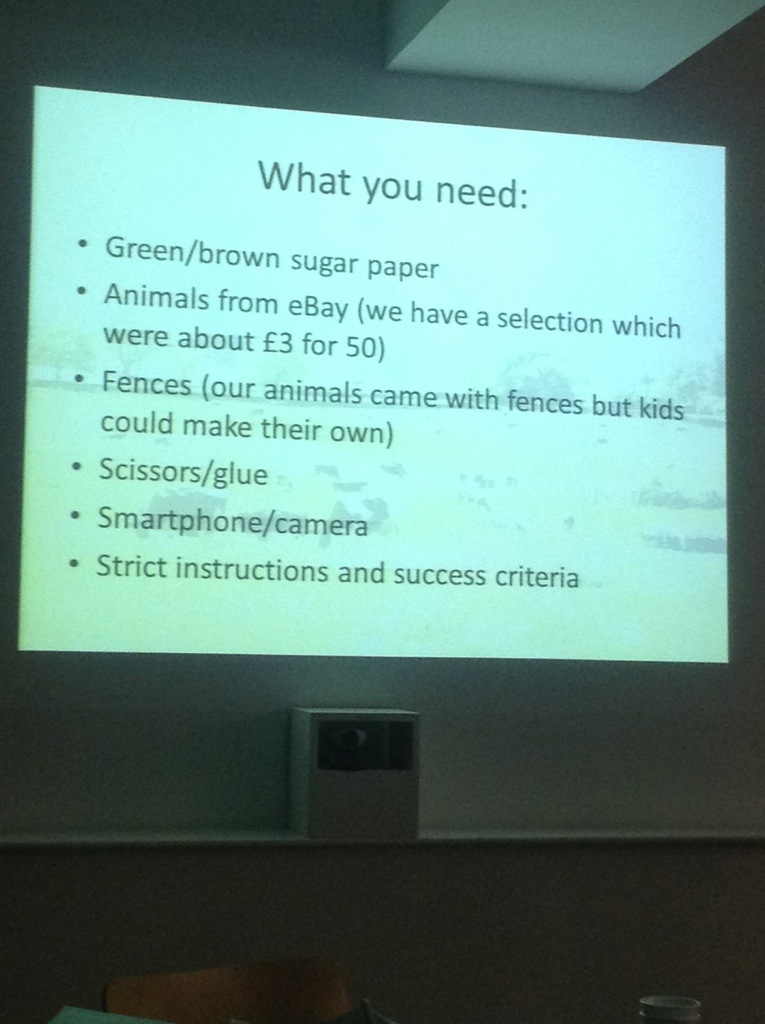
Finally, Helen Marsh from Cotham about farmyard animals to teach content. She is a proud Mr Man teacher!

20131115-135136.jpg

To begin with, year 8 students built before and enter enclosure farms. Year 11 built a farm to use as a propaganda film for collectivisation in Russia. Year 12 built farms to display the Agrarian Reforms.

Posted in teachmeet | Leave a comment

TMWilts: Clarendon Academy

Raffle, buffet and bags of sweets distributed by students! Just what is needed at the end of term,

Darren Lawrence is doing 40 ideas in 3 minutes. Not sure if even my typing is quick enough for that! They’re all focused on word walls and how to use them: link words with topic. Create question to go with word – Jeopardy. Odd one out. What do these three share. Link any two words. Give a link and then ask them to explain it. Make a chain. Six degrees of separation. Use them all in a paragraph. Turn it into a story. Tell a class story. Verbal tennis. Maths puzzles – word plus word equals which word? Which word is most important? Which is most useful for this question? Slit into essential and desirable. Pick the ones you don’t know. Pick the ones that are familiar. Pick words to answer the question. If this was an animal….? If this was a colour….? Which is most like a gorilla? Like Trowbridge? Like a rainbow? Draw them. Mould them. Just a minute on each one. Taboo. Word splat. Give us a clue. What’s missing from last lesson? What words would you add? Glossary. With a grid – randomise them using a dice. Students make grids for homework. Bingo.

I presented next about TOWER writing.

Next up, Thomas Nolan on 9 ways to use sugar paper.
Mind map, 30 seconds to look at it and students recreate it. Graffiti wall on sugar paper. Topic intro: key questions, students will go round and write their answers to them. Revisit these later in the topic so they can see their progress. Sugar paper exam: write their answers, stick on sugar paper, see which one is best. Don’t know wall – write your questions on the paper. Outline of a crime scene: draw a person and then fill it in with notes for an essay – intro on head etc. instant display wall: students put their best pieces of work up on it. Learning walk: gallery of work for students to look at and gather ideas.

Harriet Clarkson on homework.
Harriet references Laura McInerney and the homework excuse note. Pupils fill in an excuse note while others are peer assessing or doing the starter, which makes students think carefully about why they’ve missed it and then they stick it in their books so it’s clear the homework is missing to anybody who checks the book, and why. Love this idea.

Ian Carse – 9 tips for teaching and learning.
Hidden LOs: hide them under something – Ian uses a crown – and the students have to guess what they were at the end of the lesson.
Dice questioning technique: assign numbers to table groups and numbers to each child on the able. Roll the dice twice to pick who’s answering a question.
Colour palette: use paint charts and assign colours, eg “If the tsar was a colour which one would he be?”
Hide and seek: put information all over the place and get students to look for it.
Angry examiner: have a picture of an angry examiner next to a nice picture of you and point out that he is the one marking your paper, not the nice teacher.
Group work competition: groups in competition with each other for how many points they can get for, for example, helping others, answering questions, listening to others etc.
Group work “experts”: building on Dave Drake’s group work ideas from last #TMWilts, coloured lanyards to assign roles to students in groups.
Scrabble: use scrabble tiles to give groups a challenge: how many words can you make, highest score etc
Pin drop: really works to get students very quiet!

Dave Drake up next with three ideas for reviewing things.
Text the learning: give students a template of a mobile phone and get students to summarise their learning on it in a concise way.
Post its: summarise learning – what they’ve learnt and a question to ask a friend.
Key term bingo: write up 20 words, students choose the words to put in it, and then definitions are read out and they have to tick off the correct word.
Bonus idea: Homework: pick and mix grid, with 9 different homework tasks. Students have it in week 1 and have to choose 2 by week 3 and 2 by week 6. Some are creative, some are written – allows students to choose what they feel like. Helps to show homework has been set, too.

Katie Pope talking about Play Doh, next – three active writing warm ups.
Katie has a disco ball in her classroom…I like her already. She uses these ideas with a low ability year 7 class to help them get ready for writing. Five minutes or so at the start of each lesson.
Go to the doh disco: exercise their fingers before they get started. Doh disco!
Use a torch in eye dark or onto a board – students write out words with the torch and others have to guess what they are.
Eurythmy – a series of eight moves to get them engaged and moving before the writing begins.
Katie demonstrates the impact in student writing by showing a before and after piece and you can definitely see the impact!

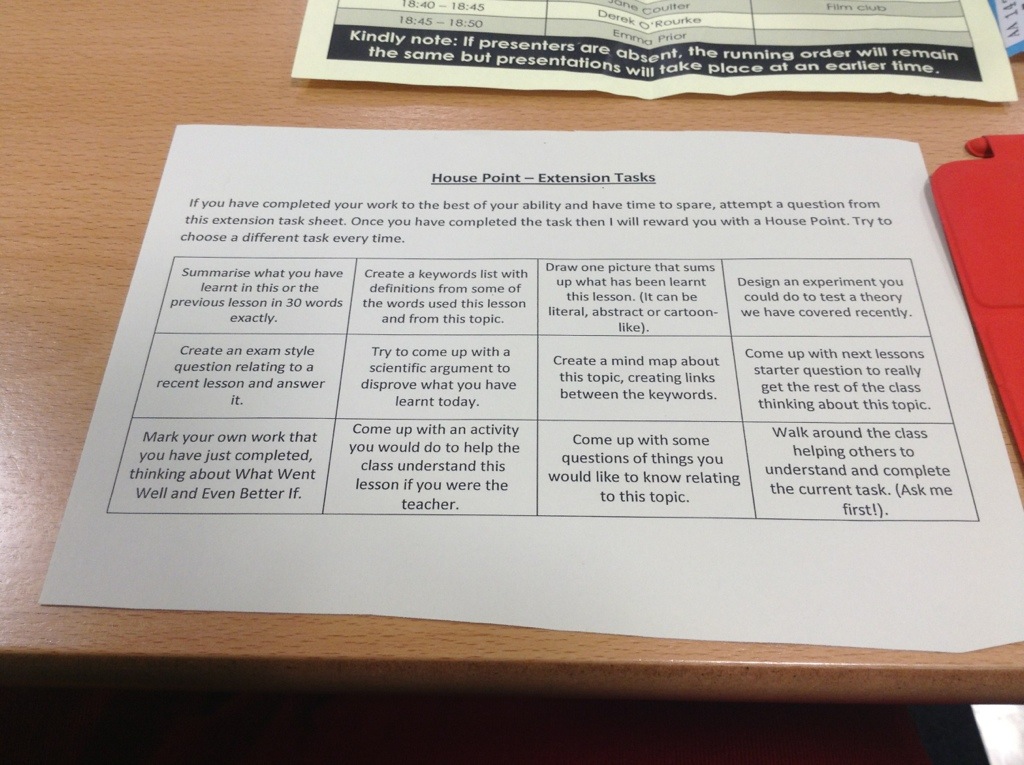
Nick Bartlett with a grid of extension tasks.

20131024-182905.jpg

He developed this from an idea from Jim Smith. The grid goes into the back of the exercise books and can be used by students to create their own extension tasks at the end of every lesson.

Jane Coulter from Film Club, an educational charity to help students and staff to set up film clubs in their schools. This sounds very easy to set up, particularly as they also offer training for sixth form students to set up film clubs for younger students and their peers – this would be great for students studying Film Studies in particular, I think.

Derek O’Rourke next, who begins by suggesting that we only have 30 seconds to engage students before they switch off, and therefo props are important. He starts with a scarf from Eire’s trip to the USA for the World Cup in 1994 when Egland didn’t go, and that that cost us £2bn. Derek also plants props around the room to see what students do with them: a giant tennis racket and ball, a stuffed pheasant which always travels with Derek to Teachmeet and shows good listening skills, and a Walkman. Very entertaining.

Emma Prior last on 3 minutes ways to break it up, break it down and bring them back, for a quick switch or boost in the lesson.
Three minute recap: blindfolded kid with a sign, has to be directed to the board by students to stick it in the correct place on the flow chart.
Dancing teacher: dance to the Countdown timer music until they are ready to learn. “It entertains them and means that something positive has happened in my life that day.” Solidarity.
Wider skills/confidence booster: simple skills chart in the back of the book, such as please and thank you, helping a partner, reading aloud, work safely in practical etc, then students accumulate ticks for that.
Draw round your hand: one finger, one echinacea you liked, the next one, where you could apply it, next one, why is it effective, then who you’d share it with, then a question you’d ask or your next action.
Three steps to success: structure an exam answer by breaking down the things they need to do into different colours. Identify, describe, discover seems to be quite a lot like point, example, explain – good idea to do this in colour.
Finally – secret post its under the desk get kids engaged, too.

Impressed at the energy here tonight at the end of a really long term! Loads of great ideas to use right away. Thanks everyone!

Next TMWilts will be Feb 6th at Matravers.

Posted in CPD Notes, teachmeet | Leave a comment

TLT13: David Doherty

David wonders, who is the Evil Knieval in your school? Who metaphorically jumps buses? David thinks it MIT be us, because we’re here today.

20131019-162015.jpg

Groups in your staff room. The ungrateful dead – they’ve retired, but they just haven’t told anyone yet. The sleeping bears – they’re good at it but they don’t share and engage with other people. How do we take what we’ve learned today back and share with everyone else, especially the sleeping bears?

David talks about his annus horribilis. His school was meant to move into a brand new building, not once, but twice. The second time they had to move everything back to the old building, and then Ofsted came in and put them in measures. This encouraged something of a siege mentality; to improve morale they had a charity event, but this got them negative press in the Daily Mail. But then something positive happened: David Laws invited them to come to London as one of the top 25 most improved schools in the country because, as a new school, their results had gone up from 0% the previous year. Clearly not actually finger on the pulse, Mr Laws.

David shares a Salvador Dali quote: when I paint, the sea roars; the rest splash about in the bath. As teachers, when we teach, the sea should roar for the pupils.

Posted in tlt13 | Leave a comment

TLT13: Summer Turner

Summer is talking about reading and how it can influence whole school literacy.

Summer is a head of English at a school in East London and has been working on strategies to develop a whole school reading culture. We introduce ourselves: lots of English teachers here looking for ways to encourage reluctant readers.

Summer gives us a Geoff Barton quote which reflects the importance of excellent, subject-specific literacy in order to become an expert in that subject. Behind the headlines about children reading less is a question: would you do Maths in your spare time because it would make you better at Maths? Why, then, do we expect children to read – why is it really important? Lots of research backs up the idea that it improves literacy, boosts vocab mastery and has an impact on the gender gap: these are all good reasons to promote it.

At Summer’s school they have been focusing on “Aiming Higher with Reading”. Research suggests that owning books improves student engagement with them (glad I make my a level students buy their history textbook now) so students have been given tablets on a hire-purchase scheme and there is a big variety of free books they can put on these tablets which gives them greater ownership of their reading. A book, or a book on the tablet, is now part of the equipment check. Teachers move from class to class instead of students at this school, and in between times are spent, by students, reading. Classes get quite excited about reading now.

Strategies. Library Invaders: helped students to get over the idea of “it’s cool to saying don’t like reading”; late at night Summer filmed herself breaking into the school library late at night and stealing a book; students had to follow the clues and the video cues to work it which book it was. Got them excited about the books and they had to do some reading in order to solve the mystery. Competitions and challenges can work really well as extrinsic motivation but it needs to avoid being gimmicky – students need to get quality reading out of it.

Community of readers. As well as students wading, parents need to promote the value of reading and events focused on readings that parents are invited to will help them to do this.

Different reading approaches. We break into discussions to look at a variety of these. We look at talking about reading – sharing ideas about what you’re reading and what it’s like. We also look at targeted whole school reading, where the English department provides an article, short story or poem for the whole school to fit into a specific theme. This must be really useful to help with the conversations abut reading. I like the idea of giving a reading out to everyone and it would be great if departments took ownership of this and contributed readings relevant to their subject. I ask if anything really controversial has ever been shared with students: this could be quite interesting.

(As an aside I have been considering, for no particular reason, the merits of having tutor time at the end of the day. It strikes me that these reading conversations would more easily spill out of tutor time among students and all the way home if that was to happen).

Other groups looked at….
Journey through books. Someone shares the different books that have had an impact on them through their lives. Often this someone is a member of staff who then helps students to put together their own journey through books. In a year 7 lesson a few weeks ago we were talking about what book has had the biggest impact on their lives and it was sad that some students claimed they couldn’t remember any of the books they had read at primary school and therefore some of them felt reading had never had an impact on them.

Summer has also started to appoint reading captains, who had to apply in writing, and who promote reading around the school with things like reading magazines. This gives reading a higher status. Conversations about reading and about why it is fun and debates about why it is important are filmed and then shared: “what about if you were in a desert? You need a book. These tablets won’t work there. It’s too hot for them.”

In the feedback, it’s suggested that perhaps there is a subject specific reading week throughout the year, where the expectation is that students will read all the time and then discuss it. Like this idea, too.

The sessions today have all been really interesting but I feel like this one has best armed me with strategies I can be using next week to make a difference. Therefore, it wins the day!

Posted in tlt13 | Leave a comment

Tlt13: Chris Chivers

Chris is talking about differentiation or, match challenge and expectation. It’s also, naturally, about personalisation.

Good differentiation requires analysing to start with: know your children, get your room together so it does its job too, bring together your resources and create a learning space. Plan for progression, but knowing the individual children at the bottom of that and knowing where you want them to be is really important. Context is vital. Consider your timescale: when will you drop the essentials in? Reviewing and recording are important, but the doing – the classroom activity – is the most important. Having a dynamic, rather than just teach-and-learn, is quite important.

We look at the teacher standards, particularly the one about expectations.

Differentiation by outcome is useful once, as a test. Through support can be dangerous, because students can become dependent. By task is a bit more difficult: spreading a task over several levels can be time consuming. Differentiation by expectation?

How about planning as a hypothesis? If you set your lesson up as a hypothesis, you’re testing it out. This might make you more able to consider what is going well and what is engaging students, and then more able to tweak your plans afterwards to improve them for next time. It even allows for adaptive teaching within the lessons, which is part of the teacher standards.

Don’t write a script, write big highlights. When you’re on a road trip you note down the big towns you’ll be passing through, to every village, and the same goes for planning lessons. This will help you to build momentum towards the best possible progress.

The big question is how to ensure that each child is challenged at an appropriate level. The learning objective becomes what the lesson is about, while the success criteria describe the steps that need to be taken to get there.

Chris suggests having targets on a flip out sheet at the front of the book, so that students can always see what the targets are, both in terms of level/grade and the things they need to do to get there. This can also provide discussion points in class, or the basis for intervention, or the context for individualised commentary when marking. Use the levels as progress descriptors within this system, and focus on what they can do.

Posted in tlt13 | Leave a comment

Tlt13: John Tomsett

John is talking about the importance of a growth mindset.

We learn over time that there’s no output without input: you only get out what you put in. As Edison said, there is no substitute for hard work. John wanted to set up a junior leadership team of six people with a single focus: to improve student motivation. They went away and did some research and picked out Dweck’s Mindset as a key piece of research for helping them to achieve this.

At John’s school, Huntington, they have two strands to their plan – teacher coaching, and growth mindset, run by eye junior leadership team. The focus has been on changing the culture. Staff have been trained on what the growth mindset is – ALL staff, not just teachers.

Trait 1: learn at all costs. Learn from criticism and suggestions; seek strategies to improve.
Trait 2: confront mistakes and deficiencies. Actively seek out learning opportunities: setbacks highlight issues and problems that need to be dealt with and learnt from. “There is no failure, there is only success and learning”.
Trait 3: talent vs effort – work hard, effort is key. Understand that no matter what your natural aptitude, effort is essential to improve and achieve. Persistent commitment and motivation are vital.

Students are given a growth mindset questionnaire and given sessions on the neuroscience of the brain as part of the tutor program. John shows examples of two girls with the same starting levels, their GCSE grades and their scores on the growth mindset questionnaire: the one with the higher score achieved better grades, which is interesting. Data like this helps to convince staff that there might be something in it.

It’s difficult to be growth mindset about everything, of course. Sometimes it’s really hard to learn from perceived failures. Also, labelling students as AGT is not helpful, because they think of themselves as gifted students who don’t need to try. Huntington has High Starters in 7, 10 and 12 who are students who are doing particularly well at key phases: this gives students something t aspire to but doesn’t allow them to rest on their laurels.

There’s a weekly growth mindset tip email, a laminate with the three traits for the front of everybody’s planner, and sessions for parents so they can use the growth mindset language with their students at home. Staff encouraged to do small things, such as respond to students who say, “I can’t do that” with “…yet”. They have adjusted “Work smarter, not harder” to be “Work harder to be smarter”.

We do our own questionnaire about our mindsets. There’s a statement about spending time with like-minded colleagues and whether we push ourselves to spend time with people that challenge us that incites some discussion. I come out at a 4.3 average. I like spending time with people that think like me, too.

The JLT at John’s school are quite evangelical about the growth mindset, even suggesting a bootcamp for those who need to develop theirs. There is huge enthusiasm from the bottom up and there’s a drive to make students work harder that has delighted a number of staff.

Posted in tlt13 | Leave a comment

Tlt13: Kevin Bartle

Kevin works at Canons High School in Edgware. His session is called the Trojan Mouse story.

He begins with the Gruffalo as an allegory. The mouse is the teacher, strolling through a big dark wood, which is their work. They’re threatened by a fox, aka political class; a snake, aka Ofsted, which has a particular impact on leadership teams; and an owl, aka SLT, who threaten with things like initiative overload and C-grade chasing. The biggest threat is the Gruffalo: teacher autonomy. It can be a blessing or a curse. Teachers need to be empowered and autonomous…

20131019-115143.jpg

Kevin then shares the journey from his school towards making teachers autonomous and empowered. The Ofsted in 2010 was outstanding, with 1s in all categories except teaching and learning, which put them right in Wilshaw’s sights. Ofsted said they needed to raise attainment and improve progress by increasing the amount of inspirational teaching that challenges and engages all students.

They decided to do it by enthusing people about pedagogy – they wanted to make it contagious. They wanted to change the culture so that it didn’t feel Ofsted was the key driver, and they wanted to create an in-house pedagogy based on some solid underpinning principles.
Bottom up.
Classroom focused.
Organic and agile – which can make it scary because there’s no clear plan.
Surplus model – audits to find out what’s good and where the best practice is. Kev thinks this one might have had the biggest impact on the teachers.

They began with a core voluntary pedagogy group. These people would work on what they chose on a project to to introduce in the following academic year. This ran for two years, and then some money arrived to build teaching school capacity which they invested in pedagogy leaders. It was a bursary, available to everybody, for people to be responsible for pedagogy. It was a project management role rather than a TLR.

20131019-120101.jpg

Somebody asks about getting the curmudgeons on board. Kevin says that there were 20 applications out of 60 teachers. Two step application – a sheet of A4 laying out vision for the school, and an outstanding lesson judgement, though this one is being reviewed. Somebody else asks if it would work in a hierarchical environment and Kevin says, probably yes, it worked in his.

The ped leaders ran a teaching and learning community in an area of strength that they had referenced in their application. Teachers were able to choose their own TLC to go along to. Ped leaders meet with SLT to keep them in the loop. There was no time allowance, but chunks of time were offered as necessary. The bursary was for 4 terms and had an equivalent to a TLR 2a. The second cohort are not all the same but the original team are still in the school who act as ambassadors for the scheme. Aspiring ped leaders make an effort to get involved in more whole school things to strengthen their application.

The first thing they had to do was a CPD day on accelerated learning, which attracted some really positive feedback. This feedback, over time, has become richer and more critical as necessary, which has provided opportunities for the ped team to adjust their plans. Recent inset involved a variety of sessions that staff opted into, and the latest inset day had sessions run almost entirely by non-ped leaders – clearly bottom up.

Ped leaders then ran a student pedagogy day, although this was the least successful thing that they’d done. (This might work quite well with sixth form: sessions on note taking, wider reading etc, to build on what we did on y12 induction day).

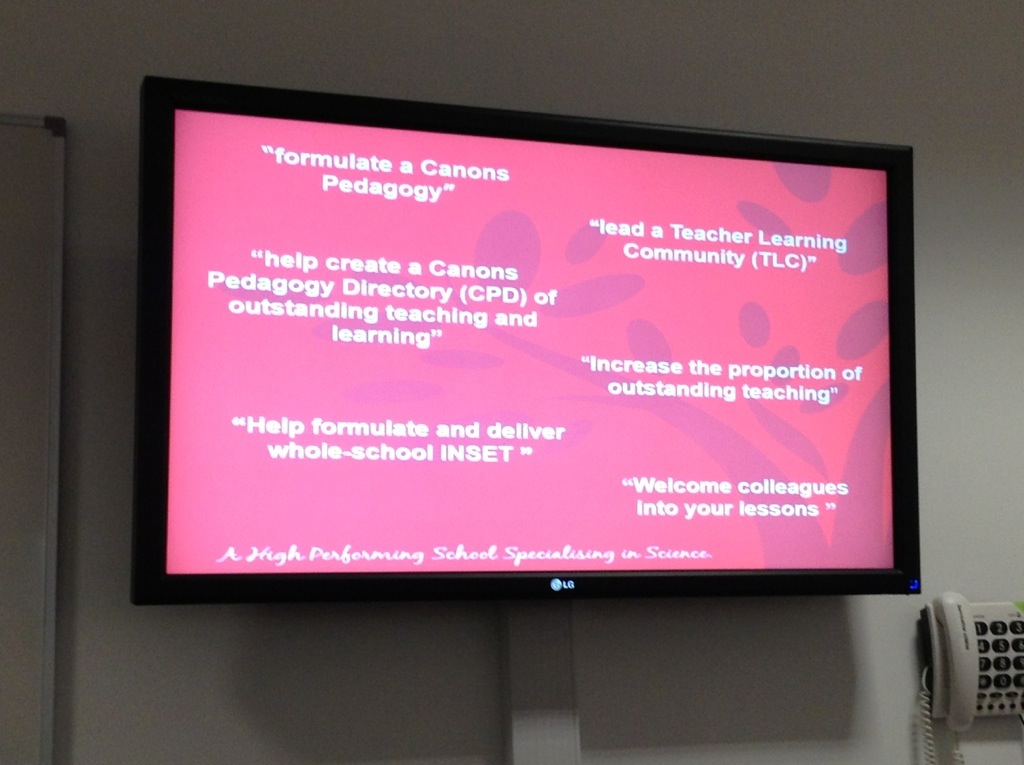
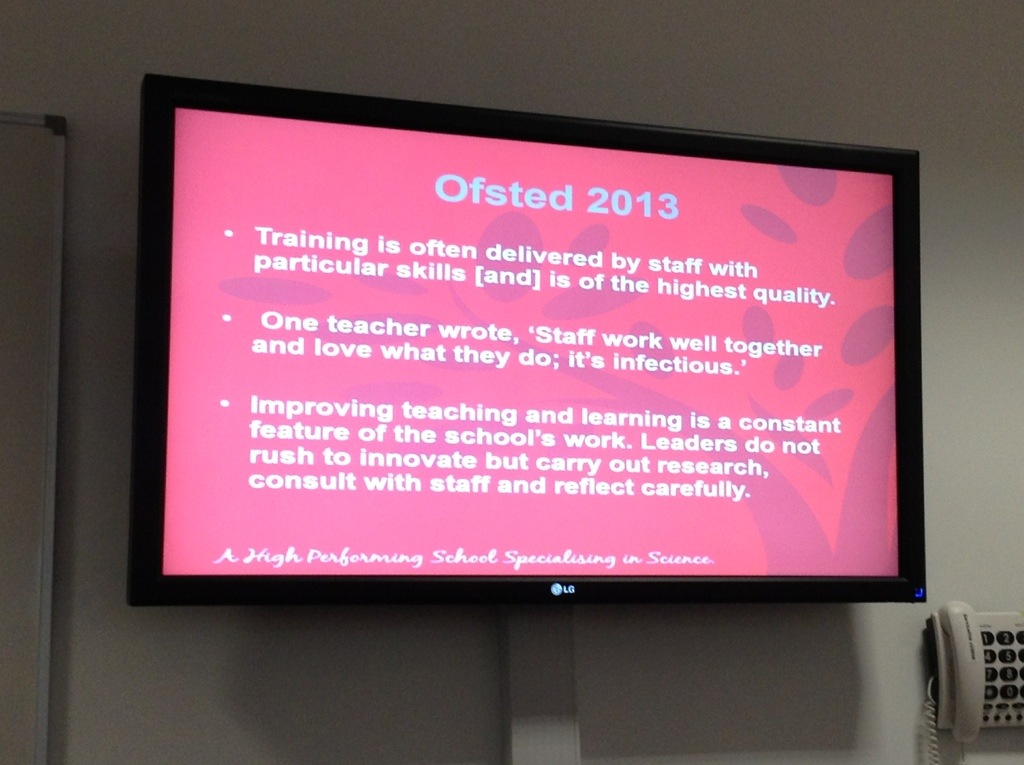
The impact on the school has been hugely positive. Other schools are adopting the model and reading/viewing the Canons Broadside; there’s a coaching culture and peer support; a pedagogy directory, based on teacher strengths; teaching and learning has improved, as validated by Ofsted:

20131019-122026.jpg

Also results have improved hugely, especially at sixth form – and it’s not an exam factory model.

Kevin uses paper mâché as a metaphor: Canons provides the wire frame in the middle for staff to lay their own strips on top. The ped leaders have taken it further than he ever thought they could.

Posted in tlt13 | Leave a comment

TLT13: Jamie Portman

Jamie Portman is kicking off TLT13 at Southampton University with the question, “Why are we here?” It’s impressive to see so many people here so close to the end of term and exciting to catch up with many old friends. Tweets going on the board in the background: one person has called us the “allies of promise”.

He starts by making the point that he is speaking from his personal point of view, and not as a representative of his school. Then he talks about a teacher, Mr B, and his student, Jamie. Mr B, says Jamie, was not a part of the teaching and learning movement in the UK. He wasn’t interested in the students or improving. There are teachers out there today who are the same, and those of us that are here today need to be like teaching and learning disciples, taking the message back to our schools, and to the curmudgeons who don’t recognise that they are a part of the movement too, whether they like it or not.

Sometimes it’s tough to work with people who just aren’t interested, but sometimes the status quo needs to be challenged in schools because it just isn’t good enough for the students that we care so passionately about. Keep sharing good teaching and learning reactive within your schools (Jamie’s has internal teachmeets, for example) because collaboration needs to be at the heart of everything we do; but we need courage too. Jamie cites Shackleton’s advert for the Arctic expedition: “low wages, bitter cold, long hours of complete darkness, safe return doubtful” – courage is a key message.

And, an ode to the grafters: the ones on the shop floor: don’t be put off by the politics of education at the moment.

Jamie finishes by talking about his experience of his school burning down. He said that it proved that schools are more than just the buildings. The collegiate approach that exists out there on Twitter helped staff to come up with low energy, high impact strategies for, for example, teaching 60 students at the same time in a youth club. It’s a teaching and learning community without walls.

It’s a call to arms, really. Our current situation as teachers is horrible, but we need to reclaim the headlines: broadcast the message that there is hope.

So, why are we here? We are here to be the best in he world at what we do, and we’ll do that when we go about it in a collegiate manner, challenging ourselves and the status quo.

Posted in tlt13 | 1 Comment