ResearchEd: Opening session

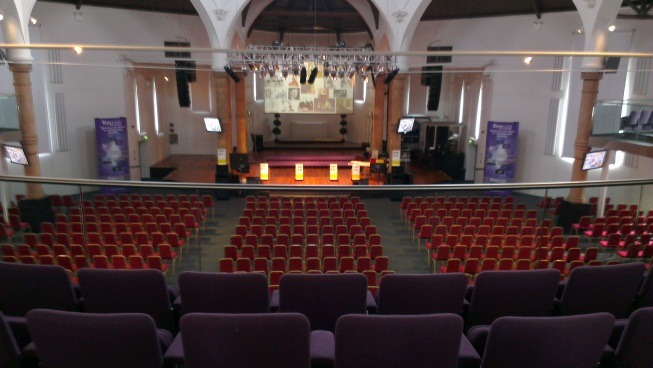
The primacy of the classroom. Good, modest teachers are the only thing essential for a good school. Teachers ambitious for their pupils, who still listen and learn. All mentioned in the opening speech from the principal of Dulwich College. Then, a thanks from organiser Tom Bennett before the keynote from a tardy Ben Goldacre.

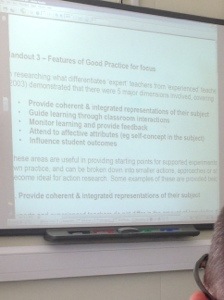
A technical hitch means that in the opening, the word Onward flashes on and off behind Goldacre, like some kind of subliminal message. Teaching should be evidence-based practice and there needs to be solid information and critical appraisal of it. In the roughly 40 years you’ll teach for, fads will come and go and it’s not enough to receive a canon of knowledge and just stick with it.

The research does need to be out into practice to become meaningful. We need solid structures for disseminating the research, therefore – not necessarily academic journals, either. Relevant summaries of the strengths and weaknesses, gaps and answers, are more helpful for busy teachers. Conferences and inset days are also useful for sharing. Journal club – regular meeting at which people present one single piece of research as a summary, and talk about the imperfections and whether it is relevant for their school. Keeps things fresh and helps for gap sting, because at the end of journal club they consider whether the piece of research should have an impact on thir teacher, and if not, discuss why not. This generates meaningful questions from the people who the research should be most relevant to/ the teacher. Operate cluefully (not cluelessly) in your school context.

This talk does remind me a bit of when my projector bulb exploded and I had to teach a double year 10 lesson with no board. #awkward. Just talk! I didn’t come to see the flow chart!

Along the way you’ll meet…
Angry people who think they know what works already.
Dinosaurs who will drag you in to the qualitative vs quantitative debate – tedious
Smug people, who are pointless bores who will waste you time
Those who say there’s nothing to do because it’s all already been done.

I am a pathfinder and today is the start of my plan!

Posted in researched2013 | Tagged | Leave a comment

ResearchEd 1: Carol Davenport

Carole’s session is a cut down version of what she does at the National Science Learning Centre with teachers preparing to do action research. It’s packed out!

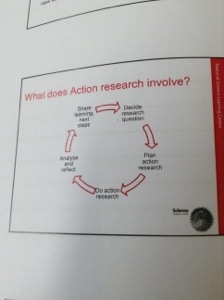
Action research isn’t a randomised control trial – it’s one person doing something in a classroom. It’s not always objective and it doesn’t always prove something. It’s not research that’s done to teachers – it’s teachers doing it. And it’s not new. It’s a way of professionals improving their practice by identifying what they’re interested in and putting it into practice, and then being reflective about it.

20130907-113116.jpg

We start by considering what makes a good research question. We look at a list of examples and talk about what makes them good or bad. I like the idea of “what strategies will most improve students’ performance on a 6 mark question?” which seems quite straightforward and gives me the idea that a research project can be mini as well as full size. The feedback from the room says a good question is well honed, deals with a specific issue, identifies how to measure and types of evidence, is manageable individually with little support. Like enquiry units in History, getting the question right can be the hardest part. You have to be specific. Spend time thinking about what’s out there

Next we consider different pedagogical areas, as identified by Hattie.

20130907-112045.jpg

It doesn’t have to be cutting edge research – straightforward is valuable because it’s about YOUR classroom context.

Then there needs to be data collection – most commonly by observation, by interview (focus groups

etc), questionnaires, testing (pre and post intervention). It will always be flawed and limited, but the thinking around it is the most beneficial part. Search on Education Endowment Foundation website for information about calculating effect sizes.

Carole talks us through her planning sheet and we have a go at it. She puts emphasis on the importance of sharing good practice with colleagues – think about how and where and when this will happen.

This has been extremely enlightening!

Posted in researched2013 | Leave a comment

What happened at Peterloo…

Earlier this year, I was preparing to help my Y11s study the Peterloo incident for their January module. Since it was a source-based paper they were sitting, I spent quite a long time online in an effort to provide them with the broadest spread of sources I could. After a while, though, I noticed that everything I was getting was very one-sided, and that it didn’t quite add up. The protestors were innocents while the local magistrates were heartless, vicious and trigger-happy; yet in a crowd of 60,000, 11-15 (depending on what you read) died. Yes, 15 is a lot and even one would have been a tragedy but it seemed like a small fraction of a crowd charged by a company of horsemen armed with sabres.

It was impossible to find an alternative point of view online. It might be there somewhere, but I couldn’t find it. This didn’t sit very well with me, so I got some books from the library.

An aside here – this is a much easier process than it was when I was a kid; and it wasn’t too difficult even then. I’d go and look it up on a terminal at the central library and if it was out on loan or in the stack I’d make a request and address a post card to myself, and after a period of time the post card would arrive and I would go and collect the book. What I did this time was, I went to my library’s online catalogue (if you live in the south west then this is your library’s online catalogue too because Libraries West is awesome) and I did a search, and I reserved the books, one of which was in the Bath stack and the other of which was in a library in Somerset, and two days later I got an email as I happened to be walking past my local library – five minutes away – and I was able to go in and collect them. This service is AMAZING. Use it.

The books I got – published in 1969 and 1989 – were both able to give me a more sympathetic view of the magistrates. Setting the scene for this meeting is really quite important and after reading, I could put myself in their shoes and imagine REALLY not wanting to be the person who didn’t send in the troops and watched Britain fall to revolutionaries*. The books were very helpful and I started to make plans to use them in class.

However, I had to stop at that point. I started to worry that my students might take on board some of the evidence from the books and write about it in the exam. The examiner, pressed in the deepest, darkest depths of a February night to complete 20 scripts before bed, might turn to the internet to verify the answer. They would not find anything, as I had not; and they would certainly not set the script aside and go to their library’s online catalogue….etc. So, I left it out. I made a real point of setting the scene, but I left out excerpts from the books and didn’t try and create a balanced view of this. Perhaps somebody who knows a great deal about Peterloo will come along and leave me a comment explaining why there shouldn’t be a balanced view of this anyway, but I felt quite disappointed in myself. I wanted to teach them all the facts and let them make their own judgments, but this might have put them at a disadvantage in the exam.

The problem is, that things like Peterloo are taught in schools, and then the same facts from the same books are reproduced endlessly on dozens of school websites, and the unavoidably narrow view of the original author becomes gospel. I found this to be the case with depressing regularity during the process of writing the revision guide published by Hodder earlier this year. History is being horribly watered down by the people who love it the most: its teachers. One of the reasons this article made me gnash my teeth (and there were several others) is because the author complained that his students were only getting one side of the story in their GCSE studies, because of the text book. I wonder why, if he has a problem with this, he hasn’t gone out and found alternative views to offer them.

Time, I expect. It’s always time.

I know I’m not the only History BA who, as an undergrad, delighted in coming out of the library with a stack of books so high it was difficult to see the steps and including references to 90% of them in a 2000 word essay. I’m not the only one who delayed concluding such an essay until the last book I felt I needed on the topic came back off loan. I’m not the only one who waited four weeks to buy a book unavailable in the UK which one bookshop in London was stocking because the owner had brought four copies back from a book fair in Florida – three of my classmates had the other three copies. I’m not the only one who, when set an essay on the Jesuits, made an effort to travel across London to the library in the Jesuit college to get a real in-depth understanding…well, maybe I am the only one for that specific case, but, yknow.

The majority of my classmates were book geeks and I bet the majority of history teachers were, too. It’s quite important to remember that, even when it’s the busiest time of the year (aka, any time of the year), and try and give our students the most facts we can find. Relying solely on the textbooks and what one can find on the internet really isn’t good enough.

* Do not mistake me: I’m not on the side of the magistrates. I’m a history teacher. I consider it my job to see both sides.

Posted in History | Leave a comment

No Pen Day: Sock puppets, Roman villa tours and Simon Schama mimicking

Last year in June I organised a No Pen Day at school to encourage teaching staff to make use of some of the technology we had access to, much of which had been languishing, unloved, or booked out to the Science department who took it to their hearts quickly.

A whole school event, I ran some after school training, completed a Learning on the Loo and offered my assistance with planning. It was largely successful. I got little feedback from the students but then, through this year, many of them have asked me when it is happening again and talked about it favourably, so we gave it another go.

This year, however, there is a dearth of technological equipment so I relied on student devices and my own ideas to promote good pen-free learning in my classroom. I particularly wanted to do something good for my Y10s, some of whom had found themselves in detention last year for not having a pen on No Pen Day (I think it was actually for rudeness to the teacher when asked to produce a pen – though I can see their point, that in fairness, they should not have required one for the lesson.)

So, I resurrected a lesson I did at the very end of the year last year, involving sock puppets and the development of the police force in the 19th century. White children’s socks can be bought cheaply in most supermarkets – mine cost £2.50 for 7 pairs – and drawn on with felt tips to create characters. They had to storyboard on a prescribed topic on their phones or other devices and present a short play to the class. I filmed this on the iPad Mini I currently have and was able to show them on the board right away via an VGA connector I bought. They’re viewable on YouTube here. In future I will be vetting the scripts a little more closely ahead of time because some of them were a bit light on content.

I backed this up today with a written quiz which students answered based on what they’d learned last lesson. We watched the sock puppets again and I filled in where I felt there were significant gaps, and it worked quite well.

With my Y7s, who are doing the development of Westbury, I adapted quite a didactic lesson so it didn’t involve writing. I went through the information with them on the board and then challenged them to build their own Roman villa using just the classroom furniture. I had originally intended to do this in the woods behind my mobile but started to worry about (a) mud, (b) splinters, (c) insect bites/hayfever and (d) trees being mercilessly torn apart in the name of a good building, so we did it inside instead.

After 15 minutes, they were ready to take the TA and myself on a tour. The best thing about this was that they really made an effort to pronounce the Latin names for the various rooms correctly, and worked together to make sure we knew what each room was for, with the tour guides chipping in. It worked well as a speaking and listening exercise.

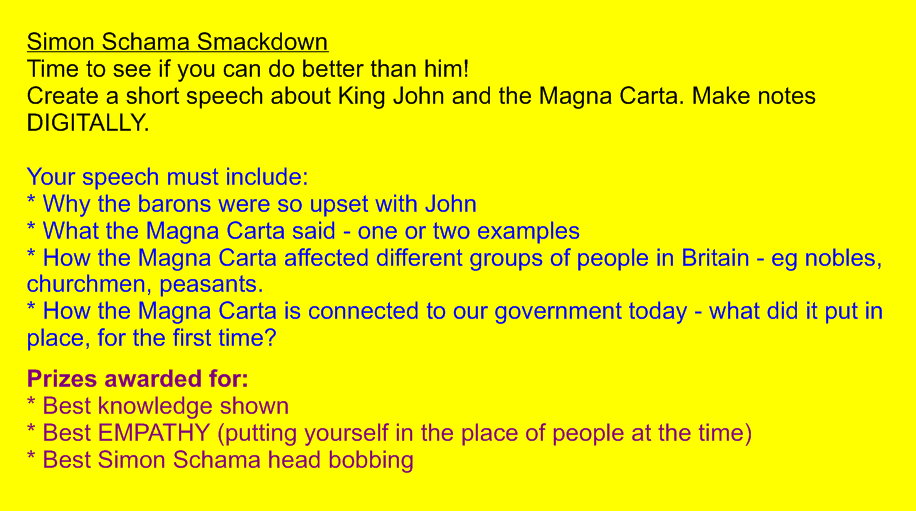
Finally, year 9 did a presentation on the Magna Carta. I showed them a clip from Simon Schama’s History of Britain, which is a bit too difficult for them to understand; then I gave them text books and a rough plan and asked them to write their own speeches on the devices they had brought in with them.

simonschama

Schama seems to move his head around a lot when he’s talking. I wonder if this might be because (like me) he naturally “speaks with his hands” a lot and when one tries to resist this, it usually manifests itself in another way. Anyway, it gives the students a sense of the theatrical when they’re presenting.

We had a good variety of devices – mostly phones, one Kindle, on iPad, and an ancient laptop I keep in a cupboard which I loaned out. I had pre-warned them so they were as prepared as they could be. We overran and I was pleased to see that most of the students still had the speeches saved on their devices when we finished off today. Historical knowledge everywhere!

Feedback from students has been quite positive so far. I definitely don’t feel they have learned less as a result of not writing. I remember a comment from the feedback last year: one member of staff said that they felt the exercise had the effect of dumbing down learning. This has preyed on my mind all year because I disagree with it very strongly; if the pedagogy is sound, the learning will still be great. I am reminded of what Martin Bean, vice-chancellor of the Open University, said when asked about getting teachers on board with new techs at EdFest (in a session which, helpfully, I appear not to have blogged) –

“Take your keen teachers and make them into rockstars. Your fence-sitters, the middle of the pack, will want a piece of it and follow eventually. The curmudgeons? Forget them.”

Second time round, there seems to be a lot more enthusiasm than last time. I saw paper planes being thrown in a lesson on aerodynamics; there was a murder mystery going on in MFL; the Maths department were recommended to me by the DHT as having done some great activities; my techno-phobe History colleague – keen but extremely time poor thanks to his additional roles within school – got me to show him Puppet Pals on the school iPods. I felt like the buy-in was greater this time around.

I’m looking forward to No Pen Day 2014.

Posted in active learning | 1 Comment

My year in CPD

The last time I filled in an application form I found myself rifling desperately through several years’ worth of wall planners in order to accurately complete the CPD column. Thus, it made sense to blog about it instead, so as to keep it all in one place; and if I am feeling arrogant enough I can just write “See blog” in that column. Yknow, if it’s a job I don’t want or something.

Here’s what I’ve attended this year in the name of honing my practice.

Teachmeets: 5

I began with #TMClevedon at the end of term 1; continued with #TMHBB at TLAB13 in March; a history-specific #TMHistorySW in May; then finished with #TMWilts and #TMSHP25 in June and July respectively. I spoke at four (three times about scaffolded marking but luckily I was the only common attendee so I got away with it).

They were all very different and I enjoyed them all immensely. It was great to hear big name speakers like Vic Goddard at #TMClevedon and I managed to get a couple of my colleagues bitten with the bug. The other four were the kind I like most of all, though, because they were full of teachers looking a little bit nervous and unsure of themselves, sharing an idea they thought was good. The particular stand-outs were the head of lacrosse talking about her triumphs, the argument tunnel, the consideration of what used to be where the M32 is now (still need to read up on that), the English teacher explaining the merits of all-boys KS4 classes, the silent movies built around WW1 artefacts and the fresh take on group work by an ex-colleague famed for his loathing of group work (or, more specifically, anything that he cannot control). I fear offending someone by not mentioning them but I reckon I’ve probably seen upwards of 50 separate presentations this year and it would be impossible to share them all.

My favourite CPD was always going into another school and watching other history teachers at work. TeachMeet is like that, and I can’t recommend it highly enough.

Teaching, Learning and Assessment Conference at Berkhamsted

The brainchild of Dr Nick Dennis, this one-day, Saturday, bargain conference aped the SHP model but provided excellent CPD across a range of subjects. I loved the two history workshops I went to, one of which was full of hands-on, practical ideas I could use right away, while the other provided a case study on improving student writing which I have used and refined at key stage three for the remainder of the year. There were also three lectures which really got my brain ticking over about the broader aspects of education and pedagogy, my favourite of which came at the end of the afternoon with Bill Rankin. My blogs of the day can be read here. I’ve already diarised this for next year.

Inspire, Create, Teach second cohort launch

As a school, we’ve been very fortunate to win a grant from Wiltshire for the next academic year to run an action research project focusing on technology and its ability to narrow the gaps. We are one of only three secondary schools in this year’s cohort and it was so interesting to go to the launch and hear about what all the primary schools are intending to do, as well as sharing ideas with one of the secondary leads who has already gone quite a long way down the BYOD route. I am really looking forward to the meeting in October, when we will see presentations of the results from the first cohort who have been running their projects this year – including one of our feeder primaries who presented her digital leaders at the ICT conference at UWE a couple of weeks ago.

It was also really useful to hear from county advisers on the best way to run an action research project, and be provided with tools and tips for planning it and carrying out the necessary baselining. I am really looking forward to getting started with this project and this was an excellent launch of it.

The Education Festival at Wellington College

After seeing this flood my Twitter feed in 2012 I booked an early bird ticket for two days without really looking at who was speaking and when. The first day – Friday – was jam-packed thanks to some juggling in the schedule so we didn’t even have time to eat (read: queue for) lunch. I loved the diversity of the festival: Wilshaw and Gove rubbing shoulders with Katie Price; inspiring educators I’d seen presenting at local teachmeets along with big hitters from the education world. I was glad my colleague and I decided to stay over locally because I was exhausted by the end of the first day.

Overall, I felt this could have benefited a bit more from having a few more hands-on teacher sessions, or at least rooming the ones it did have in spaces large enough to accommodate all who wanted to attend (in my bullish resolve to squeeze into Tom Sherrington’s session I half sat on somebody who turned out to be a bit of a VIP #awkward). I know it’s not a conference aimed solely at teachers but we seemed to be in the majority. I know the Knowledge vs Skills debate continues to rage for some reason but, while this is interesting and I have an opinion on it, I can’t help but feel it is somewhat above my head as I focus on the day-to-day teaching that goes on in my classroom; I felt that the sessions were focused a little too sharply on the rhetoric for my tastes. Perhaps it was just the sessions I chose to attend. The blogs of the sessions I attended are here.

SHP Conference

The 25th annual conference was the best yet, and booked out this year. As usual it provided great variety of plenaries and workshops; this is just the thing for the end of the school year and has got me flitting around reorganising KS3 and GCSE practice ahead of the new school year. It was great to catch up with old friends and meet so many new people. It was also very gratifying to get so much positive feedback on the workshop we ran: there is little better than having colleagues comment favourably on what you’ve been slaving over all year. The blogs of the sessions I attended are here.

Some other bits and pieces: I’ve had six days of exam board meetings this year, too, connected to my role as Assistant Principal for a GCSE paper. From this perspective I’m not sorry to see the January modules go. There’s been some in-school training on Ofsted. Timely, since they came in February. In my capacity as a staff governor I was involved in the head teacher interviews which was absolutely fascinating and excellent training for me.

Additionally, I’ve been involved in delivering some bits and pieces this year, as well as the SHP workshop, like the whole-school CPD on teacher questioning in November, the visit to a Bristol school in April to share GCSE tips, the AGT session for second and third year teachers in the West Wilts Alliance in January, and the exam-busting workshop on Medicine Through Time I spoke at here –
IMAG0466

with Chris Culpin and Richard Kerridge in March, where I got to wear one of these –

IMAG0467

However. Amazing though all this CPD has been (and cheap, too – I self-funded EdFest and TLAB out of money I earned doing additional work, like exam marking and book writing, in the spirit of reinvesting career gains into my career, so the total cost to school for this year was £150 not counting supply), my favourite piece of school training this year was something completely different.

That came in November, when I went to the snowdome in Hemel and finally achieved my ASCL qualification after failing deferring the pass the previous year due to lack of confidence/ability on the slopes. This, in spite of scoring 93% on the written exam! Being a swot turns out not to be everything. I’m not naturally sporty. I worked extremely hard to improve my fitness and skiing in the interim year and it was really exhilarating to see that finally all come together.
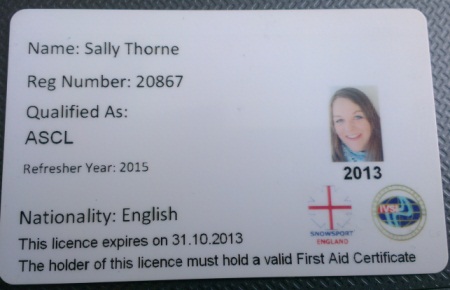

IMAG0643

Posted in CPD Notes | Leave a comment

SHP: SOLO Taxonomy Workshop

Lesley Ann McDermott (@LA_Mcdermott) and I ran a workshop this year on SOLO taxonomy. I’m sharing here our PowerPoint and the related resources which we shared at the session.

I sometimes worry that things won’t make a great deal of sense to people viewing the materials without attending the workshop, so please get in touch if there’s anything that needs explaining, or if there is a resource you’d like that isn’t here. This is the version of the PowerPoint that we used for the second session so it might look a little different – again, please get in touch if there’s anything missing.

Hopefully I will come back and do a write up of my thoughts on the session but these things have a habit of being put off so I won’t make a promise!

SHP SOLO Final 2013

Here is Pam Hook’s hexagon generator. My blank revision hexagons. Lesley Ann’s Prohibition hexagons and Highway Robbery hexagons. My American West Revision Hexagons.

Medicine Through Time Medical Megastars connections map. This is a Publisher file which WordPress doesn’t like, so I have uploaded it as a PDF – please get in touch if you would like an editable version.

My attempt at a History-focused SOLO unit planning sheet, along with my first attempt at using it. I have bronze/silver/gold success criteria on my lesson slides so the sheet is coloured accordingly. I should probably replace the word “Groups” with “Lessons” on pages 2 and 3 because this seemed to be confusing for some; I didn’t want to use Lessons to begin with because sometimes there is more than a lesson’s worth of stuff in each row.

(More resources to follow)

I had a great time working with Lesley Ann on this, even though we live at opposite ends of the country, and I like that we both approached the workshop with something different in mind. Thanks for the positive feedback from everybody over the weekend. It is really good to know that some of this stuff is going into classrooms this week, because my favourite workshops are always the ones that I can use right away! – the #quickwins as I like to call them.

Posted in shp25 | 3 Comments

SHP: fifth workshop

Steve Mastin, how do I avoid teaching to the test?

Steve says that when he started teaching he went to a meeting about GCSE specs and it seemed to be one moan after another about how boring it was, and how students are almost being hoodwinked into taking it. The mark scheme. The syllabus. The miserable grope for one more mark. He and his fellow PGCE graduates started to be concerned that they had been hoodwinked and not teaching GCSE properly. And as it turned out, most teachers taught this way. Why?

Culture.
Pressure from SLT.
Loss of confidence among students when it doesn’t look as they expect.
The requirement to report working at grades.
Ofsted – or perceptions of Ofsted.

Steve says he’s not anti-mark scheme, but they’re designed for us. The culture has shifted and now it’s not just endemic among teachers, but among pupils as well, who want to see the mark scheme and the success criteria. The mark scheme is useful, but for us, to inform our teaching.

We teach them very well at key stage three – perhaps even more critical thinking than is required at GCSE, and the best of that, if we’re really confident that it is rigorous and worthwhile, should be promoted at key stage four as well.

He suggests five principals.

1. Enquiry questions
This works very well at key stage three and there is a lot of research and advice about it. So why not at key stage four? Steve shares some enquiry questions he has taught for Modern World over the past few years and we discuss the benefits of them. The questions go generally way beyond what they would ask in the exam – who was satisfied by the Treaty of Versailles, for example, would become was Clemenceau satisfied by the Treaty of Versailles. When students ask how many paragraphs they need to write for this example, ask them what they would need to include, and whether they would put each person in the same paragraph.
The questions are engaging, and promote discussion and debate, which will challenge pupils in a more engaging way that learning the mark scheme.

2. Second order concepts and processes.
Change and continuity; causation; evidence; historical interpretations; diversity; significance. The first three are very explicit in the NC. The last three tend to drop off at key stage four.

3. KS3 success leads to KS4 success
Steve shares an example of a big success/failure graph, which they create on the ceiling, and explain that it helps students to think at a deeper level about whether the factors can be judged against each other fairly and what criteria should be used to judge success. This isn’t something they need to do in the exam, but it helps them to think more critically and deeply about the topic. He also shows a graph to consider how effective opposition to the Nazis was – active/passive crosses effective/ineffective.
The key with both these is to ask students to do MORE than the exam requires, so the exam will then seem easy by comparison, I extrapolate.

Role play – whole class is really good, though it takes a whole to set up. Students get a character that they are not allowed to share, and then over a series of lessons the characters are revealed – when would these people have started voting Nazi? NOT empathy.
He asks how it could be adapted for our depth studies?
I think in American West, you could look at when particular characters started to turn against the Indian population through the 19th century, though perhaps it works over a shorter space of time.

We look at a snakes and ladders version of the Cuban Missile Crisis. What are the high points and lows points? Write a justification on the snake or the ladder.
Design a League of Nations. This is given as an exercise before they know anything about it. Location? Aims? Membership? Leadership? Decisions? This makes them think about how the league was formed and flawed from the start, so better than what students are expected to do in the exam.
Interrogate statistics with no contextual knowledge (or at the end, with all the contextual knowledge). What questions do you need to ask? What stands out? We look at German election results between 1919 and 1933.
Use a picture as a lesson stimulus – not a starter, but just something on the board to look at when you get started.
Causation target – factor in the centre with relevant factors written in the rings, getting less relevant as they work out from the centre.
Myths. Provide pub quiz facts that are generalisations and reword, combine, go beyond, knock down..
Teach a lesson in character. Steve teaches Nazi lessons; he doesn’t tell the students he’s going to do this, but instead gets them to do these in a carousel so that they can understand what students were taught in the nazi regime, and extrapolate from this the aims of the system and what was important to the nazis (half the lessons are sport, for example).
Chalk on the carpet to show the post-war German divide. Allows for a visual representation of how people could and couldn’t move around.
Start or end a lesson with what three people have in common, or who is the odd one out, with no clear answer, to help them to develop their skill in describing.
Start a topic without telling them what it is about. Give them some cards about women’s actions, for example, when doing the suffragettes/ists, and ask them to identify the suffragette references in the Mary Poppins clip.

4. Interpretations
Look at real historians writing real history, rather than the gobbets we usually deal with. This is excellent advice because for me, one of the biggest leaps between key stages four and five is being able to identify the voices of different historians in the topics they are studying. Giving them a variety of opinions, summarised, allows them to access the debate – give them the original source too if you like, underlined for assistance. Makes me think of the Churchill speech about Gandhi I shared with my year 8 class this year.

5. Handling historical sources
Another thing they don’t need to do for the exam but will help them to answer the exam questions. Give them the sources and ask them questions – very natural questions, nothing lifted from the exam board. Interrogate the sources to consider what they say. The exam doesn’t encourage students to ask interesting questions, but we can do this.

A final tip!
History cafes.
Weekly Revision session from January onwards with a different focus. At parents evening you look at the mock and identify which sessions students should come to.

Posted in shp25 | 2 Comments

SHP: last plenary

Peter Mandler on History, National Life and the Curriculum

Peter is a university lecturer at Cambridge. He admits he knows very little about history in schools, because he says there are too many people whose voices join the debate when they have no connection with it, perhaps because it seems to touch their sense of self more than other subjects. There is responsibility attached to this too, though, to make sure it will work under your grand design. You can’t just extrapolate from your own experience. He doesn’t feel very well qualified to talk about the national curriculum, something he explains in a lengthy, self-deprecating, interesting speech.

Before the NC, there was considerable autonomy in the history classroom, unless you we’re sitting a public exam – school certificate, o level – when you had to study what the exam board said. Entry to the professions was achieved by apprenticeship rather than exam qualification. Only a few careers required a university degree – most graduates became teachers – so the focus was not on the exams. “The position of a teacher in an English school is a happy one….history teaching should not be put into a strait jacket.”

The DfE promote the idea that before the NC, it couldn’t work because teachers refused to be told what to teach, but this ignores the history of government intervention in schools in the twentieth century. There was a resistance to central control due to the liberalism in education and elsewhere, which increased funding but not control. Arm’s length government was the name of the game in the early twentieth century, and it was fiercely defended. There were arguments about schools being forced to fly the British flag or celebrate Empire Day. This went for arts, universities, the print media…more power was confided to the state but freedom of individual expression was jealously defended.

This ethos continued to be applied in education for a long time after the war. There was a push for science and technology over arts and humanities, but the will to tell teachers what to teach was simply not there. In the end, the choice stayed with students, and they voted with their feet. Science and technology actually lost ground at A level in spite of the promotion. This led to more on the job training in those subjects, because there was no intention among the government to dictate to schools.

So why did we get a NC? Thatcher wasn’t that interested at the start of her premiership, but over the cours of the eighties that changed. Key people in the government started to argue that it was important for social mobility and poor education was holding Britain back. This led to the GCSE and an expansion of sixth form places to promote university attendance – which has risen from about 14% to nearly half of school leavers.

The first NC was remarkably uncontroversial. There was quite a widespread consensus that here should be a NC although there was an equal consensus that such an abrogation of liberalism required a focus on consensus building. (That’s a lot of consensus in one sentence and I haven’t spelled it correctly first time yet…)

The drafts produced quite a lot of academic debate and consensus was built up, so that what was ratified was very similar to what was proposed by the working groups. Celebrity academics were wheeled out and the media printed hyperbolic headlines but there were focus groups etc and the civil servants, of whom there were more, better resourced, mediated between the groups and the ministers.

This time, there is no independent body to consider all the sides which has impoverished public debate. Expert groups are ignored, as are the opinions of key academics. So we’ve ended up with what the minister has drafted, without assistance. It has inadequacies which indicate more about the problems of the process than what we’ll be teaching. We’ll worry about it when it’s published.

He’s not sure that the government wants a NC. So many academies! This is true 1950s style that the Secretary of State knows best, coupled with 1980s style that teachers and parents know best…on alternate weeks.

The draft is a politicians’ curriculum, thinking the main focus of the history NC is to tell the story of the political mechanisms of the world, eg the development of democracy (my current year 9 unit…). So there is plenty in there about acts, etc – politicians are the heroes and the fulcrum around which all other events dance.

At this point I went to Twitter to respond to an MFL teacher who said yesterday that he feels the history curriculum is reducing uptake in his subject by not teaching enough about our place in Europe, finally fired up enough by what Peter is saying about the bias imposed by various people to think of what I wanted to say. So I missed a bit. But I think this suggests the lecture had its intended impact.

We need to safeguard the integrity of the subject and an NC will do this, but it mustn’t be focused on what any one person or group of people think. It should not be taught for either national or international political ends. We haven’t managed that this time but perhaps we can learn from history next time.

Posted in shp25 | Leave a comment

SHP: Teachmeet

@johnmayo first, sharing a couple of helpful websites about teaching Irish history – Century Ireland from RTE and the Down Survey of Ireland on the Trinity College website, which shows land distribution in Ireland to help show colonisation, etc

@davestacey talking about making a wiki with students, using Google Drive. Key msg for me here was “trust them, they’ll surprise you” – agree, agree, agree.

Lesley Ann @la_mcdermott talks about using Socrative in lessons for quick knowledge tests and getting feedback.

Steve Seger from Euroclio talks about Historiana and invites ideas from us about how to improve the website.

@Ericha1806 talks about disguising learning with fun this year, especially in home learning. Monarchs’ tea party: research a monarch, then in the last week they have to come to class in role and do something like speed dating. Also play doh answers – create a 5 mark question in play doh.

@danlyndon talks about a project on WW1 with the Imperial War Museum, inspired by one key artefact. They produced a narrative in a silent movie, which they story boarded first. This was really powerful.

Don Cumming @jackdisco suggests asking students for feedback on what made the lessons better and what activities they enjoy – he shares their advice on post its with us.

@nickdennis talks about the apparent skills vs knowledge dichotomy. He talks about a project with his library staff on researching the Black Death. He created a fake website about the Black Death and asked students to critique both the knowledge and the layout.

Evernote saved my marriage! (I missed this lady’s name, sorry) she has been able to hoard all the interesting stuff she comes across without creating piles of messy paper.

Rich Kennett @kenradical talks about choosing a history hero and having your picture taken with it. Add a bit of writing to justify your choice. He got all his year 8 to do it, which created a bit of a contest to get the weirdest person. These were displayed in the history department and other faculties have got involved. Has created a lot of passion and debate, as well as a great display.

Posted in shp25 | Leave a comment

SHP: third plenary

Michael Maddison, HMI, on outstanding leadership in history.

Michael begins with some press headlines in the 6 months leading up to the publication of the new curriculum, and then invites us to identify the papers that have reported various headlines since. Michael is going to share Ofsted’s evidence, giving us a snapshot of the current picture. He fears that at primary, the picture has become less positive with less subject specialism and greater focus on creativity. It is episodic and leads to episodic knowledge. In secondary, there are huge successes. It is well taught by subject specialists and the NC has led to high quality teaching and learning. Attainment is high and entries are rising. History maintains a consistent GCSE entry for the past 20 years. Roughly a third of pupils take it.

There are concerns, though. More non-specialists and variable teaching time mean that standards are variable and progress is not fast enough. The person who indicates that his school gets 3 hours a week for history in year 7 is treated to envious sighs from the crowd. Students are restricted from accessing history post-ks3.

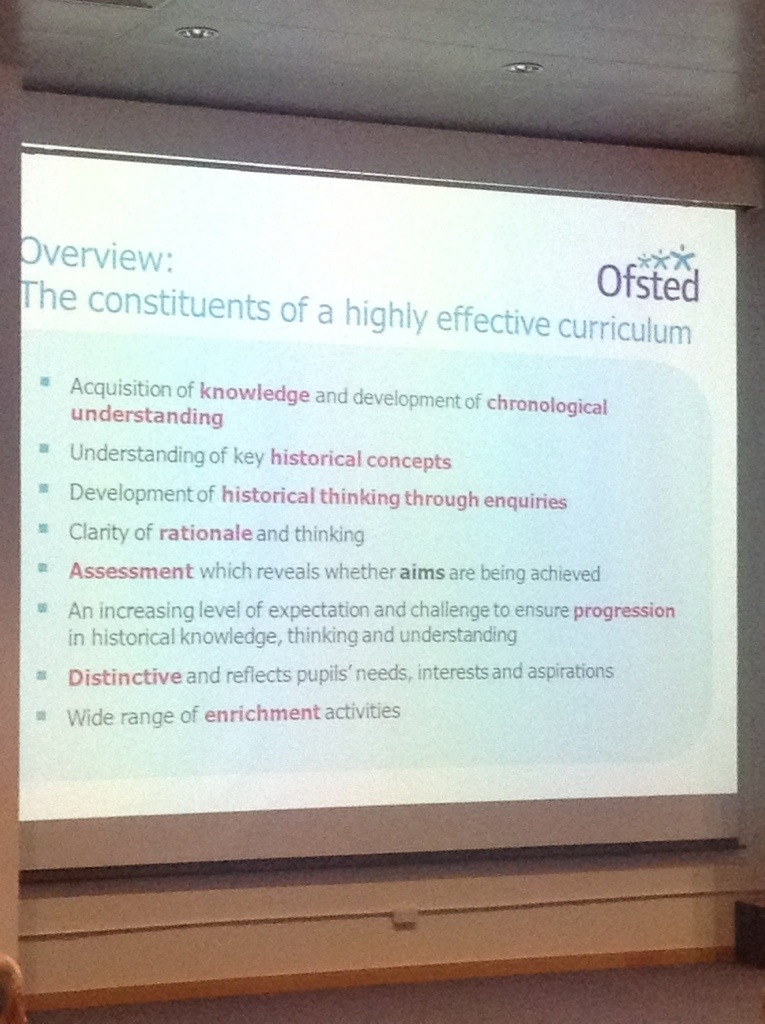
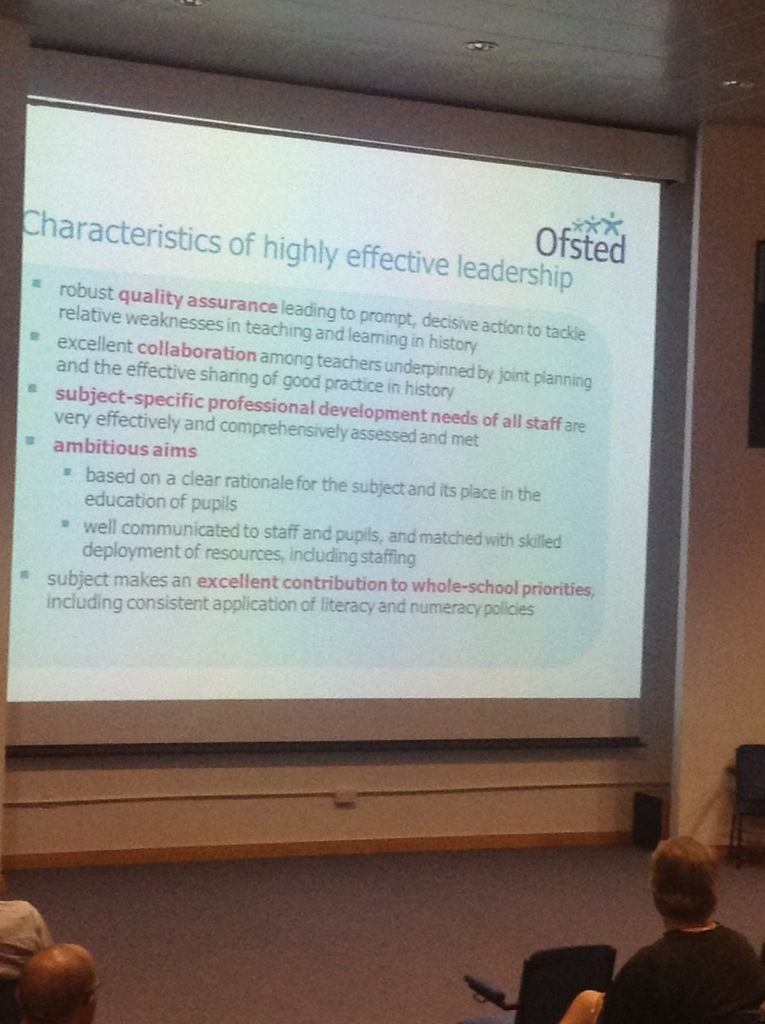
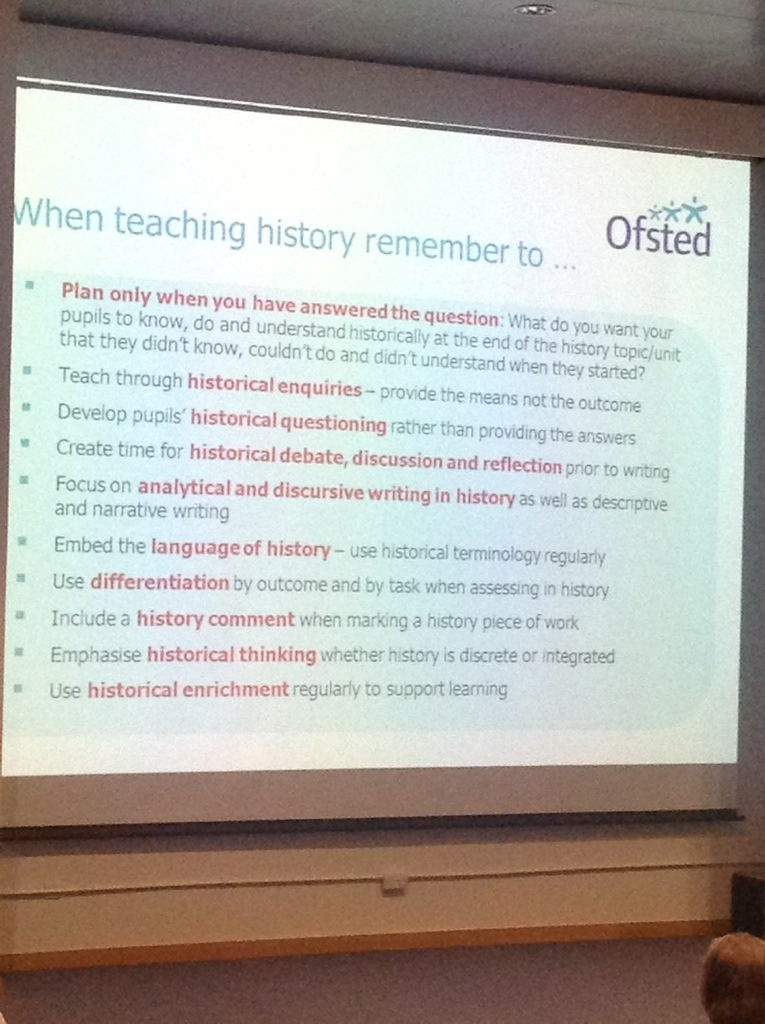
Regarding good leadership, Michael recommends a few books, including Ofsted’s Good Teaching, Effective Departments. He talks us through the supplementary history-specific guidance to go alongside the Ofsted level descriptors. Effective teachers have good subject knowledge. The learning is rooted in rigorous historical enquiry. Historical thinking, the ability to investigate, consider, reflect and review events, is well developed in great lessons. It’s also important to explain why they’re doing it. Lots of people singing from this hymn sheet this weekend. When Ofsted saw me, they did ask the students why they were doing their activity and they were able to answer. It is vital, he says, to have a clarity of rationale and thinking. Why, what, how, when? What do we want pupils to know, do and understand that they couldn’t before? Let the prior learning guide your planning.

What makes a good curriculum?

20130706-143232.jpg

He cites the Hampshire History Steering Group and their work on getting children to appreciate causation at a much younger age. He also mentions Harris Academy and their 2 year KS3.

Use the data to assist when leading in department. he takes us through some slides, available later, showing statistics about achievement in history. On average, girls do 6 or 7% better than boys in history GCSE, for example.

20130706-144935.jpg

He recommends the case studies available from Ofsted as models of good practice, and finishes by asking us to reflect on what we’ll do differently after today’s session. Replan ks3 – I don’t think I’ll have time to do two more.

20130706-145605.jpg

He also says that all/most/some is a cop out and reduces challenge immediately. Hear, hear. As Jackie Beere said in a session I went to once – who wants to be some?

Posted in shp25 | Leave a comment