TLAB14: Elise Foster, keynote

Elise has come over from the US to talk about her Multipliers theory. Genius or genius maker?

Sometimes leaders have the effect of dumbing people down, like they are unable to allow anyone else to be the cleverest person in the room. Multipliers give people the freedom to do their own thing, mobilising the intelligence and energy around them.

Utilisation. How deeply are leaders utilising the talent of others? Elise asks how many people have been in a job where they felt completely overworked whilst simultaneously under utilised. She shares a case study of a very enthusiastic woman who fell prey to a micro managing boss. This sort of micro managing stops people for thinking for themselves, whereas having a boss who has confidence in you can be exhausting, but exhilarating.

Access. Am I tapping into the greatest number of brains? How can I fuel growth with the resources I already have? Multiplier leaders get more from their workers just by asking for it.

Elise shares the results of the poll of people here on their leaders:

20140322-100112.jpg

Then research on a bigger scale that suggests diminishers are only accessing 40% of people’s intelligence, whereas multipliers see intelligence as a muscle that needs to be stretched and worked and access 93% of what people have to offer.

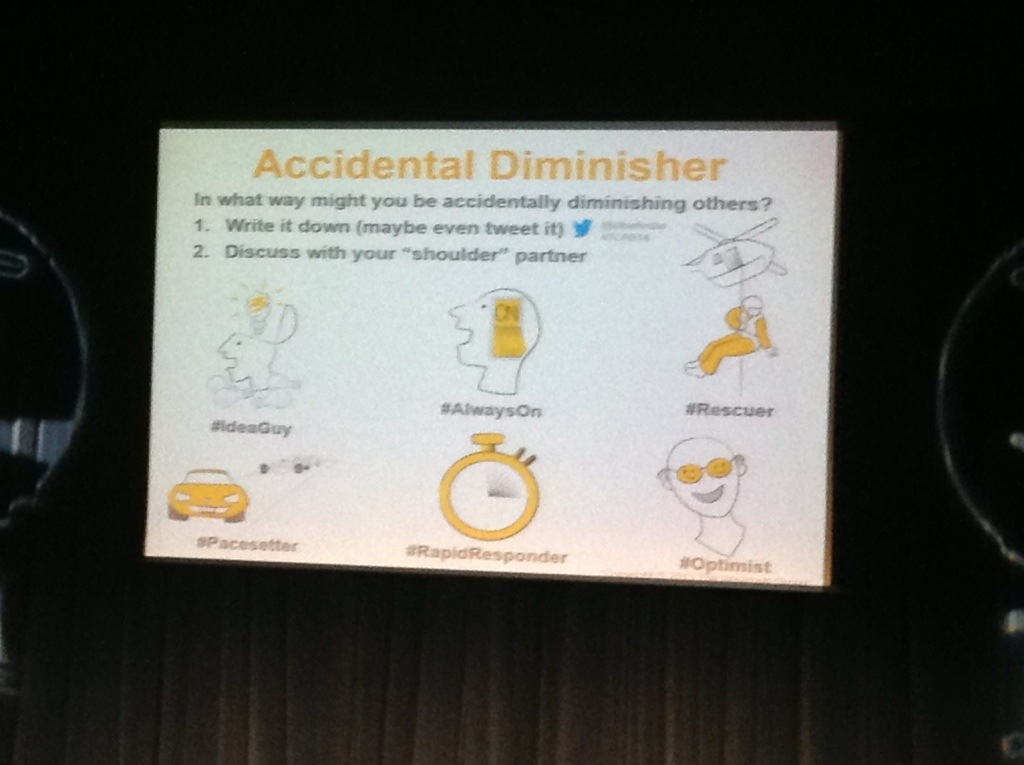
Elise talks about accidental diminishers, and habits to avoid. Ideas-guy has 15 new ideas by lunchtime and people are confused, can’t keep up with the idea du jour. Always-on thinks his energy is contagious but people switch off. The rescuer hates to see people fail, so they wade in to help, which shuts down people’s independence and takes away important learning experiences. The pace-setter thinks everyone will follow their lead, but if they get too far ahead people give up trying to keep up. Rapid responders make decisions quickly but people need time to get used to things. The optimist has plenty of positives to say but that can be exhausting for everyone else.

20140322-101612.jpg

How to avoid this?
Shift from answers to questions. The best leaders don’t have the right answers, but they have the right questions. Elise gives us some other tips for being better leaders in our classrooms and schools, a sort of homework for the week, to work on one diminisher habit this week. Be a genius maker!

Posted in tlab14 | Leave a comment

The Development of British Democracy

We decided, a few years back, to have a go at teaching this to year 9. We like to have a couple of chronological units in each year, but year 9 was lacking and I think we’d all got a bit tired of teaching a cut down version of Medicine Through Time. So, we had a go at this. Typically, it didn’t work terribly well to begin with, but I tried it again at the end of last year with my amazing (and very pliant) year 9 class, who were able to give me some great feedback, and then again this year, when it required further tweaks to take into account the new setting imposed on our groups – I now teach one enormous top set and two tiny bottom sets, after 10 years of more or less mixed ability, which is a whole blog post in itself.

I’ve now reached a stage where I thoroughly enjoy teaching it, and am sorry I now have to wait until September to have another go. I was concerned that some of the lower ability students might struggle, and I think it is fair to say that they didn’t all develop a good understanding of the development of democracy over time, but there are so many excellent stories in this study that they were all able to make some of that all-important progress by explaining various events in detail. Meanwhile, the brightest of my top set were able to select key events based on a variety of interpretations, which is a good win.

Here are the topics we cover:

Lesson 1: Our current system of government; what is left-wing/right-wing?

Lesson 2: Stage a mock election – this is an excellent ice breaker for the start of the year, allowing for meaningful group work and there are probably great citizenship links in there too that I neglected to focus on directly

Lesson 3: King John and the Magna Carta – after a quick consideration of people’s rights and responsibilities in the feudal system, we compared two old textbooks to help us work out why it was signed; then Schama’s History of Britain with Tony Robinson’s Crime and Punishment to help us consider the impact.

Lesson 4: Simon de Montfort and the Provisions of Oxford – I have a card sort for this that involved ordering chronologically and then (with more or less scaffolding, as necessary) pulling it together to explain why the Model Parliament was launched.

Lesson 5: The Peasants’ Revolt – we start by comparing this to the poll tax riots of the last century; then there’s a role play, with a part for Johanna Ferrour after last year’s SHP.

Lesson 6: The Civil War – students study the Civil War as a depth unit in year 8, so they already have some background knowledge of the intricacies of the power struggle. This lesson puts it into the context of Magna Carta.

Lesson 7: The Glorious Revolution – this fills in the gap between the curbing of royal power with the Civil War and the important changes of the 19th century.

Lesson 8: Peterloo and the Great Reform Act – as part of their study of the Industrial Revolution in year 8, my students will have covered the three reform acts and the growing number of people able to vote; this lesson therefore is about some of the agitation that took place to provoke a change in government in the first place. There’s also a great opportunity for looking back here, because through their actions before and after Peterloo, the government were breaking some of the key points laid down in the Magna Carta. That got some students a bit riled up.

Lesson 9: The Ballot Act – here’s an excellent opportunity for a local aspect, because we have a close of houses that was built by a parliamentary hopeful as accommodation for workers who had been thrown out of their homes for not voting for their boss. Therefore, the secret ballot was clearly very important for the people of Westbury, and the lesson is all about national changes in a local context.

Lesson 10: The Suffragettes – the last piece of the puzzle: how women got the vote. I used an old GCSE sources paper to cover this, which formed part of the assessment for the top set.

Lesson 11: Assessment – I set my question, in the style of a GCSE or A-level essay question, as “‘The Magna Carta was the most important event in the development of British democracy.’ How far do you agree?” With hindsight, this needs a bit more consideration, at least for the lower sets, who struggled to make the connection between Magna Carta and our current parliamentary system.

I think the study hangs together very coherently. It sets up some important things for GCSE – notably Peterloo and the Suffragettes which are both part of the Crime and Punishment unit; it ties together some key events we study lower down the school; and it has inspired me to plan a new unit on Medieval power which I am currently teaching to Y7. My working title is, “What was the biggest threat the the Medieval Monarchy?” which I feel is going to be broad enough to bring in all the things I want, from the Crusades to the 100 years war to the Black Death. The inspiration for this can also be laid at the door of the White Queen and World Without End, the dramatisations of which have encouraged me to learn more about the monarchs of the Middle Ages and their problems. But, that’s a post for another day.

Posted in History | 1 Comment

Autumn Wins

I have really enjoyed reading a broad variety of #nurture1314 blogs over the holiday. I intended to write one for myself, but I find it difficult to consider the new year as a turning point at work. I like to keep my January new year for focusing on my life outside teaching, such as it is, and then enjoy all the freshness of a second new year in September to consider my teaching.

Before I realised that, though, I did spend some time thinking about what I would write in a Nurture post. Thirteen things I haven’t already mentioned? Fourteen goals? That’s quite a lot of stuff. It did make me consider what I am pleased with since September that I haven’t blogged about yet, though. Here we go:

1. Purple pens

There’s nothing in the colour. I just like purple, and History was purple on the NC when I started teaching; and I like stationery. I bought a set of purple pens (and a really snazzy pen tidy so I know when I’ve got them all back at the end of a lesson) to use for peer assessment, in the first place, and then I decided I would use them for DIRT. To save you having to Google that, like me, that stands for Dedicated Improvement and Reflection Time. I read about this on Twitter (presumably) and it chimed in with the work I’ve been doing with Neal Watkin’s TOWER model to some degree; so, beginning with my year 10s, students started using the purple pens to improve their work based on my feedback, using DIRT given at the start of a lesson. Now my KS3 students respond to my green marking in purple. They are eager to do this – more so than before they had the purple pens, oddly. They work for 30 minutes in silence on it with minimal coaxing, and I feel all smug knowing that they are working independently on personalised targets. Then when I red mark their books* it takes me half the time and they’ve almost always improved by a sub-level **.

I shared this at a Hums faculty meeting last term and, on Tuesday, my HoF went round the faculty handing out boxes of purple pens. I hope it works for everybody as well as it has for me. I was chatting to my very experienced History colleague on Thursday and he said, “It makes such perfect sense! Why haven’t we done this before?” He’s normally seen every new idea at least twice during his career (and not in a smug way) so I was quite pleased about that.

2. Writing more

Steve Mastin suggested at SHP in July, getting students to complete tasks that are much more challenging than those they might encounter on their exams, thus making the exams look like a cakewalk. Brilliant. Last year I did this throughout year 10 to encourage them to plan and write longer essays , which has helped them to cope with the demands of the controlled assessment this year, so I have continued with that; I have also started setting my year 12s long essays based on exam board questions. The feedback they get from me on this is not specifically tailored to the markscheme; but then they take the essay, and my feedback, and write a timed exam answer using only the best bits. It has helped them, I think, to focus on maintaining their analysis, and I can correct factual inaccuracies and misunderstandings in a more meaningful way.

3. Democracy Unit

Blog post pending on this one; I am now onto my third time through of a year 9 chronological unit about the development of British democracy we first trialled several years ago and I feel like I’ve finally cracked it. I’ve also LOVED reading more about the various events we cover.

4. Rise of the British Empire

We restructured KS3 a bit this year and I was in the middle of floundering around with a Rise of the British Empire topic when I went to SHP London in November. I was really taken with the enthusiasm shown for the 18th century by Alison Kitson and it really helped to crystallise the topic for me. Unfortunately time limitations meant that I wasn’t able to do everything I hoped with it, but I feel like my year 8s are experts on the impact the British Empire had on Britain and now have masses of context for their study of the Industrial Revolution. I am really excited about teaching this topic again in the future.

5. Achieving UPS3

Just squeaked in before it went. It might not last: the amount of boxes that need ticking to maintain it feels quite challenging, and if I move schools….but, anyway, it was nice to pass.

6. Being a teacher

A restructure last year deprived me of my TLR for AGT. I was anticipating it and remain quite stoical about it; no other local schools have had a paid AGT post for a while and we’re all facing a challenging financial climate. From September I returned to being officially mainscale. I was quite worried about the significant bump in hours: a combination of losing management time and the increase in teaching load across the whole staff which came this year. It hasn’t been a problem though. Not really. It’s just making the year go so quickly. Meanwhile I have loved concentrating on my teaching and on development within the History department: it has felt like a real treat. Sometimes it’s frustrating being so out of the loop but then AGT is a funny post and so I was never quite in the loop, anyway. I remind myself of the advice of an outgoing AHT: “What it comes down to is, when you kick the door shut and it’s just you and your students and your lesson…that’s what it’s about, really.”

7. Revision App

Following on from the revision guide I wrote for Hodder, which was published in January, I spent the autumn working on the content for an app to accompany the SHP series; it’s not published yet but here is its twin for Modern World. It was very exciting because it covers the Crime spec, too, which is quite unusual, there being not enough Crime entries to make it worthwhile publishing paper materials. I also got to work with the mighty John D Clare, who wrote the Germany content. I’m really looking forward to seeing the finished article and sharing with my students something I wrote that they can use for their revision. Other than the GCSEPod content, of course.

That’ll do, I think!

When I started my work blog I did try, for a while, to post weekly wins. Then, when I couldn’t keep up with that, I tried to at least tweet for Pedagoo Friday. Sometimes, though, it’s hard to find the headspace to clearly see the wins at the end of a long Friday. There seems to be a penchant in my social circle at the moment for jars, into which one pops nice things and wins as they happen; perhaps I should start keeping on of those.

* Look, I think it might be mild OCD. I like to do my formative marking in green and my summative marking in red. I am extremely picky about the type of pen I use, as well as the colour. I like homework tasks to be written in a yellow box on the right hand side of my slides, and I am unhappy drinking coffee at work out of anything other than my Scrabble mug. I find it better just not to pick at this thread.

** Yes, still using those.

Posted in wins | Leave a comment

Christmas History Lesson: World War One

Because we’re the only history department in the country (probably) who doesn’t teach WW1 at the start of year 9, it meant that this December we were coming to the end of our WW1 study and therefore I was unable to steal wholesale Richard Kennett’s excellent austerity WW2 Christmas lesson. Instead, I set out to plan my own “Christmas in the trenches” lesson.

I decided to focus on the famous 1914 No Man’s Land football match, so off I went to read a bit more about that. I struggled to see how I could make it meaningfully last an hour, though, short of getting them to make newspaper helmets and go out on the field to recreate it (not sure how meaningful that would have been).

However, after a bit of reading something took shape for me. The interesting thing for me about this unofficial Christmas Day truce was that the officers were against it, the censors removed references to it from letters (which means it’s a bit secretive) and it was not repeated through the rest of the war. This was because they didn’t want the British public, let alone the soldiers, to think of the Germans as like them, because it would be impossible then to effectively wage a propaganda war against them and convince the soldiers to be as brutal as was necessary.

With the censors, I had my hook. After using Rich’s suggested video clip of Christmas in Afghanistan as a starter, we looked at a range of sources of information about the Christmas truce, starting with the scene from Oh What a Lovely War, and the trailer for Joyeaux Noel (which seems like a French version of the truce story but rather misses the point by suggesting that “this event changed everything” when, actually, it doesn’t appear to have changed anything, but that’s the film industry for you – and I am making a snap judgement based on the trailer). After that I distributed packs of information snippets I had slurped up from various websites, and students wrote a Christmas letter home about Christmas day in the trenches.

That probably lasted for a good 35-40 minutes, and then came the fun bit. I explained that the censors would not have allowed mentions of the truce to go home, and we discussed why that might be. Then students swapped letters and received a highlighter or a marker, as was their wont. Their next task was to censor the letter, redacting any mention of the Christmas truce. Some students were horrified to receive their letters back with almost the whole text coloured in, with only “Merry Christmas, I miss you” visible at the bottom.

I was pleased with my effort: it was seasonal, it was meaningful, and they got a good whack of knowledge about trench warfare and propaganda that they might otherwise have missed. I felt even more successful today when a student, during a discussion about why the government introduced conscription in 1916, wondered how people were put off joining the army by the terrible stories reaching Britain when the censors had been at work on letters home from the trenches.

Slides as a PDF WW1 Christmas lesson (the PDF creator didn’t like my first slide much so the text is a bit wrong…it didn’t look like that on the slide). Snippets from websites WW1 Christmas info.

Posted in History | Tagged , , | 1 Comment

Georgians Revealed Exhibition

Now that I have just about finished teaching about the 18th century, with some spectacular assessment pieces from my clever year 8s about how the British Empire led to some of the significant changes in this period, I am reviewing my scheme of work and it is a good time to be reminded of the Georgians Revealed exhibition at the British Library on Euston Road. I mentioned this in my first blog post from the SHP day conference but unfortunately I had to rush off that day and didn’t have time for a good wander around (just as well, I would definitely have bought books and then had to lug them back to Bristol on the train).

I am happy to note that the exhibition is live all the way through to March 2014 so I am looking forward to going at some point between now and then, to help me fill in any gaps in my scheme of work and get some extra “nuggets” to make it even more appealing next time I teach it.

Posted in Uncategorized | Leave a comment

Christmas History Lesson: Mussolini

Inspired by Richard Kennett, I’ve been concentrating on quality History Christmas lessons this week.

I teach AQA’s “Mussolini’s Italy: A New Roman Empire?” in Y12. We’ve had a cut to teaching time at A-level this year so my share has gone down from 5 contact hours a fortnight to 4; this means that my usual Christmas offering for Y12, which would probably involve some kind of rambunctious answer-grabbing or a factor auction to consolidate knowledge, needed to be adjusted slightly to ensure we can cover all the content before the (very early) exam. Still in a slight panic if I’m honest, as we’re already three weeks behind where I was last year.

Enough bellyaching. I decided to teach a lesson based on the Opera Nazionale Dopolavoro’s approach to festivities.

dopolavoro

The OND, or Dopolavoro as it seems to be more commonly known, was arguably the most successful aspect of Fascist provision. Launched in 1925, it seems to have been some sort of giant PTA – quite literally if some authors are to be believed, because it attracted a lot of teachers amongst its organisers – whose job it was to provide fun with a Fascist undertone. “Look how much fun you’re having!” it pointed out, regularly, “and the PNF is paying for all this! This is way better than your rubbish old trade unions.” Consequently it all but monopolised amateur football, provided drama and theatre groups, cheap travel, opportunities for group excursions and so on. Thus, even though living standards fell thanks to wage cuts of 25-40% during the Depression, lots of people felt positive about the PNF.

Here’s what I did:

1. I provided my class with a set of notes (OND notes) taken from the text, in short paragraphs, widely spaced. Normally I would ask them to do this reading themselves but they are feeling the end-of-term squeeze so this is my Christmas present to them.

2. I added a reading from a text I found on Google Books, to show the broad variety of activities the OND organised for people.

3. We discussed the opinions of two historians on the success of corporativism, to recap on last lesson. I paid particular attention to Tannenbaum because of his suggestion that it held divergent forces in Italy together; my contention was that one shouldn’t generalise, because economic policies such as the Battles drove them apart (especially by widening the North/South divide) but the OND is an economic policy which brought people together.

4. After the starter, we talked about what a Fascist Christmas celebration would include. The class came up with: Mussolini (we thought maybe a reading of the famous “Duce” poem set to Jingle Bells); sports; a heavy dose of Catholicism; lots of Cult of Romanita propaganda; and possibly some wheat-based foods to celebrate the Battle for Grain. They haven’t covered foreign or social policy yet so we didn’t consider Empire or family time, both of which would have featured strongly, I think; I prompted them to include a program of welfare for the needy.

5. In groups, they created a plan on flipchart paper which they then presented back to the rest of the class.

This helped them to focus on the propaganda aspects and attempted fascistisation of the Italian people that was taking place in the 1930s. We had soup kitchens, tug-of-war with a giant cracker, Mussolini riding topless on a reindeer, a wide selection of Fascistised Christmas carols, excursions to the tomb of Santa Claus*, lots of references to wheat and wheat-based recipes and many church and sport activities. There was even a mention of a national Mussolini Christmas card – you open the card and Mussolini’s face pops out. I reckon the Dopolavoro would have taken that one to their hearts.

The exercise was, of course, rife with anachronisms – their lack of general knowledge about Italian Christmas traditions hampered them, but I think I can forgive them for that. I was able to brush up, handily, by watching Nigelissima last night. Fortuitous.

* I read in a travel magazine that his body is embalmed somewhere in the south of Italy, where it apparently emits some kind of weird fluid which is bottled and sold. Festive.

Posted in History | Tagged , , | 1 Comment

TeachMeet Post-16 at City Academy Bristol

We begin with a keynote from Mark Anderson, who gives us some background on teachmeets and how powerful he thinks it can be. The numbers stack up – if the 670 teachers who attended TeachMeet in Clevedon teach 8 classes each, the impact could stack up to 160,000 students! Wild.

Mark suggests positive learning characteristics – independence, organisation and skill. Independence: help them to work independently for extended periods of time, to ensure their revision is planned and thorough, research effectively using tools like Pinterest, and use past papers independently of your classes. Organisation: working to deadlines, use online systems to organise notes and folders, use social media to keep them on task during extended assignments, get your message across through things like digital signage and Edmodo. Skilled: offer byod to improve listening and note taking, encourage use of online tools like Socrative and blogs for problem solving and collaboration, offer a variety of tasks to engage across different learning styles, improve personal responsibility with a system like ClassDojo.

A few more ideas: live tweet your class and use Storify to create a permanent record of it. Use Padlet to allow students to share comments and resources during a lesson. Write raps and record them on Songsmith – a free tool through Microsoft partners in learning. Give out poker chips which they have to spend on questions. 3D essay planning: get a template for a dodecahedron and get students to map out their essay on it. Use Evernote to share notes. Speed dating or musical chairs to critique each other’s work. Use student voice: we asked, you said, we did – encourages partnership in learning. Slides available on Mark’s blog – or buy his excellent book!

Isla Johnson from Oasis John Williams, talking about stretch and challenge for post-16. Many came from the Challenge Toolkit on TES. Use de Bono’s Thinking Hats for individual students to review their essays. Give students a figure from whose point of view they must write/argue/think. Give some random words and ask students to make links. Use Bloom’s to encourage students to ask better questions. Isla uses big questions in her lessons now to encourage challenge.

Matt Pullen from CAB speaks next on supporting learning beyond the classroom. Use cloud-based systems like Google Drive to share work and feedback. this encourages students to make corrections and update their work. Use iMovie to introduce new topics: signpost content. Shadow Puppet: an app that will record the discussions that go with various images shown on screen.

Jamie Goddard now from Chepstow, talking about flipped learning. He’s fresh from a flipped learning conference at the start of the week. I also heard his colleague Dave speak about this at TMHistorySW two weeks ago so, with apologies to Jamie, I won’t replicate it here.

Marie Hazel from CAB next on SOLO taxonomy. Marie is doing a Masters in Science Education and has been using SOLO to structure her approach in class. This helped her to ensure her lesson plans were properly tailored to the flipped learning her A-level biology students were doing. She also uses the accelerated learning cycle to build the lesson plan. Marie then shares details about SOLO (again, with apologies, I won’t share here what I shared last summer after SHP – I can only blame the low battery level on my phone!) Marie has sythensised SOLO, Blooms and the Accelerated Learning Cycle to improve progress among her students.

Emma King from St Mary Redcliffe next on AfL. Emma uses bronze/silver/gold target setting and students peer assess each other’s notes and classwork. I like the idea of setting targets for a flipped learning homework and then beginning the lesson with peer assessment of the task. Emma also uses a proforma where students self-assess their essays before they had them in. She awards peer assessment stars as well to show that it is valuable and to ensure they were very clear about their criteria.

Next, a student film from Oasis John Williams. The context is that students need to be given clearer guided learning hours now in a sixth form (640) in order for schools to retain full time funding, so these two students, who hold leadership roles within sixth form, are presenting a video on what they do for their hours. Volunteering – can include being a reading buddy, or doing a primary school placement, or working with small groups of students within lessons. Work experience. Pastoral program.

We continue with a presentation from Kath Cooper who is head of post-16 at Oasis John Williams. She makes the point that knowing the context of your students is vital and at OJW they think of themselves as gap-bridgers. They use data to track underachievement. They also use subject teachers to fill the pastoral care gap – flag up issues and seek guidance if unsure: this, along with other pastoral support carefully sign-posted, has improved attendance, attainment and behaviour.

The final presentation is a video from CAB catering students. It’s great to hear their positive experiences completing their catering course: running Bistro, for example, which is an open restaurant on the site which students run.

A very enjoyable and inspiring TeachMeet!

Posted in teachmeet | Leave a comment

SHP25: early reflection

My brother’s lamentable absence from his convenient London flat tonight provides me with a rare opportunity to reflect on today’s excellent conference. It was really quality stuff, all of it, and maybe even more helpful than the summer conference – less to absorb and coming at a time of year when enthusiasm is flagging in the face of mocks, controlled assessment and data scrutinising, coupled with more natural energy drains like the darker days and grey weather. There are many things I can take back that will have an impact on my practice, but I think Alison Kitson’s session on the 18th century is going to be most useful because it will change some of my lessons this week.

When we reconsidered our key stage three programme of study in July, we decided to adjust year 8. We’d always been a unit light here and all filled the gap with something different, but the decision to move the Civil War unit to year 7 made the situation rather more pressing. We had also identified a gap in student knowledge when they arrived in year 9: when teaching the causes of WW1 they struggled to comprehend the impact of the crumbling European empires, or, indeed, the role of empires at all.

We decided to adjust our study of the British Empire. We split the unit in two, to look at both the rise and decline. The rise comes first, with the working enquiry question, “What impact did the British Empire have on Britain?” This then segues neatly into the Industrial Revolution, allows for a world study encompassing the America revolution and civil war, and can then be rounded off with a collapse of empire study at the end.

Having taught our usual year 8 opening chronological study on the history of Britain through art, I have been working on the rise of Empire for four weeks, so roughly 6 lessons. It has proved difficult to resource. There’s not much out there on the impact on Britain of its colonies. I gave up after a frustrating 20 minutes of Googling, after having been met with site after site detailing the impact of the Empire on insert-colony-here. I’m sure there’re actual books out there about it – so I will be better prepared for next year. In the meantime I trawled old text books for material not focused on interpretations, and chalked up quite a success after a lesson on British taxes on Indian cloth was met with a, “OH so that’s why we ended up with more cloth factories here!” comment from Fraser, my resident year 8 Industrial Revolution buff.

But, inspiration has petered out a bit. I was toying with the idea of doing forced child migration and Barnardo, then looking at children left in Britain during this time, inspired by an episode of British History in Numbers on Radio 4 (podcasts still available – highly recommended if you’re a bit of a stats geek like me). I was left with a nagging feeling that I was missing something, though, especially since, for the first time ever, I am teaching top sets in year 8 this year^. I wanted to give them a better understanding of the state of flux.

Alison’s presentation today, then, couldn’t have come at a better time. Clearly the biggest impact of the Empire was in terms of wealth, which I have tried, and largely failed, to express through my examples in lessons thus far. Looking at the growing wealth gap in Britain and the creation of the Middling Sort, alongside the changes in agriculture and the squeeze on the working class (I can bring in Ian Dawson’s Corn Laws activity here #SHPMashUp) provides me with the perfect link for the two units. There’s only so far one can go with the impact of Barbadian sugar, Indian tea and cotton and African gold, but looking at the bigger picture* is where the real story lies. As I mentioned in my post, too, I can have the tea thread running all the way through, from the growth of tea plantations in India to the tea drinking classes in 18th century England to the cup of Earl Grey in the Great Reform Act lesson.

So, the devil is not in the detail in this case! This week’s lessons will focus on 18th century changes and the tastes of the population, in both tea and other Empire goods such as that mahogany tea table mentioned in the first reading we had, and the deteriorating living standards among the poor, leading to the growing agitation for a voice, among the middle and lower classes. This then leads into the political changes.

I love it when a plan comes together.

^ we’ve not set in history before, but are timetabled against English this year and are using their sets. Across key stage three I have three top, one middle and four bottom sets. It’s been very interesting, and probably worthy of a blog post in itself.

* I quite often find myself unable to see the wood for the trees in this way.

Posted in shp25 | 1 Comment

SHP25: Michael Maddison

A regular at SHP is the HMI national adviser for History – what would we do without him? He’s very generous with his time and always shares useful and insightful things. I fear I never spell his name correctly, though.

It turns out Michael is a fan of the 18th century, having taught it at ks3, o level and a level.

We look at some political cartoons to begin with and consider the way historical figures have been characterised in them.

Michael’s slides will be available on the SHP website and it’s all about history in schools. It’s a very mixed bag. In primary, history is better taught when taught discretely. Knowledge is episodic and chronological understanding is shaky. H shares an example from a primary school who are attempting an enquiry based system, showing real willingness to engage with the pedagogy, and pleads with is to develop closer links with feeder schools, which is timely because we are off to a feeder school on Tuesday afternoon to teach a master class to year 6.

At secondary level, history is a success story: well taught and well led. Attainment is high and entries are rising.

20131130-152242.jpg

I do love this graph and it is always worth looking at again. The 2013 data will show an even greater increase. The picture is the same for A level. Something is definitely going well, no matter what the headlines say.

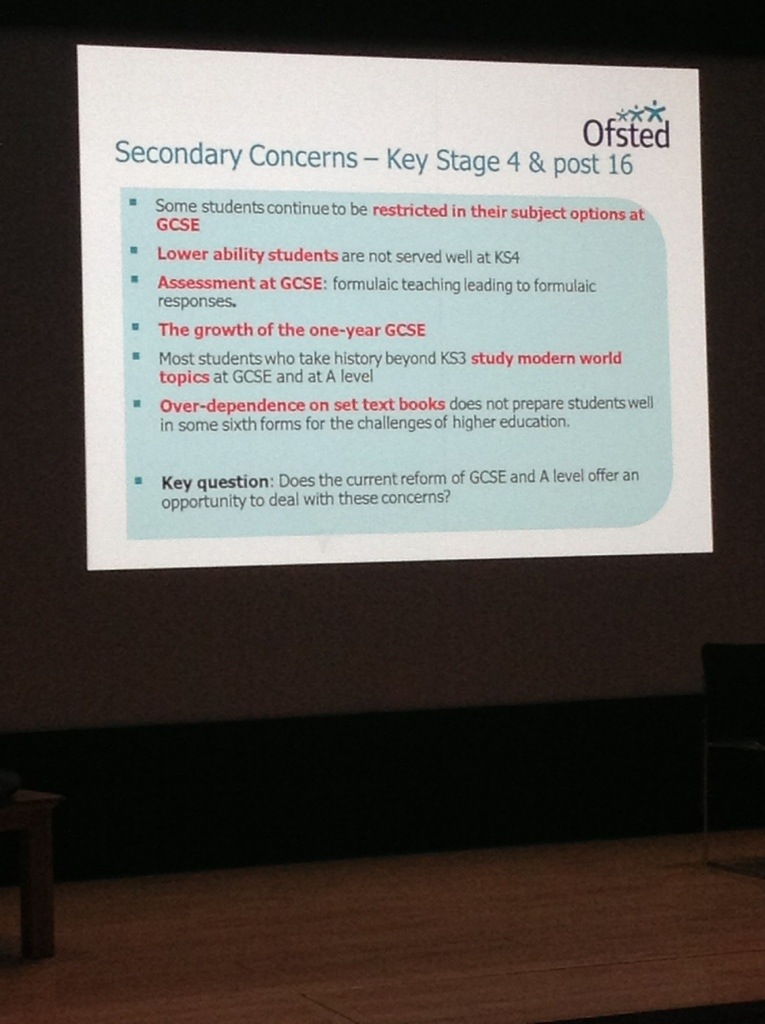
But, issues. Non-specialist teaching – 28% with no relevant degree. Change to two year key stage three, or competencies. Reduction in teaching time. Insufficient emphasis on analytical and discursive writing development: too much descriptive and creative writing. Poor planning for progression – tying in nicely with Ian and Richard’s session from earlier. Misuse of levels of attainment. The failure of some subject leaders to provide a rationale (ditto). History has become marginalised; standards are too variable and progress is not fast enough.

We critique a two year key stage three program of study. Someone comments that the chronology is all over the place – do people really think that teaching units in chronological order helps them to understand chronology better? I don’t.

Michael talks about all/most/some and says it is a huge cop out in terms of differentiation, and his colleagues in other subjects agree. This is partly because it creates homogenised groups; the associated descriptors are often trite.

20131130-153644.jpg

Re: one year GCSE – apparently heads get students to take both history and geography in one year and take the best grade for ebacc. Horrifying! We whizz through our GCSE course to be ready for revision by January of year 11 but I don’t think we could go any quicker.

Onto highly effective teaching. Good subject expertise, rigorous enquiry, good historical thinking and understanding, solid assessment. Michael bypasses the skills vs knowledge debate with barely a raised eyebrow in its direction. Developing historical thinking: Michael uses an example from a primary school where they study Samuel Pepys and are able to develop an understanding of that uncertainty in history (case studies available on Ofsted website when they have finished being reviewed, along with all other documentation, to check they don’t promulgate a particular teaching style, in line with Wilshaw’s wishes).

I’m a bit distracted by this news for a moment and by the time I get back to concentrating we are considering data which shows GCSE outcomes for SEN, ethnic groups and FSM, as well as breaking down entries by area – there are more in the east of England than anywhere else, for example. Links are expressed between history and English, and the importance of better literacy.

What can the inspectorate do for you?
There’s a dedicated subject page on the Ofsted website. There are lots of case studies there, and a training resource to use in subject meetings with some helpful questions to ask.

The new key stage three offers lots of opportunities. Can you sign up to the spirit of it? – even if you don’t agree with the way the content or aims are expressed.

Some ideas about challenges. A movement away from what we teach but instead how we teach it – we need to plug into modern scholarship much more.

20131130-160125.jpg

We are invited to email Michael with answers to this question by Easter, so he can use the information anonymously in his session at the HA in May.

20131130-160511.jpg

Michael shows us the seven myths of Ofsted’s view on history teaching to finish, and a clip from Horrible Histories – Born to Rule by the Four Georges.

Posted in shp25 | Leave a comment

SHP25: Stretching A level students

Diana Laffin presenting on A level teaching, using a study of Lloyd George. Diana sets us a starter task of look at a statue of him being unveiled by Prince Charles in Parliament Square and asking us to guess when it was unveiled. Turns out it was in 2007 and it’s an interesting interpretations exercise to consider what other statues there are in Parliament Square and when they were put there.

Is Lloyd George Britain’s best PM? He had a lot of impact on normal people. He made a great speech when he said that the cost of running a duke is equivalent to two dreadnoughts. He had a film made about him during his lifetime – the first one.
Why did it take so long for him to get a statue, then?

We begin with an art exhibition of images of Lloyd George, from which we must make inferences about him. This helps students to pose questions about him – we generate some of these and share them. Diana uses the questions to help plan the enquiry, using some of them as research homeworks.

Now, onto pants! You can choose the big safety pants: cover everything in extreme detail, fill in the blanks study packs full of exam criteria. They keep management happy and make you feel safe but will they encourage and enthuse your students? Sometimes the sexy pants have to come out to solve this problem: student-led learning, lots of random sources etc.

Most able students. Diana shares her definition of a gifted historian – this would go nicely in the front of the assessment booklet we are planning to make up for our sixth form students.

Should we bombard with past questions in case they come up? Diana says that the problem of doing this is that students might go into the exam and see a question they think they’ve done before, and regurgitate the answer, only there is a subtle difference in date or focus and they won’t do very well. So, it’s important to teach them the skills of applying the knowledge to different questions.

Diana shares some readings she gives out for homework. She differentiates readings among her students and in the next lesson the form seminar groups to discuss the learning from the articles and then come to a developed judgement at the end – not a conclusion, because there are always variations, qualifications, developments on those judgements. We discuss the different readings and come up with an answer to the question, “Why does he have a statue there and why did it take so long?”

Diana recommends moving as much knowledge acquisition as possible outside of lessons. She suggests calling it “prep” and shows us a log sheet for students to complete about their readings, which she backs up with positive reinforcement by lavishing time and interest on students who do the reading. One in three lessons is a seminar style lesson such as the one we modelled in today’s session. Think this would work especially well with the year 13 students.

We return to the question. Diana enthuses about the History of Stamps book she receives recently, which she says she did not expect to find so interesting. We look at a stamp of Lloyd George, depicting him as a young man. We return to the film, which was a huge and expensive project, directed by Maurice Elvey. Unfortunately it was rubbished by a commentator who wrote that it was made by nasty immigrants (children of Jewish refugees) so Lloyd George bought everything to do with it, at a cost of £20,000, and it wasn’t released until 1996 when a descendant came across the materials. It is very useful to watch as an interpretations exercise, although it can be a challenging process.

Supporting the rest. Encourage self review and make it clear that everyone benefits from identifying and acknowledging things they can improve. Make literacy big – key terms and vocabulary at the heart of your study. Here have been some lunchtime support sessions but they are not always popular and can put students off continuing with their study of the subject. The results of Diana’s study of what works with support showed that students like to feel supported – worksheets and readings and all that can only go so far, but it is the fluffy, supportive environment that they appreciate the most.

Posted in shp25 | Leave a comment