Setting HW on Moodle #1

School’s VLE of choice takes the form of Moodle. I have been looking at setting homework through it, particularly for my year 10s, who I think are finding the jump in the amount of HW they get this year quite difficult to cope with.

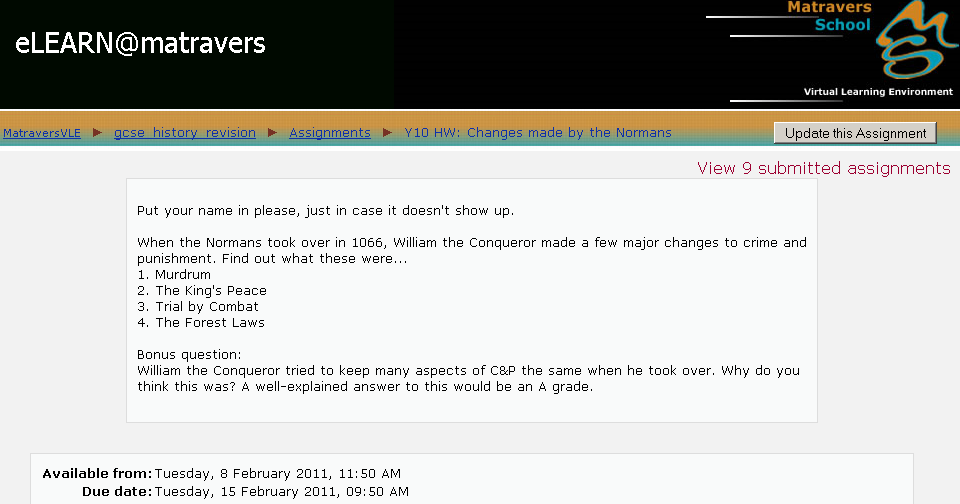
Students across all year groups are set their ICT work through Moodle so they are alrady familiar with how to use it. This week I set them a research task as an online assignment. It looked like this:

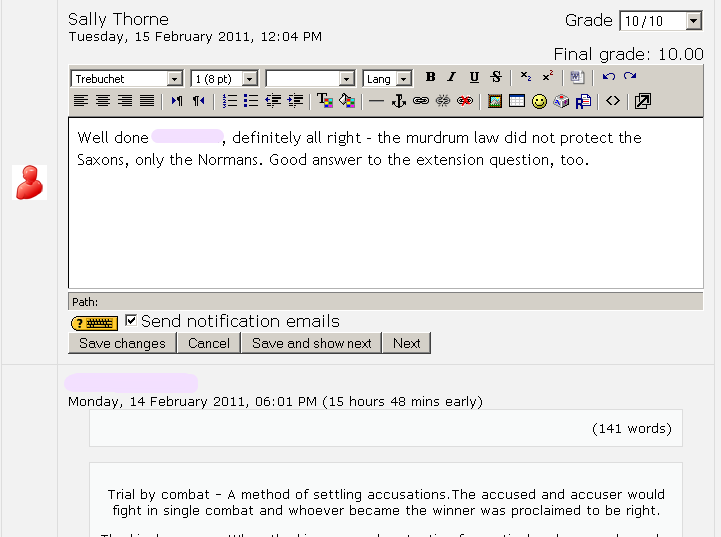
Students were able to click on the assignment and type their text into the box provided, and then hit submit. I then marked the assignment online (some before the lesson, some in the lesson while the students worked on an assessment task) and provided individual feedback.

Here’s how I did it:
1. With editing turned on, select “Assignment – online text” from the “Add an activity” dropdown menu
2. Give the assignment a name and add a description. I liked this bit because it meant that the students didn’t have to write down all the instructions in their planners, since they are on the VLE.
3. Choose a grading scale. I made mine out of 10. You can choose to have no grading scale.
4. Choose the dates the HW is available for. This would allow you to schedule homeworks ahead of time. You can also choose whether to allow HW to be resubmitted – after you’ve marked it, for example – and whether you get an email alert every time an assignment is submitted.
5. Click “Save and return to course”. The assignment should now appear on your Course page.

When you’re ready to mark the assignment, click on the link to it from the course and click “View .. submitted assignments” in the top right hand corner. There is an option to grade each piece, and you can also add feedback here.

There are dozens of helpful Moodle tutorials out there. I like to use these.

Posted in HW | Leave a comment

GCSE Success Criteria in History

I’ve been studying for a Geology GCSE with some year 10s after school for the past year and a half. As you might imagine, what amounts to a weekly observation of a teacher from another faculty has had a big impact on my practice, especially in terms of sharing success criteria.

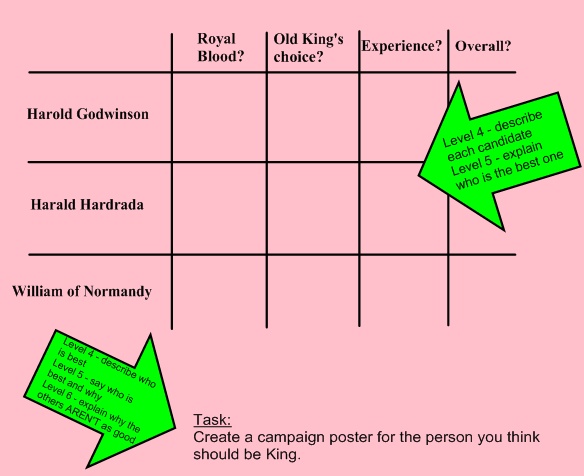
We’re big on success criteria at school these days. I’ve struggled a little bit to see the wood for the trees, in that I can easily share my lesson objectives, but expressing these in terms of a level or a grade is more difficult. Key stage 3 has not been such a problem. I have started to include big arrows on my slides for every activity, like this:

I discussed this with my Y8 classes when I started doing it and they were very positive about it. I think it needs some tweaking, perhaps to include a low level 5 and high level 5 instruction, but it’s a good start.

However, I struggled with KS4. We spend a lot of time learning facts and less time on exam technique, especially in year 10. My lesson objectives are split into Knowledge and Skills, with Knowledge being by far the bigger part. I was stuck on how to translate this into GCSE success criteria.

The GCSE Geology lesson slide always has success criteria on it, laid out as follows:
A grade: I can use all the different methods for identifying a mineral and use a full description to analyse it.
C grade: I can….
(being a keener, I never write down the C grade criteria).

I firmly convinced myself this could not be translated into a History lesson. What does C grade knowledge look like? And A grade? Well, they can look the same because it’s what you do with it that counts. I was in serious danger of becoming whiney about it. To try to prove my point, I sat down to write success criteria that was skills based, to show that it worked for that side but would not for knowledge.

Here’s what I wrote:
A grade: I can explain two reasons why the Homesteaders had problems on the Plains, backing up my points with precise knowledge.
C grade: I can describe two problems faced by the Homesteaders on the Plains.

On reading back over it, I realised I had actually done what I said could not be done. I hate it when I’m wrong, especially when I am the one proving myself wrong! But there it is.

I’m going to start keeping a blog post of the success criteria I use as we move through the Crime and Punishment study of GCSE History, so check back in if you’re interested in seeing what I come up with.

And thank you, Phillipa.

Posted in Success Criteria | 2 Comments

Classroom Kindles: part 1

In the autumn term I started to think about Kindles in the classroom. I was getting tired of photocopying the same sheets every year and having them ripped, graffitied or thrown away by the students using them. If I had a class set of Kindles, I mused,

  • I could make my worksheets PDFs on the Kindles and use them year after year
  • I could write my own material instead of buying textbooks
  • I could use more complicated words, thanks to the built in dictionary – perhaps this would have a positive impact on literacy

And why Kindles and not something sexier, like iPads? Precisely because they’re not sexy. Black and white screens, not backlit, not particularly useful for anything other than reading….they’re not high on the list of most kids’ desirable kit. I think the chances of a kid walking off with one is quite low.

I concluded Kindles would pay for themselves eventually. Unfortunately I couldn’t find anybody to help me fund my project. Emails from Amazon fobbing me off made regular appearances in my inbox.

Then, in November, I found out the Federation were distributing grants to schools for new technologies. This project involves using something in the classroom for two terms and blogging about it, and then passing it on to another school and trialling something else. I put my Kindle request on the bid and was successful. Hurrah! They are being ordered today: a set of 26.

I have decided to go with the 3G model. Initially I was working on the expectation that I would have wireless Kindles, since they are considerably cheaper. I don’t have wireless in my mobile classroom, but it’s not very secure either so the Kindles will live in the main block and synch when I bring them back up at the end of the day.

However, I changed my mind. Here’s why.

1. Schools can claim the VAT back, which makes the 3G price a bit more palatable.

2. The 3G offered by Kindle is free, internationally, for life. This is an outstandingly good deal, especially since there is a built in (though experimental) browser.

3. Wireless access would mean the Kindles being set up on the school network, which would be several hours of work for somebody. When they go to their next school, it will be another several hours of work.
(There is a small fee for receiving emailed files over 3G so wireless connection is still advisable, but it’s not something that has to happen before the Kindles can be used).

4. The battery life on the Kindle is roughly a month, if the wireless is switched off. Wireless would have to be switched on all the time, or I’d have to go through each one and manually switch it on each time I wanted to synch….yawn. With 3G, I can ask pupils to switch the wireless on in the classroom and they can download the documents. They can then switch the wireless off again. Less charging necessary.

5. We can take them out with us, on field trips, abroad, wherever, and they will still be usable, even where there are no wireless hotspots.

Now I need to start writing materials for them. Watch this space!

Posted in Kindle | 1 Comment

End of term activity: Candy Castles

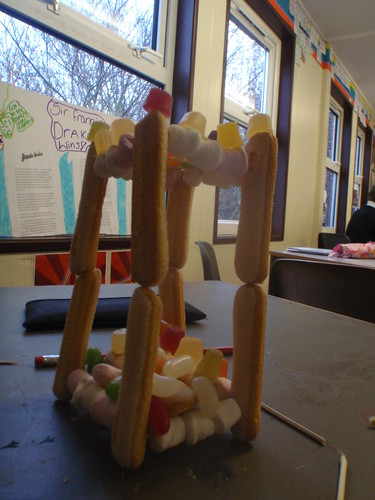
I think pupils do a lot of passive lesson activities this time of year. Mindful of this, I went to the supermarket last night and purchased cocktail sticks, bamboo skewers, sponge fingers, marshmallows and a variety of other sweets, and this morning set my year 8 class a challenge: to recreate a Medieval castle using these sugary treats.

They worked in 2s or 3s. They had to use the textbook (which has a helpful chapter on the changes castles underwent following the Norman Conquest) to design their castle and work out exactly how many of each kind of sweet/stick they needed to build it. I then carefuly counted the sweets out, telling them that I was counting once the castles were finished and if any sweets were missing, I would get to eat the castle. This kept them honest about the quantities they needed and ensured there were enough buildings materials left over for my colleague, who is repeating this lesson this afternoon.

They rose to the challenge well.

Unfortunately I didn’t anticipate how sticky they would get, and had to send them away a little early to wash their hands before their next lesson. I then had to spend a few minutes with a cloth and cleanser, wiping down the tables. It reminded me a bit of the infamous Nutella jousting incident of July. But, I think it was worth the extra effort.

See the rest of the castles here.

Posted in active learning | Leave a comment

Using Google Maps with a class

When I posted the link to the Google Map I made of the homesteaders’ journey west on Twitter, a few History teachers tweeted back something along the lines of, “Great – did the students collaborate?” to which the answer, unfortunately, was no.

It did make me think, however, about how this might be achieved in a school where the majority of students don’t have Google accounts, there’s no wireless in the History classrooms and computer rooms are as rare as hen’s teeth, especially in the last week before Christmas.

The plan I came up with was related to 1066. This unit, which focuses mainly on the Battle of Hastings, lends itself well to a Google Map, being all about the geography, both of the battles and the characters fighting for the throne.

I split the group up into six teams. Each had a topic, textbooks, printed articles from the BBC History website, and a netbook. I had the skeleton map on the board, with the markers in place, though without any text. I talked the students through the task and made the objectives clear, and off we went. The aim was that they would write a short piece for their marker, which could be saved on a memory stick and then transferred to my computer and pasted into the box.

Here is the map they came up with. (Frustratingly I can’t make WordPress embed it. I seem to have forgotten the trick from last time…)

The students enjoyed they task and were rightly proud of themselves for completing it in a single lesson. We have produced a resource which their parents can see and which I can embed into the Moodle. We have also consolidated our knowledge of the unit, ready for the assessment this week (assessments: what children REALLY want for Christmas).

Next time…

  • Everybody in the group needs a clearly defined role and I will aim to give them too much information – there just wasn’t enough for some students to do. This led to some members of the group having some downtime which led to silly behaviour (which led to me being in a poor temper)
  • I’d like to find a way of getting them pictures. I thought about letting them use my phone as a wifi hotspot, to search for pictures; but even though I have unlimited data on my plan I was afraid a lot of searching might lead to a stern letter from T-Mobile about fair usage. If we’d had a little more time they could have taken it in turns to use my laptop.
  • Better spellchecking. I told them to take care (see screenshot) but they ran out of time.

And as an awesome aside to this lesson – I set a big project HW which involved researching Medieval weapons/battle tactics with a creative presentation of findings. One kid made a longbow! Thankfully he didn’t bring in any arrows.

Posted in active learning, GoogleMaps | Tagged , , | 1 Comment

#tmbristol

In a very belated post, I want to talk about #tmbristol, which took place at the Grange School, Warmley, on November 10th.

Vital kindly sponsored the event, and Clare was very helpful when it came to publicising it to schools, and brought plenty of chocolates to munch on! We had about 15 people in attendance, plus another 15 or so popping in and out of the live feed, which worked well once we’d worked out how to switch the sound on 😉 Here is a link to the recording.

We had a wide variety of presentations on new techs in the classroom, from some very usable things I could do the next day, like using a Google form. to bigger projects, like Edmodo – which is definitely something I will be encouraging my year 11s to use with me for revision this year, especially if the snow keeps up.

We also had a good presentation from Julia Skinner on the power of commenting, which I really enjoyed. Julia, a retired primary head teacher, has made it her mission to stalk class blogs and make comments on them. This has made her very popular with pupils all over the country. It made me think of Sugata Mitra’s Granny Cloud (if you haven’t seen this talk, it is well worth 15 minutes of your life) and my own tutor group were thrilled when she left them a comment on some homework pictures we’d uploaded later that week.

Julia also wrote a good blog post about the event, much more quickly than me, which can be read here (Make her day and leave her a comment!)

On the theme of pupil motivation, Mark Anderson talked about how a flatscreen TV in the reception of his school, combined with blogs, had prompted a dramatic improvement, while Alessio Bernadelli, in an interesting Welsh-Italian hybrid accent, explained how he livestreamed pupil work. This also made me think about the Granny Cloud. With Westbury (the town where I work) putting in a bid for the high speed broadband from BT, perhaps we should recruit some interested vounteers from the community to watch pupil presentations online. Alessio has since launched a TV channel through Livestream.

There were several other excellent presentations, and I am slightly embarrassed that I did not keep a proper note of them at the time, relying instead on the backchannel discussion we kept up on Twitter, which appears to have disappeared into the Twitterverse. It made me smile a bit to watch all the teachers and other audience members tapping away on their smartphones or laptops throughout the presentations, discussing the content silently through Twitter; it was the exact opposite of what would be allowed in a classroom full of kids. Shame, really: the backchannel was one of my favourite parts. It has set me thinking about how I might achieve something similar at school, but that is a project for another term.

I really enjoyed my evening and couldn’t believe how fast it went. I am looking forward to the next one, whenever that might be. I hope that if you get the opportunity to attend and present a TeachMeet, you will go alog: they are only as strong as the people attending, and I feel very fortunate that we had such high quality presenters this time. It was also nice to catch up with Marie France, whose tutor group I shadowed for part of my PGCE: it’s a small world! Putting faces to Twitter names is another bonus. We also had excellent tech support from Mr Thorne, who looks after all things technical at the Grange.

By presenting on Google Maps at #tmbristol, I have now completed all three of the action points I set myself following Google Teacher Academy in July. So, now it must be time to set myself a new challenge, right?

Funny I should mention that. Watch this space!
Posted in CPD Notes, teachmeet | Tagged | Leave a comment

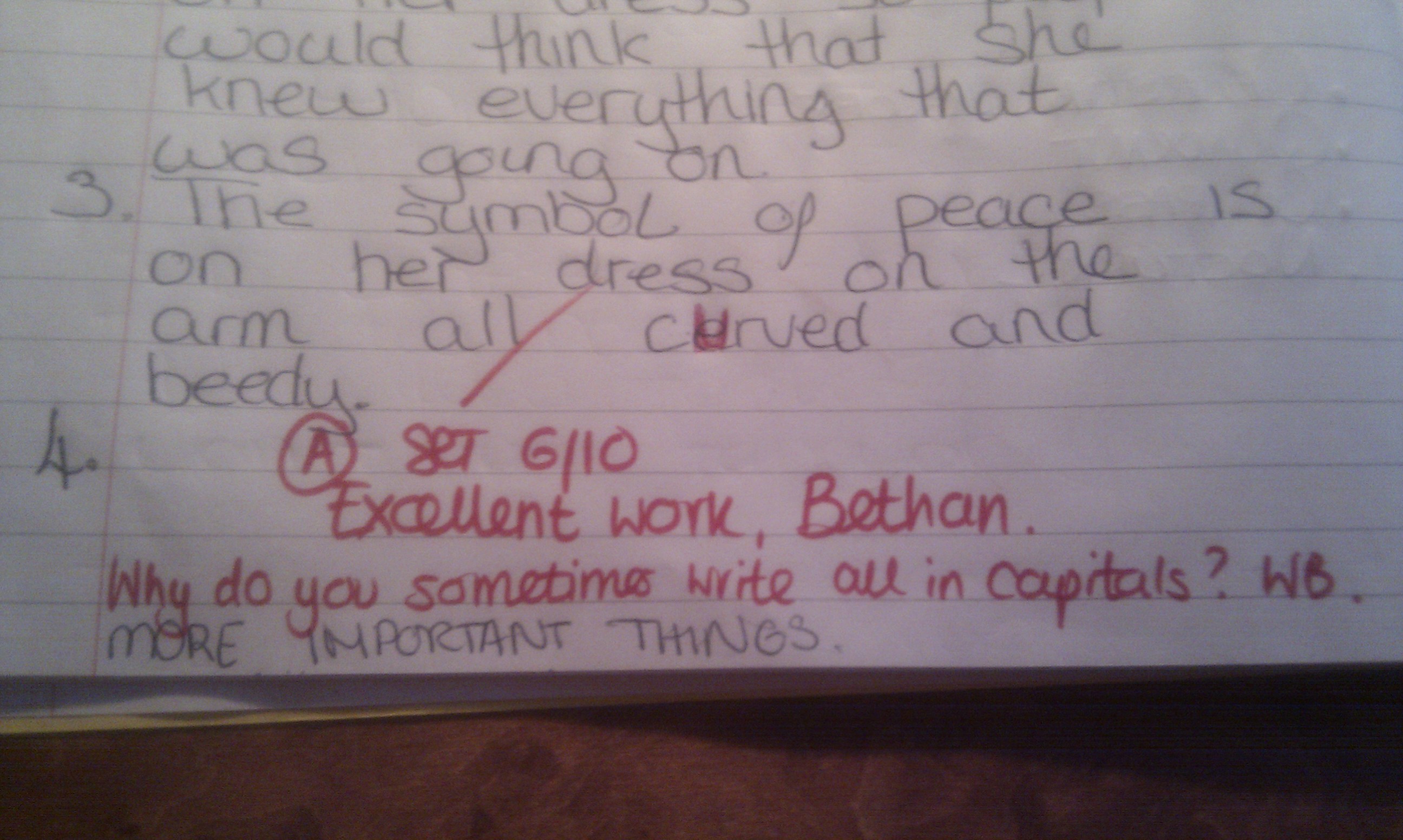
Feedback: WB

WB in actionWB is text talk for “Write Back”. I learnt this from reading scribbles in the corners of exercise books or screwed up bits of paper I had confiscated, and last year I started using it when I was marking exercise books.

Quite often when I’m marking I will ask a question, which might be as simple as, “Why did you skip 3 pages in your exercise book?” or something a little more complex, like, “Are you enjoying your History lessons?” I founnd that these questions were very rarely answered, almost as if the pupils thought it was a purely rhetorical device, perhaps designed to remind them they were doing something wrong.

However, when I added a WB I started getting answers. I didn’t even have to explain what WB meant: if they didn’t know, someone on an adjacent desk would soon enlighten them. I have had some interesting back and forths with pupils in the past year, just from these two little letters. Try it!

Posted in AfL | Tagged | 2 Comments

This week’s wins #5

1. Wider reading with Y10
I mentioned in wins #4 that I was intending to use extracts from the Prairie Traveler with my year 10s; this happened over a week ago now, turned out to be very successful. I was concerned they would find the old-fashioned language a barrier, and so when I gave out the extracts I warned them it was difficult. Nobody missed a beat: even the weaker students were able to access the material and I was left feeling a little foolish. They pulled out some wonderful bits and pieces of advice, ranging from what to take on the journey to when to beat your oxen.
Unfortunately, feeding it back was a slow and frustrating process and I lost a lot of their focus during this section of the lesson. I let them up to the board to write themselves but, while they can write little bits legibly, they weren’t so good at selecting the most important bits of information and thus were writing whole sentences up.

Next time, I think this feedback would work better by setting up some sort of speed dating exercise, where they have to share their information with another person in 30 seconds or less. Then I could do voice recordings of their favourite bits of advice for the Moodle. I intend to use this as a revision lesson with year 11, and possibly revisit the exercise as a last-lesson-pre-Christmas with year 10.

2. Wider reading with mixed ability year 9
I’ve been slogging through Birds Without Wings by Louis de Bernieres since the summer. (It has taken a while, because I realised it was about to become tragic and set it aside for nearly 2 months; a common pattern for me.) Last week I read through the sections where Karatavuk remembers the trenches at Gallipoli. This was very enlightening for me; never having studied WW1 in any depth, my knowledge is very heavily biased towards the western European experience. It also made me wince with horror, so I decided to share it with my very mixed ability year 9s, ahead of their assessment.

Part of their assessment involves them describing the horrors of trench warfare, for which they can achieve a level 5, if they do it well enough. We would normally expect year 9s to move up the levels later in the assessment; but with this particular group I expected a fair number would be relying on their trench description to achieve their 5. So, I took the book in and read to them.

I don’t think I’ve read a storybook to a class in many years. I couldn’t give them extracts to read because of the language (for those who’ve read it: Fikret and his, “I’m from Pera…” motto is enough on its own) but they were entranced and asked for more the following lesson. Then: assessment. I decided I had done the right thing when one of the boys put his hand up to ask how to spell cordite. I’d only mentioned it during the reading.

Assessments will be marked tomorrow and I am crossing my fingers for the best set of descriptions yet!

It’s a struggle to maintain creativity this close to the holiday, and awash with assessment leassons. This week, however, I am hoping to use the EeePCs with my year 11s to do some presentations on the protest movements of the 19th century; and I’m looking forward to getting some creative homework projects. As a result of attending Geology lessons, I have started to add, “Present it in a creative way” to my research homeworks when I set them, which is how I ended up this week with a model trench in a shoe box covered in information about Harry Patch, and this:

Yep, John Cabot Lemon Drizzle Cake. My students know me so well. “It’s nearly half term: placate her with cake!”
I’m quite looking forward to seeing what turns up this week.

Posted in wins | Tagged , , | Leave a comment

This week’s wins #4

Week 4. Traditionally a week thin on the ground with wins. The kids are starting to tire and it’s dark when I get up. Added to this, the week was bookended by miserable weather which led to the annual sponsored walk being postponed. And it was open evening. Creativity was thin on the ground; but I did manage to roll out one of my favourite starters to year 9.

Trench

The starter goes like this:
“Here is a trench diagram. Working with your neighbour and using items from your bags, recreate it.”

They’re never quite sure how to go about it, which is why I always get some 3D, as above, and some flat. I quite like it that they’re confused. It’s also usually quite easy to spot the gender of the creators from the pictures.

Flat trench

Special mention this year for Nicole who ingeniously made use of lockets to represent sandbags, and Harry who produced a variety of chargers from his bag to represent barbed wire. Mrs Brown and I had a very difficult time judging them, but in the end the prize went to the lockets-for-sandbags entry. You can see them all for yourself here.

I also tried a new activity with year 10, which we agreed did not work especially well. To get through 6 pages of background on travellers across the Plains pre-1860, they were allocated with one topic (Mountain Men, 49ers, Oregon/California bound) and given 20 minutes to read the information and come up with 8 key facts. They were motivated to find the best and most important facts by a chocolate bribe: one Celebration for each good fact.

In reality, this took over an hour because they almost all struggled to digest the text book and draw out the key information. Once we had cleared that hurdle, I encountered a problem in feeding back, that they had written facts small on cards and once these were stuck to the board they were too small to read – I had considered hunting down some acetates and hauling out the old OHP but didn’t consider it necessary. There was also confusion over who had the best facts, since 8ish pupils did each topic. I ended up giving away a lot of chocolate and we rushed to finish getting notes in books.

Next time, I will

  • Have 8 facts selected by me which they have to match or beat
  • Provide acetates or netbooks
  • Think of a way they can work collaboratively whilst ensuring everybody does some work

Tomorrow we’re looking at the journey itself, and since another win for me last week was to embed my Oregon Trail map into the History Moodle, they will be using that for HW. I am excited to see how it works. We’re also going to be using extracts from the Prairie Traveler (sic). Published first in 1859, it’s packed full of excellent advice for travellers, including on Jerking Meat, and Indian Sagacity. I picked it up last summer at the Donner Memorial in California and I’m thrilled to finally get a chance to use it.

Posted in wins | Tagged , | Leave a comment

This week’s wins #3

1. Creativity Learning Community
Post-Ofsted, we are all part of different learning communities. I picked one on creativity. People think I’m already creative, but they don’t know about all those lessons involving a worksheet, a text book and 15 minutes of silence. There is always room for more creativity.
We had a long meeting on Monday which involved some computer time. I was able to be very helpful to my colleagues by showing them, by turns, a PE teacher’s blog, how to set up a Posterous blog, and how to put a picture into Smartnotebook and annotate it. I was most pleased with the last one because I know from my PGCE student it was put in practice by the end of the week.

2. Oregon Trail Google Map
I am not going to say this is finished, because I am still waiting for a recent picture of Fort Hall from an old friend I have who lives very close to it, but it is definitely getting there.

(With thanks to Tom Barrett, whose post on embedding Google Maps in blogs was very helpful).

This project was really interesting for me, because I learned a lot about the trail that I didn’t already know; I made some new friends on Flickr who very kindly allowed me to use their pictures; and I made a resource that has already had positive feedback, and it’s not even really public yet. This was also one of my three action points following Google Teacher Academy, so I guess I can give that one a resounding tick.

3. WW1 songs
I found this excellent website on Friday morning, after spending 20 minutes hunting for my old CD of WW1 songs for the lesson I was planning. As it happened, we didn’t use the website because we got so engrossed in looking up names from Westbury’s War Memorial on the Commonwealth War Graves website; but I think I will be using it this week.

4. Y10 remembered stuff
Last week I blogged about a super-speedy carousel activity to get notes in books. This week I followed up with a quiz. Now, they didn’t all score full marks, but there was a good amount of retention: as much as I might have expected if the topics had been spread out over a few weeks; so that is a definite win for the activity. Tomorrow we will follow up again by making revision materials.

5. Lenin on Facebook
I liked the historical event Facebooks I was sent links to over the summer, so this week my year 12 class and I had a crack at creating a fake one for Lenin, using this Power Point template. We have so far managed to fill in his interests and background infromation; next lesson we are going to start tracking the major historical points in his life through status updates. Year 12 think it is hysterical when we make Lenin say LOL and FTW on his Facebook. I think we may have to create pages for all our Totalitarian dictators this year.
The Power Point template is an excellent place to start, but I am not satisfied, and am busy thinking about how I can improve on it. I’d like something that can be displayed on one long page.

6. I marked books!
I know this shouldn’t be a win because it is, you know, my JOB. But I still find it arduous and dull, and I managed to do two sets over the weekend, both KS4. Go me. The big stack of stickers I got in a teacher swap made it a lot more fun.

And one (almost) fail….
When you think you haven’t planned a lesson and spend ages rifling through your filing cabinet for resources to an old, forgotten, back up lesson, CHECK YOUR PLANNER. It is very likely that you have booked a computer room and have just forgotten. Luckily, a conscientious pupil will unwittingly remind you what you had planned on his way into the classroom, but you will still feel embarrassed that you didn’t even bother to check.
Planner: reliable. Memory: not so reliable, especially by Friday.

Posted in GoogleMaps, wins | Tagged , , , , | Leave a comment