TLAB13 first workshop: John Mitchell

A History session, John is talking about signposting progress and promises we will all have something we can slot into our lessons straight away. There is certainly a good booklet of stuff to take away.

Make you lessons ring: Relevant, Interesting, Naughty, Giggle.

Starters, plenaries and mini-plenaries are the order of the day. Lots of ideas presented in a history context, backed up with examples of how they have worked in John’s classroom. I especially like the idea of putting up a picture and asking students to predict what the people in it are thinking. We also have a look at some 12 sided dice: thrown a 6? Then summarise the lesson in 6 words. Or use an alphabet dice and challenge to find 5 words beginning with that letter.

John also reminds me of how much I love Storycubes and how I must use them more often. He suggests getting students to throw one of the action cubes at the start of the lesson and then they have to include that in their work at some point during the lesson. He suggests downloading the app so this can be done on the whiteboard.

We look at word clouds and getting students to create their own, picking a shape for summarising the topic and identifying the most important words before starting to construct it, so they can write those ones bigger.

Extend an A-Z activity using a bingo card – pick their top 9 words that summarise the learning for them and put them on a bingo card. Teacher selects first letters and when a student calls house, they have to explain why their words are important.

Shopping! You have £8 to spend in the history shop: create a list and they have to buy factors. eg, what was important to getting the liberal reforms passed. This is a way of creating an essay plan without them really noticing.

Learning grids: 12 images, 12 sided dice – throw two numbers, now explain the link between those two pictures. We get to throw our own dice and have a go! Dice to take away too. Winner.

John finishes by talking about effective feedback. He sticks “good progress” stickers in books and students have to fill them in to explain why (this would make a fantastic addition to scaffolded marking). Students can become “learning spies” too, going and sticking their own in their peers’ books.
Posted in tlab13 | 2 Comments

TLAB13 Keynote 1: Alistair Smith

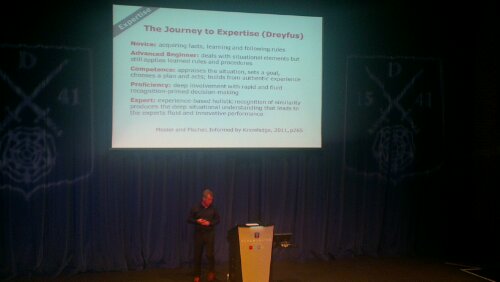
50,000 chunks: how we become experts and what it means for us. Great teachers interleave different strategies. Alistair implores us to reclaim language from Ofsted: make teaching pupil-centred again. We look at the numbers of hours needed to become experts in a variety of things (knitting: 5760!) Deliberate practice is when we’re at the edge of our comfort zone. Masters retrieve key information more quickly than novices. Expertise differs from experience because it requires deep contextual understanding of their subject matter. Persistence, cognitive flexibility also key.

image

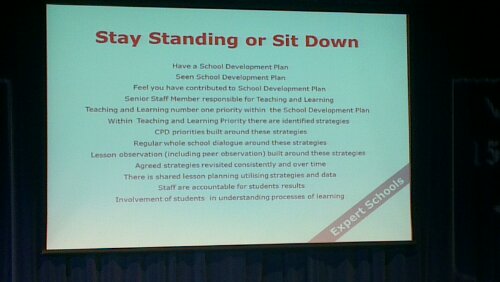
Make an expert school. Establish a core purpose and make it the centre. Be clear on who your great learners and teachers are, and what excellent learning and teaching looks like. Be coherent with your message: plan for excellent teaching. Lesson plans should not be a to-do list and Ofsted should not set the agenda. Be consistent. Build a community: supportive environment. Beware the Ofsted whisperers because their agenda is different. We all stand and Alistair eliminates us one at a time using statements to identify expert schools. Lots of laughs at the idea that schools have a develoment plan than some staff have never seen.

image

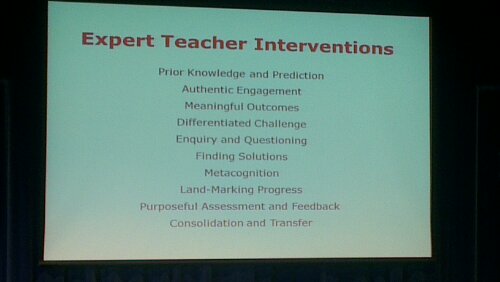
Good point: marginal gains are all very well, but “you still have to cycle the bike up the hill” – the basics need to be in place. Alistair cites St Andrews school who moved from special measures to Outstanding across the board without the Head mentioning Ofsted once. “Get the outcomes right and they’ll give you the rest for free.” Model the practices you espouse. Be visible – leaders and teachers. You can game the system but that’s not what gets you up in the morning. What makes expert learners? More responsibility: Learning Leaders. Effective interventions:

image

Alistair finishes with some examples. He talks about the holy trinity of feedback: self-, peer- and tutor-assessment. Video clips model this. Lots to think about here! Enjoyed Alistair’s focus on how to make a difference, and humourous delivery. Www.alistairsmithlearning.com

Posted in tlab13 | 2 Comments

#TLAB13

I’m at the Teaching, Learning and Assessment conference in Berkhamsted today, organised by Dr Nick Dennis. Like SHP last summer, I will be attempting to liveblog each of the three keynotes and three lectures I attend.

Posted in tlab13 | Leave a comment

Top Down Planning

According to Carole Dweck in her book Mindset, having higher expectations of people can lead to improvements in their levels of attainment. Believing there is a ceiling to one’s achievement creates a ceiling to one’s achievement, the argument goes.

In school, I translate this into, a student who is predicted a C runs the risk of never being challenged at higher than a C. All students are capable of achieving the highest grades (though clearly, it may take some of them literally years to achieve them, a luxury which is denied them, and us, at school). This doesn’t seem like news to me, but then, I am the product of a public school education: our ability to accomplish anything was drilled into us every day. It is something that I feel is lacking from a lot of state schools, for whatever reason.

Top down planning can help to redress this. Other benefits include a life made easier by differentiating in only one direction, and providing challenge for your most able which may lead to improved behaviour from those students.

Start by mentally identifying the brightest student in the class you’re planning for. Look at the data but use your own judgement too. Plan your lesson as if all your students were working at the same level as your chosen student. Create your resources for him/her and pick out lesson activities that will provide appropriate challenge.

Now you need to add scaffolding for the rest of the class. Pick a student from the middle and a student at the weaker end and think about what support they will need to achieve success in the activities you have planned. My example is a note-taking exercise in which students have been instructed to condense three pages of textbook information (I love a good chunky textbook) into notes to answer the question, “What factors lit the fuse of the Civil War?”

civilwar3

On this sheet, the brightest students have what is essentially a blank sheet, to enable them to write as much or as little as they choose. The six headings are taken directly from the text; there is not a great deal of point in this sheet, other than it being a nice little visual and making it less easy for students to work out who is doing which exercise.

civilwar1

Students “in the middle” have a little more structure. Here on sheet 2 I have written headings for key pieces of information (such as the date) and provided some question prompts to help them identify the facts they need to include in their notes.

civilwar2

Students working in a lower ability range have a lot more structure to their sheet. They have a combination of gapfill and some questions to help scaffold their note-taking as carefully as possible without it becoming meaningless.

When I teach this lesson, I go around handing out the sheets and asking if students want Normal or Extra Challenge. What is “Normal” will naturally vary depending on the prior attainment of each student, so this is where your AfL comes in – use their previous work to help you assess which version is their Extra Challenge. It is common for students with high prior attainment to coast by asking for sheet 2, but it’s quite straightforward to flatter them into attempting sheet 1 and offering a copy of sheet 2 “just in case”. Likewise, the students with lower prior attainment who want to challenge themselves get sheet 2 but I might leave a copy of sheet 3 on the desk too, so they can refer to it if they get a bit stuck.

This method of planning works well for me because, as I said, it means only differentiating in one direction. I only have to think about how to scaffold for those who need a bit of extra help, rather than working out that scaffolding whilst at the same time coming up with an exciting extension activity to challenge the able and/or enthusiastic students who burn through the tasks in half the allotted time.

I think this method also leads to stronger culture of achievement in the lesson. Sometimes everybody is a bit weary and the uptake of “Extra Challenge” is never going to be as high on a Friday afternoon as it is on a Wednesday morning, but over time more students start to opt to challenge themselves without your coercion.


Update: I came across this excellent blogpost by headguruteacher today. It was published before his blog made it into my Reader but I think it makes excellent reading alongside this post.

Posted in Planning | 2 Comments

Adventures in AfL: Piecemeal Assessment

I decided to try something new with year 9 assessment this term. We study World War One, this term, with the question, “Why did men stand and fight in the First World War?” I gave them the assessment sheet, that I use to mark the end product, in the first lesson and we spent a little time planning how we could answer the question and they went through what evidence they would need. I tweaked my lessons accordingly, so that I covered the breadth and depth they were looking for.

As the lessons passed, they built up a paragraph here and there that slotted neatly into their final essay. I did quite a lot of on-the-spot marking as per our new school policy (blog post pending on that) and then at the end of the unit, I went through the paragraphs and gave them an expected level and some advice on how to improve. I then set a homework to write or type up the paragraphs with an overall conclusion, acting on the advice I had given.

This seemed like it should be foolproof! But, of course, it wasn’t quite as perfect as I had hoped. Here are the best bits:

  • Students were working towards the success criteria for the essay from the very first lesson, so that every piece of information had a purpose, which I hoped made the study more meaningful.
  • I was able to intervene to tweak things like spelling and little factual inaccuracies, and also to see my feedback on how to improve acted on, rather than just fading away.
  • It has had a significant impact on students’ ability to express change over time – in this case, that soldiers volunteered to begin with and then needed to be conscripted. I don’t know why; I guess this is a particularly difficult concept for them to grasp and revisiting it helped them to improve their explanation.
  • It meant I didn’t need to spend an hour growling at a class as they wrote in silence, at the end of the unit.

Here are the not-so-good bits:

  • It was quite common for my feedback not to be acted upon. In one case, a girl carefully transcribed her original paragraphs to the point where she included spelling mistakes, even though I had corrected them on the original! Simply copying work seems like a complete waste of time to me and I am amazed so many of them did it, so pliantly – it is worrying to think that this is so normal to them that they didn’t see anything wrong with it.
  • Very few had added a conclusion, even though this was part of the HW and clearly stated on the success criteria.
  • The essay planning lesson was hard. It was a test of my questioning skills and I had to do a lot of teasing out.

I think the final problem could be solved with practice, and the middle problem solved with a 10 minute conclusion-discussing-or-writing plenary on the day the HW is set – or the more draconian returning-essays-without-conclusions approach. I’m not sure about the first problem. I suppose that draconian approach would work here, too, but I would prefer not to have to do this. I could write to parents and ask them to spend some time going over my feedback and the child’s finished essay, but I’m not convinced they would all do this, nor that they should have to.

I’m lucky with my year 9 class and they are a lovely bunch, so I think I might just ask them when I return their essays this week. They almost all made progress – some significant – against their levels from the end of Y8, but it wasn’t quite the breakthrough I had been hoping for. Though, arguably, a better understanding of change over time will be extremely helpful in the future when they’re doing their GCSE Crime and Punishment study.

I’m not sure when I’ll try this again because our next History assessment (we’re doing Geography at the moment, thanks to an adjustment in the way we approach the teaching of Y9 in Humanities this year) is a choice between verbal and written, so it doesn’t really lend itself. I might try it with year 8, doing the English Civil War.

Posted in AfL | Leave a comment

#SHP12 – Presentation link

So! SHP is over for another year. We managed to get #SHP12 trending on Twitter last night during Ian Dawson’s session which was quite exciting. In fact, the top three trends were education related last night: lots of teachers getting busy with training on a Saturday night – commendable!

I managed my goal of blogging all the sessions I attended, thanks to the WordPress app for Android which is extremely good (I wish Blogger had a comparable one), though I do notice that my speedy thumb typing has resulted in some absolutely heinous crimes against grammar and punctuation. I do know how to use an apostrophe and in fact I am a bit of a pedant about it, I promise; going back through to edit out mistakes and edit in pictures I took which have mysteriously disappeared will be my task of the coming week.

For those of you who attended my Bring Your Own Device session (and anybody else interested) you can access my slides here. Thank you for the positive feedback left on Wallwisher, and it was nice to see some faces from my workshop last year and hear from someone who’d used it in his classroom. I hope this year’s was equally helpful.

I expect I’ll be back with my to-do list for next year soon. It’s going to include SOLO, Mastery Learning, reading Ron Berger’s book, and Carole Dweck’s, and making my students practise good writing more*. And a load of other things I can’t remember.

* better writing than this sentence, obviously.

Posted in shp12 | Leave a comment

Workshop E

John Stanier: Mastery Learning in a Linear Universe.

The key tenet to this is that children can’t move on to the next thing until they have mastered the first thing.

John explains the impact Hattie’s Visible Learning has had on his teaching. For him, it boils down to mastery learning, acceleration and feedback. You can boost bright children’s learning by accelerating them through the curriculum rather than doing more depth – not sure how this would work in my classroom though: needs more thought.

John has also been studying karate. This relies on self-discipline, repetition, clear progression and peer support. John recommends reading Thinking Fast and Slow at this point, about how the brain works.

Therefore…
Learning must control the progress, not time.
Students may assess when they have mastered the skill or information.
Constant feedback BOTH WAYS about the learning/teaching.
Able children learn more when given more to learn. Like building up any muscle, less weight = less development.
Repetition is a vital learning tool.

We look at a picture that looks like a wand. The white bits at eother end are the teacher input. The rest, the black bit, is pupil input. This is how a lesson should look. We looked at some amazing flow diagrams John has put together to map the learning through a unit. I love these! New way of planning, I think. It shows that students don’t have to follow a single path – more knowledge can be built in to stretch the most able and provide scaffolding for those who need it.

This has resulted in much deeper learning than previously. GCSE results have improved because knowledge is better.

We apply this by doing a group task looking at a battle from Star Wars.

This is a really good activity. Each stage of the flowchart has a table with resourcesx activities and mastery criteria. Students need to master what is on that table and have a friend test them before they can move on to the next thing. John admits that this takes a huge amount of planning but that your time in the classroom is freed up and assessment becomes easier.

Hattie says that parent income has the biggest impact on learning, but also the precedent of a poor performance in a previous exam.

Now need to move on to paper to plan my own mastery learning. Pens, markers and flowcharts – I love blogging but this is my home territory!

Contact John for more information – @johnstanier1
He would like to set up a Dropbox for people to share mastery learning resources.

John finishes by explaining how he intends to teach from September. To begin his GCSE, he’ll do the whole course – all three bits – in one hour. Then Crime in 1 hour, AmWest in 1 hour, CA in 1 hour. Then more depth on each one. Sounds exciting! I might try this too.

Posted in shp12 | 1 Comment

SHP Sixth Plenary

Chris Culpin: 40 years on – what do young people need from history now?

Before Chris, notices. Carenza Lewis shares the finds from a test pit dug behind a halls here. We are directed to Lifelonglearning.org.UK – Euroclio conference, 7-13 April in Germany. This sounds interesting. Also the SHP conference in London on November 24th is a must-attend, surely!

Chris begins by reminding us that reviewing the National Curriculum is a political process. He talks about writing the initial National Curriculum.

We then compare Gove’s vision for education with the standards students are judged against on the international league tables, PISA, and find a complete mismatch. Learning by rote does not help students to think critically.

The new primary curriculum has disenfranchised some of the experts on the panel, who have spoken against it. Will the same thing happen with secondary?

It seems History won’t be compulsory to 16; that there might not be a national.curriculum. But (WTF, says Culpin) – does all this matter? If everywhere is an academy, a free school or an academy, it will be irrelevant.

SHP was set up 40 year’s ago, in 1972. It focused on the question, What are the needs of adolescents which history might meet?
1. Understand the world in which they live – hence, Modern World study.
2. Find their personal identity by widening their experience through the study of people of a different time and place – met by the Depth study.
3. Understand the process of change and continuity – Development study. Big picture thinking.
4. The need to acquire leisure interests. Thevworking week was diminishing in 1972, so the History Around Us study aimed to fill this.
5. The ability to think critically and make judgments about people and places.

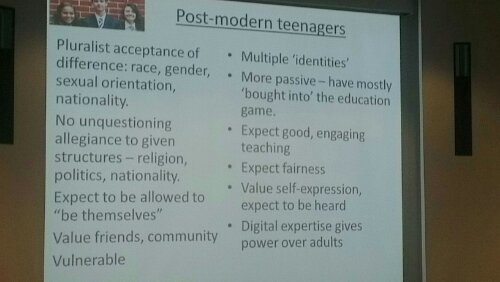
Today? British children are the unhappiest in the world, apparently. And now a lot of projects aimed at young people – Aim Higher, Connexions, EMA – have been cancelled. Tuition fees are on the up. We now have the “post-modern teenager” –

image

How can History help with this? They still need to understand the world they live in – particularly, to deal with the news explosion. Maybe the depth study needs rethinking – Medieval Baghdad, anyone? Change and continuity – war, and people working together. Four Nations. Power, and the struggle for it. What about ordinary lives? Inequality? The Spirit Level has some good graphs to show the impact of a range of social issues – these look suspiciously like the graphs my HoD used in his assembly this year. I now know what he’s been reading!

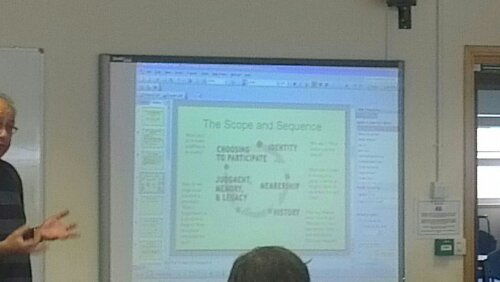
Chris returns to the principles of SHP at the end of the session.

image

Posted in shp12 | Leave a comment

SHP Fifth Plenary

Ian Dawson with tabards on a Saturday night. Don’t anticipate this post being long as I hope to be donning a tabard!

image

Looking forward to the magician’s show, “when we cut the Ofsted inspector in half”.

“It might be history to some people. To us, it’s family, pet.” – Close the Coalhouse Door, Alan Plater, 1968.

Dale Banham encourages students to summarise a decade in 150 words. They research and interview. Compare with Kynaston.

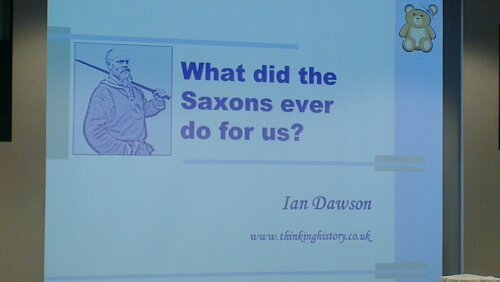
We had a great time playing Saxons. I was the 5th century and got to wave a sword around. Lots of focus on the Battle of Edington which was nice because it happened by my school and we teach it! …as a poossible battle memorialised by the Westbury white horse.

I love these sessions! See Ian Dawson’s site: Thinking History

Also a big thank you to Mrs Ian Dawson, Pat, who gave me some good nerve-steadying advice yesterday.

Posted in shp12 | Leave a comment

TM SHP Edition 2

Dan Lyndon has been working on a project with the British Museum to create some materials to go with their Indian artefacts. More on this at the SHP conference in London on November 24th. Students looked at warrior helmets and then designed their own.

John Heffernan next, all the way from Northern Ireland. His links: linkbun.ch/ffkk
Podcasts and resources available on a variety of topics of Irish history from 1912-1923.

Adam O’Connor now on Austerity Apps. Voicethread: put a question on, students can respond with a voice clip. Timetoast: good for Christienological skills. goAnimate. Newsmap: maps news stories from all over the world. Capzule let’s you create your own time capsule. Photobabble: Adam showed me thuis in my session yesterday and it’s definitely worth playing with! Look at the Vital History Site for more.

Michael McIntyre: works for an organisation that focuses on education around genocide. Promote history in an interdisciplinary setting.

image

Freely downloadable teaching strategies from the website. I missed the link though…will edit in later.

@JulestheTeacher talks about impact of SHP 2011. She has used SOLO taxonomy after Neal Watkin shared it. She has put card sorts on hexagons instead of squares.

Posted in shp12 | Leave a comment