SHP2014: Richard McFahn and Alec Fisher

Sadly, without Alec Fisher. Richard is going to be talking about teaching outstanding history.

Make your lessons a flipping PEACH: feedback, prior knowledge, engagement, access, challenge, higher order thinking. We look at the advice for Ofsted inspectors when they are considering learning over time and it is littered with references to these things; they do look at quality over time so it is important to keep these things in mind consistently.

Michael Maddison, the history HMI, promotes historical enquiry among other things as key for outstanding history teaching. Richard models the enquiry process for us, beginning with a fake archaeological dig (blindfolded kid kneeling down with a trowel), then moving on to a picture of a skeleton that has been dug out of the ground and asking us to write down questions we might want to ask about it. After these have been, in our imaginations, written onto the whiteboard (to allow for clear progress as we tick them off as they are answered), we get a written source to add some more flesh to our skeleton (ha ha) and then started to hypothesise about why the skeletons might be there. Richard suggests providing hedge words to help students with this: a certainty washing line hanging from the ceiling; laminates of words like possibly, probably, fairly, maybe, not sure, perhaps, sure for students to choose when they indicate where they are on the continuum. More evidence is then added and we’re invited to come up with a second answer, this time supported with evidence. Now even more evidence: why did so many people die from the Black Death? And then finally, writing an answer to a bigger question, about why so many people were buried in that place.

We identify aspects of feedback, challenge, access and engagement in that process and then Richard moves on to talk about sustained progress over time vs accelerated progress in 20 mins – of course everyone wants to first one. How do you ensure students make progress over time? You need to plan for it! Start by thinking about second order concepts. Cause, consequence, change, continuity, significance, interpretations. Richard and his colleagues thought hard about what the epitome of success in each of these skills would look like at the end of KS3, KS4 and KS5. Identifying where each of the skills are going to be taught across key stage three helps to ensure progression. He also shows us how he broke up the idea of interpretations into components to ensure progression over time. This is a valuable thinking exercise on which to spend time.

Richard suggests a way in to interpretations: show an artist’s impression of an event and ask students, “Did the artist do their homework?” He gives us a picture of the Battle of Hastings and we check the facts against the Bayeux Tapestry and some other sources. Then there is a discussion about artistic licence and whether historians should be allowed to use their imagination when they’re telling a history, such as Schama describing the sounds and feelings of the men at the battle in his History of Britain.

Then we move on to think about causation: Richard uses an example from his teaching of the French Revolution. We look at pictures of Louis and identify the change between the two, and then the cartoon of the guillotine and his execution; the question to go with this is “Was it inevitable that the French would kill their king?” This is followed up with a card sort to consider the changing popularity of Louis over time. Richard suggests providing some cards without dates when doing a chronological sort to encourage better engagement; then we make a popularity graph on the desk. Then, students can identify one point in the timeline – not the day of execution, because that would be too dangerous – to send Dr Who back to intervene: when could a change have made a difference? When did it become inevitable?

Richard finishes by impressing upon us the importance of teaching a chronological framework and overview; and encouraging us to go to his website for today’s resources: http://www.historyresourcecupboard.com

Posted in shp14 | Leave a comment

SHP2014: Big History plenary

This plenary, with Denis Shemilt and Frances Blow, links in with the workshop I went to this afternoon.

Frances begins by defining big history. The study of human kind through time and space from the first modern humans to the present, presenting the past as an unfinished story that runs into the present and the future. It’s not world history, or the history of the universe. It’s large scale, low resolution, and an open-ended picture of history – but not a replacement for small-resolution topics. Big history should be nested with topics and theme based histories to help with building up a picture of the past. It will enable students to evaluate and construct their own frameworks of the past, without offering a master narrative.

Denis picks up by explaining that this concept has been around for a long time, but it has often served religious/political agendas. There is a strong academic case for considering Big History:

20140711-200329.jpg

To understand the past properly, you have to keep on changing scale: like on Google Maps, you can zoom in and out to understand better how something it placed within its context.

Frances comes back to explain some issues revealed through the study of bigger history so far: Medicine through time was diminished to a series of topics with little focus on patterns of development; but revisions of the material and beginning with a big framework on which to pin later knowledge helped to address this. Now feel vindicated in spending 3 or 4 lessons on the overview at the start of the Crime and Punishment course.

KS3 however presented a different challenge, being the whole ability range and not a self-selected bunch of (probably) interested students. In an experiment at Ripon Grammar School, students studied the usual range of topics at ks3, but at the end of y9 students would attempt to make links across the entire SoW by graphing individual freedom vs centralised power. Most found this extremely difficult, which led to the conclusion that it doesn’t work to do the patterning after the study.

This led into the Magna Carta experiment at Benton Park. Students learned about the Magna Carta and then placed it by contextualising within Anglo-Saxon England, and then continued after King John by showing how it was important afterwards, and how its importance grew over time. I quite like this idea because it is quite close to what I teach for the democracy unit in Y9 I blogged about earlier this year. The experiment had positive outcomes, but students still struggled to link it with their other learning. Frances uses an example of a student who knew the Magna Carta story but thought it completely unconnected with the Norman conquest.

Denis makes some suggestions about what the big history curriculum might look like. A big framework, followed by a depth study, then back to adjust the framework based on that learning….and so on. After three years the big picture will be much more detailed thanks to regular scale-switching. Denis suggests that it offers the optimum solution to “the content problem” and encourage scale switching, decreasing fragmentation of knowledge. This will also provide them with a framework on which to hang future, post-school historical learning and help them to take the long view when making decisions.

Posted in shp14 | Leave a comment

SHP2014: Dan Nuttall and Laura Goodyear

Dan and Laura are running a workshop on “Big Picture, Small Details” using their study of the slave trade as an example.

They aimed to raise historical consciousness, connecting past, present and future and recognising their place in time. They also need to recognise that History operates on different scales and make informed judgements based on their understanding of the past. The BIG History of slavery reinforces the patterns in human history, from hunter-gatherer societies right through to today. It’s loosely based on the work carried out by the Big History Group at Benton Park School.

The study of the transatlantic slave trade was placed within the 13,000 year study of slavery through human history. The slavery focus worked well because there were plenty of misconceptions and issues with definitions to challenge. For example, the distinctions between slaves and non-slaves are subtle, not simple; slavery is not a spatially and temporally localised phenomenon.

Laura talks about the skill of scale-switching: not everything requires being taught in the wider context; one or two units a year is enough to help them recognise that history works on different scales and help them to hone their skills. The slavery unit, for example, is 8 lessons on the context and 4 on the transatlantic slave trade, for example.

We have a look at the lesson resources, beginning with the lessons on the transatlantic slave trade, which cover the triangle trade, the life of a slave (through sources) and abolition. After this, students are polled on, for example, when they thought slavery began, which helps to identify any misconceptions which students might have inferred from studying the transatlantic slave trade. There is some discussion with delegates about whether they held these misconceptions before that study, or whether the power of suggestion meant that they answered in a certain way.

Laura then shares information about student work on the bigger picture lessons. She makes the interesting observation that, especially the brighter students want to drill down in extreme detail on each time period and sometimes struggle with the bigger picture. We spend some time looking at the big picture lessons and accompanying resources (I liked the hunter-gatherer decision making activity a lot). Afterwards students were polled using the same set of questions and the data showed a reduction in the misconceptions after these lessons; they showed gains in historical consciousness. It also created a real buzz with the students and within the department, and it seemed to have a lot of “stickability”.

I like this idea: it might be useful when teaching the conflict between Plains Indians and white settlers, to place this in the wider context of colonists subjugating natives.

Posted in shp14 | Leave a comment

SHP2014: Don Cumming

SHP number 26 opens with glorious weather, as it always seems to. The first session is Don Cumming, talking on “Our island story: really?!”

Don says that some of huge changes make him feel a bit like Statler and Waldorf from the muppets. Changes across all years are putting lots of pressure on us as history teachers; measuring progress now that levels are dead is a new challenge; promoting good literacy within our lessons; managing Ofsted and responding to Ofqual. There is some lovely stuff. The new ks3 opening statement and the framework for the new GCSE are proof it is not all doom and gloom.

However, there is a worrying rise in nationalism recently, and maybe as history teachers we have a role to play in this. Don talks about the Scottish vote and the issues surrounding it, identifying the bias in Scottish history towards the notion of England as conquerors and questioning whether we do the same in the history classroom further south. We teach 1066 as the story of a vicious French Viking but what about the Norman empire? Perhaps we need to adjust the focus for some of our units to ensure we’re not teaching a UKIP-approved programme of study.

Some more ideas. Use timelines to teach interpretations – all timelines are an interpretation, really, so there can be some real rich learning going on when considering their focus. An activity involving tabards and considering contextual understanding:

20140711-144214.jpg

Different empires: USA, Scottish, Belgian, Nazis, French, British; and a number of statements about what empires might have done. It’s important to consider them all under the same terms. This isn’t just a problem here: countries all over the world are working to ensure the history taught in schools gives as broad a picture as possible, as our society becomes more international.

How to avoid this? Teach them to be fighters. If they are good historians they will have the intellectual power to recognise interpretations and selective stories. They can recognise how to frame the questions they need to ask about a variety of topics. We consider a variety of pieces of evidence (the one I scanned had a killer snail on it) to consider what it tells us about the period.

Don gives us some literacy ideas: write, cover, spell, check; creating a bank of hedging words; using colour to identify different parts of writing, consistently and then getting them to do it; do some action research and share what you find out; train them to be better peer assessors, improve their classroom dialogue, practice their writing, use a wider range of evidence – Don shows us a game with a rugby ball, firstly watching some throwing and then describing what is going on, then getting them to do it with their eyes closed and doing the same: recording evidence of the throwing so that they understand better what different types of evidence can show.

Don’s final message is a call to reach out and create better communities among history teachers, and to teach our students to be good historians and recognise insidious, creeping bias.

Posted in shp14 | Leave a comment

Edfest: Early Reflection

In a repeat of last year, I went to the Festival of Education with my friend and colleague, Tut. To say that Tut was on one this year would be something of an understatement: I put this down to her being all about vocational learning (she is the school Queen of BTEC) and getting the hear Alison Wolf. Here’s how many of our conversations went on Friday:

Tut: How was that talk?
Me: Oh, it was very enjoyable. REALLY good speaker, could have listened for hours. Funny, too.
Tut: What impact is that going to have on your practice, then?

BAM! Um, OK. Yes, I do see that that is the point of the conference, but I do sometimes need a little while to think it through, especially with something like this: there weren’t really any history-teacher-specific workshops which are the easiest to work in, and although I mostly try and pick things that are going to be helpful to my practice, sometimes it’s nice to see some stuff that is just interesting. This is what EdFest does in spades: there are so many workshops (15 possible sessions to attend over the two days) that I can go and see the interesting abstract as well as the mechanical how-to. So, what will I do differently as a result of attending this conference?

1. Pedagogy Postcards:
The T&L team at school, of which I am a member, have been struggling to share our ideas in a meaningful and accessible way with other staff. Someone suggested using Learning on the Loo, but then Tom Sherrington referenced his Pedagogy Postcards blog series during his session, and that was the first thing that made it onto my plans list.

2. Positive Praise:
The combination of Swinson talking about behaviour management and Wilson talking about underachieving boys made it really clear that this is something that might be missing from my classroom management arsenal. Not that I never say anything nice, of course, but I am from the more laconic school of teaching and I could probably stand to hand out more praise. I have in my desk, for example, signs which I occasionally hold up. They say “Stop talking”, “Don’t tip your chair”, “Spit that in the bin”, and “W1” and “W2” for our warning system (these last are rarely used, I hastily point out, because I do think the warning should come with a little behaviour-correcting chat). When delivered with a raised eyebrow they usually have the effect of nipping that behaviour in the bud without causing too much confrontation. Now I am thinking it would be nice to have some signs that say “Housepoint” and “Well done”. And, yknow, do other more meaningful things to raise the level of positive reinforcement in my classroom.

3. Word Rich:
Geoff Barton’s talk on habits of the word rich will probably have the most instant impact on my practice. I love the very simple idea of dictating a sentence each lesson and scoring students on their grasp of various grammar rules and key spellings within it. I think this might be a great tutor time activity and allow for a year group leaderboard in which tutor groups compete to have the highest score (although my tutor group is significantly smaller than most of the others so we’d have to think of a way to cheat win in spite of this). I could dictate the learning objective: the benefit of being word rich is that I can craft something challenging out of the dullest sentence.

Just to clear up any confusion, I don’t agree with making students write down the LO, but our interim head last year insisted and now they’re in such a habit that they do it without me telling them to and some of them even panic a bit when I forget to put the LO on the slide, so I have to add it for them to copy. Thus, even though (I think) this is no longer the rule, I don’t want to rock the boat. Dictated LOs seem to be slightly more meaningful though, as they will be getting more writing practice.

 4. ANYTHING rich, really – sharing the love
A theme I picked up from many of the sessions I went to – Sherrington, Swinson, Wilson, Barton in particular – was the idea of what I like to inarticulately call “Getting at pupils the way they are best got.” This has impacted my lessons in a variety of subtle ways this week; a bit more praise here, some more support there, a slightly more progressive activity with one class, using a slightly broader vocabulary with another class, selecting pairs for tasks based on friendships as well as data….working at being engaging is not a shameful thing. I remember when I had my old tutor group in year 7, being resistant to a totally full tutor program on the basis that, for some of those students, the 20 minutes we spent chatting in the morning might be the only meaningful conversation they had with an adult all day. That’s not necessarily helping their numeracy or literacy or imparting great wodges of knowledge, but it is setting them up better for a day of learning, the way my mum used to set me up by chatting through my day with me on the way to school. In a perfect world we don’t have to provide that for our students, I know but….Context, again. It is definitely my favourite word. So, I’ve made more of an effort this week to nourish my students in little ways, and I feel like a better differentiator because of it.

5. More navel-gazing
Somebody suggested to me earlier this year that teachers all overthink things and History teachers are especially guilty of this, so I can’t believe I am actually going to aim for this, but, there you have it. Coe pointed out that we have a good learning model in schools – teach, practice, practice, practice, assess, feedback, practice, practice, assess. Teachers generally skip everything after the first step when it comes to their own learning, though. I should think more about impact over time. It’s not very easy to express this sometimes, because I think I soak up a lot more subconsciously than I could ever recognise, but I will certainly revisit my blog notes a bit more regularly over the coming year. Sometimes I remember the simplest little lesson hacks from my teaching youth and wonder how I ever forgot them; evaluating and reviewing in a more systematic way might help with that. An extra column for this on my weekly planning sheet (I can’t get on with a day-to-view planner, no matter how hard I try) might help.

6. Don’t upset a primary teacher: Boy, are they angry with Gove. Some of them were still fizzing when we left the tent, after he was hustled to his car by his enormous minders, thus cutting dead my audacious attempt to ask him to pose with me for a selfie. Something about a phonics test pass mark not being released by the DfE. Somebody commented on Twitter that the early years teachers were angry at being unable to cheat, but I think I need to have that explained to me; how does knowing the pass mark enable one to cheat? This is the thing that might end up having the biggest impact on my practice, come to think of it, so please enlighten me.

Posted in edfest | Leave a comment

Edfest: Wilson

Gary Wilson is speaking about breaking through barriers to boys’ achievement.

I’m late. I hear that boys start the stray from education in around year 8.

In 1993 he started to work with the parents. There was an 18% achievement gap in GCSE (today’s average is 9%). He arranged a meeting: 77 mums, 5 dads. Some of the mums said they were still packing their sons’ bags at the age of 15 or 16. More girls join the library; the Kindle adverts have more girls than boys in. We perpetuate it!

Gary identified peer cadets low down the school who are capable of dragging the whole cohort down, because in some schools, it’s this group of boys in year ten that run the whole place. Peer pressure is one of the biggest barriers to boys’ achievement: not just how and when and why to work, but what sort of boys they can be. He uses his peer cadets as role models: he sends them down to primary school to show them how to make pancakes, rather than coaching in sport.

When Gary started this he was very successful and he was recruited by the LA to manage boys’ achievement across the whole authority. At this point he said he saw an advertising campaign in BHS with “lazy and proud of it” t shirts; he had to take it to a government level to get it removed. Stereotyping is exceptionally damaging in this case. Labels stick. He launched his own positive advertising campaign. He wanted to get the boys in the right emotional frame of mind for learning, so he introduced peer massage: positive physical contact is something that some of these boys never experience at home. Breathing exercises. Self belief exercises. Boys need more praise and attention because they’re so used to getting negative attention from a very young age. Girls use a lot more language in their play, which puts boys back from the start.

His examples of negative stereotype reinforcement are relentless and I start to goggle at the scale of what we are up against. Scary, but lots of food for thought here.

Posted in edfest | Leave a comment

Edfest: Claire Fox, Keith Vaz, David Starkey, Katie Hopkins

These four are debating what children should learn for the future, chaired by Alice Thompson.

Katie begins. She has advice. Completely reverse our current trend by leaving behind those who are not worth the effort. Social mobility upsets her deeply. Funds should not be diverted to the underachieving in underprivileged areas. There should be no coding because computers will be able to do the tech for us, so soft skills are more important. Tech therefore does not matter.

David believes that social mobility matters very much (applause, which “horrifies him”). He was dragged up from the working class swamp thanks to education (and having Quaker parents). He is an elitist too, but thinks we need to be careful with definitions. We are at a let moment in the survival of this extraordinary cultural tradition, which is rooted in the dialogue of past and present and our system(s) of education need to be defined by approaches to rigorous academic education, as a vehicle of social mobility.

Katie appears to be practising her teacher stare through this section. More practice needed.

Claire thinks the implication that future education needs more skills like coding is a complete betrayal of our academic tradition. No soft skills, no coding. Discrimination in schools is important. An academic liberal arts curriculum is a must for all students to the age of 16: she cares not if they yet are bored or fail or find it irrelevant. Being well educated is vital regardless of future job prospects.

Keith feels he is clearly the moderate. As the son of a teacher, he feels the system does not value teachers enough, and valuing them more will improve the education system. His parents came him from Yemen because the UK had one of the the best education systems in the world. Knowledge, understanding, skills and qualifications are important; education must embrace multiculturalism and diversity. He references one of the Trojan Horse schools in Birmingham, saying that this place knows how to deal with the context of the their students.

Katie rejects all of this. 16% of the population have an IQ of less than 85 and wasting resources on these is a criminal mistake. Alice disagrees, as the daughter of a former borstal head. Claire points out that IQ is not biologically determined (rubbish, counters Starkey) but that the important thing is to do your best with what you have, and teachers should introduce the greatest art and literature and let them do with it what they will. Anything less is a betrayal of the concept of education.

Keith thinks you can mix both Katie and Claire’s ideas. Children only have a limited amount of time to be educated and cannot wait for all the faffing around of politicians.

Alice thinks the changes have been very good, but is cut off by Starkey accusing her of journalistic self-congratulation, which delights Katie to the point where I think I might have to heave leave. David thinks we should look at the best of what we’ve got: public schools have set the model for behaviour; models from other countries should also inform us: very diverse types of school which will help to fight the influence of their families.

Questioner wonders, there’s a link between education and good health, so shouldn’t PSHE be compulsory? Claire thinks definitely not. It drearily endlessly preaches a public health message and relationship education is in the same boat. Keith thinks PSHE is a great opportunity to remind children about the importance of good health. Lifestyle messages are best put in school, where peer pressure can be brought the bear.

Next questioner points out that Katie’s sycophantic attitude towards David during this lecture is base hypocrisy since he is a product of social mobility. Katie seems to agree with her. She says current approaches to social mobility are what she disagrees with. It enrages her with a passion that competition is not allowed.

It enrages me with a passion that she is allowed.

David could not give a fuck about sport (I quote verbatim) but is in favour of competition. He thinks that Katie, as a fan of money, should not disparage plumbers or caterers or builders, since they are usually extremely successful and often very clever. He somehow manages to link this back to his original idea that other countries offer educational diversity much better than the UK.

Last question comes from that #toughyoungteacher Oliver, who wonders why Wellington is lauded over other schools that move their students on much further and faster from their starting points.

What’s your favourite school? Asks Alice.
David: Brighton College. All sixth formers must study History…surprise.
Claire: not clear what her answer is – one where everyone can fall in love with Beethoven. A Hirscher, then.
Keith: his school in Yemen, his school in Twickenham, and Latymer Upper.
Katie: Conniton? Honiton? Grammar.

Posted in edfest | Leave a comment

Edfest: Barton

Geoff is speaking on the habits of the word rich. He’s basing it on a book called the Power of Habit by Charles Duhigg, who says that 40% of our daily actions are habits! because the brain is constantly looking for ways to save effort. This is why parents sign up their children to music and sports lessons: developing habits and encouraging social interaction.

A rough guesstimate of word knowledge among the word rich is around 60,000 words. It is unusual to find someone with a word rich vocabulary partnered with someone lacking it. He then talks about the difference between a student who writes “it says” instead of “he suggests” which makes me think of Richard Kennett’s work with his year 12s on evaluative words.

Geoff considers how things have moved on over the past few years. He explains the Matthew Effect: well-invested talent pays dividends; the rich get richer and the poor get poorer. 30% of UK households have 3 or fewer books which is not going to pay dividends in terms of language acquisition. Silent reading hours don’t help either because they associate reading with authoritarianism. Geoff references the Book Whisperer, which claims that there is no such thing as a non-reader. He talks about verbal rehearsals and improving the quality of discussions; that the brightest students write the shortest sentences because they know the power of short and long sentences.

We do some tasks.

1. The Habits of Talk: we have a brief discussion on, are public schools better than state schools?

2. The Habits of Spelling: a short spelling test. I don’t know whether he means, for the last word, funny, or that bone.

3. The Habits of Decoding (I think – I missed it): we read some poetry. Sometimes language is difficult and it is hard to figure it out.

4. The Habits of Writing (a): dictation

It’s really beautiful out there. In here, however, it’s quite claustrophobic.

5. The Habits of Writing (b): describe your journey here today.
We were confused, because the satnav brought us in a different direction to the way we drove yesterday, but the route was much prettier.
C/D borderline students will default to the most tedious, but fail safe, methods: “My journey here today was….” And telling them to make this more interesting is pointless.

Habit 2: playfulness
We look at things like local newspaper trivial headlines and discuss why they’re funny – cultural knowledge and understanding. This is something we need to teach to our students to help them become word rich.

Habit 3: prior knowledge
We consider the little discussion we had earlier. He predicts that we wondered what he meant by better, a prediction that is correct.

Habit 4: writing well.
We self-regulate as the word rich. When I wrote the sentence above, under number 4, I didn’t make a conscious decision about the capital, the apostrophe, the correct there, the punctuation. He suggests you dictate a sentence every lesson and allow points scoring for each one, to demonstrate what our habits are and encourage students to develop their own.
Lexical and syntactic variety: encourage students to start their writing in a different way. You need to add input into their writing in order to upskill them.

He suggests sneaking in books everywhere: sixth form common room has been the first stop at his school.

Loved this – could have stayed and listened for hours!

Posted in edfest | Leave a comment

Edfest: Bristow

Rod Bristow is the head of Pearson and is talking about their new approach to developing assessment, which they have dubbed “The Path to Efficacy”.

How can we have a measurable, positive impact on learner lives? The importance of measurement is talked about more and more these days, so Pearson have pledged to report on its impact on learning as well as its financial state. They will cease to invest in anything they feel isn’t on the path to efficacy, even if it provides a financial return. This is causing much consternation within the organisation, but it is a path – milestones, plans, an ongoing process. The learner is at the centre of everything they do. Previous engagement with a wide range of stakeholders has shifted this focus, but this is going to change.

Why now? There are greater demands about education than there have ever been before – closer connections between education and success in later life, and more tools at our disposal, with a better understanding of pedagogy and cognitive science which helps us address the issues. There’s more data, thanks to international benchmarking. Advances in technology mean the generation of data on learning which is “just mind blowing”.

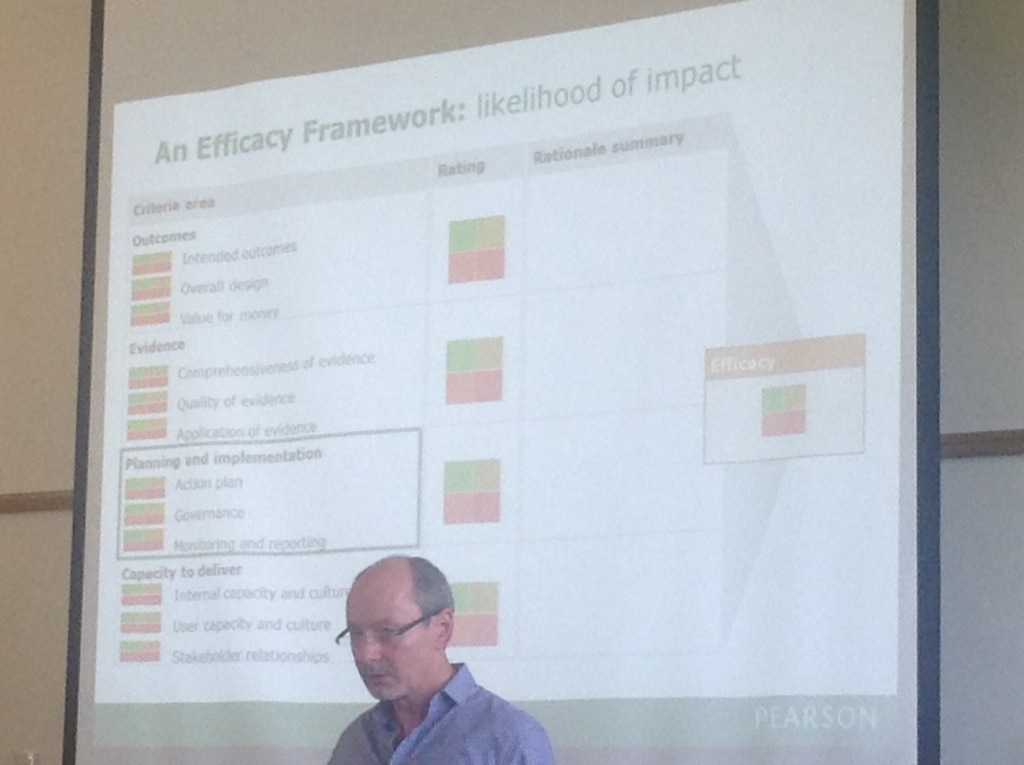
Rod shares the Pearson approach to planning for efficacy.

20140621-115045.jpg

Rod explains how Pearson applied this framework when considering the development of their new “world class qualifications”. There were four key principles: Rigour. Inclusivity. Empowering – transferable skills, or maybe cultural capital. (I missed the first one, sorry).

Lessons learned? You won’t improve learner outcome if you can’t define clearly. You can demo your impact on learner outcomes if you’re not measuring them. Appropriate learner outcomes vary wildly according to CONTEXT! And, to improve learner outcomes, stakeholders must be aligned to the same goal.

It is comforting that they have spent so much time considering the wider implications of the qualifications they are offering.

Posted in edfest | Leave a comment

Edfest: Blakemore

I have been looking forward to hearing Sarah speak about the teenage brain ever since hearing her at TLAB in March: even though I think much of what she says will be a repeat, I do think I bears repeating. It may mean this blog post is very short though.

Adolescent brains have a very strong awareness of self, especially social self, and are much more likely to take risks. Why is peer influence so strong at this time? Social exclusion has a negative impact on mood and anxiety, even more so than in adults. There is a big drive to fit in with your peers during adolescence, more so than in adulthood. This means that being ostracised by the social group is a bigger threat than, say, smoking or speeding.

Sarah then goes on to talk about the development of brain matter from the age of 4 to 21. Younger than 4 is very difficult because they won’t keep still in the scanner! Grey matter the the prefrontal cortex peaks in adolescence and then begins to decline: that’s not a bad thing, but a very important neuro developmental process. The number of neurons changes very little between birth and adulthood; the most dramatic change to them is in huge number of synapses that links them. To begin with the brain hugely over produces synapses, and these are then pruned away, depending on the environment the child is in. This is vital information for teaching, because teachers are part of the moulding and shaping of children’s brains that happens at this time.

Sarah finishes (after talking about social development) by talking about adolescent behaviours and the impact of empathy, which experiments show improves over time through adolescence. The ability to take into account somebody else’s perspective in order to guide one’s own behaviour develops through adolescence, but even in adults it isn’t brilliant.

20140621-104143.jpg

Terrible picture of the summary, sorry.

Posted in edfest | Leave a comment