Edfest: Guy Claxton

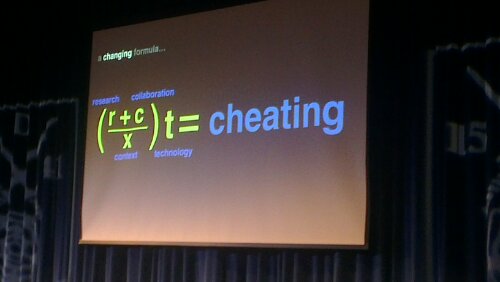
Claxton was so popular in his first session that Katie Price was bumped into lunch and he’s repeating his session, which is again full. He starts by talking about useful attitude for life.

20130621-122557.jpg

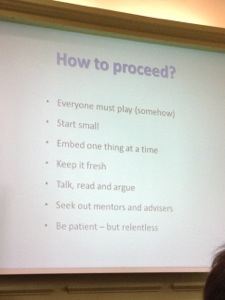
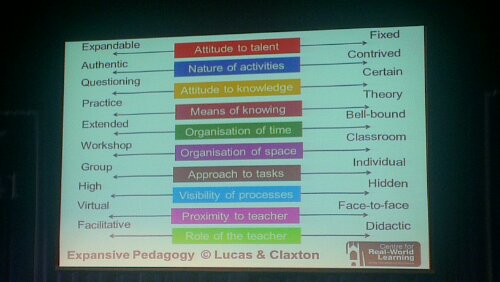
This is familiar from Bill Lucas at TLAB13.

What do our children need to flourish in the 21st century and how can we give it to them? Disadvantaged youngsters often don’t have a social safety net, so they need more grit, more social intelligence and more self-control than wealthy kids (Paul Tough). Resilience is key to help students achieve at university. Teachers should provide opportunities to develop resilience and resourcefulness.

gordonstoun have been working with Building Learning Power for a few years and have seen the impact on their results. Upskilling instead of promoting knowledge acquisition is cited as the key here, but Claxton says he’s not changing the frame – he’s making it larger. Not sure, but think he means knowledge is important but skills must be included.

Schools should become powerful incubators of powerful habits of the mind. Claxton shares some insightful student comments about resilience and its importance.

20130621-124905.jpg

Claxton references Carole Dweck’s work on the old theory of intelligence and how talking about the brain as a series of learning muscles reframes the process of making mistakes as training, rather than a negative reflection of a fixed ability.

He shares an example of youth teams of the premiere league, who reframe activities to ensure they remain sufficiently challenging to stretch them and low them to improve. Then references Hattie taking about great impact of teachers constantly tinkering at school and improving the curriculum for students.

Good leadership vital to facilitate this. Another drum well-beaten today. Habit change is also important.

20130621-130116.jpg

Posted in edfest | Leave a comment

Edfest: Leadership for the Future

Chris Husbands from the Institute of Education talking about future school leaders. Wooden floor and lots of late comers making it difficult to hear and follow the first part.

Are we heading for a fully marketised school system? Chile operates close to this – 75% of children are in private schools. Are we moving towards a system of school commissioners? Or should we refocus existing structures, offering school leaders new sets of skills?

Innovation is great, but must be balanced with coherence. We also need to plan to make sure that schools appear in the right places, and that we square the excitement of dynamic innovation with the needs of the vulnerable in our school system.

Chris hands over to Steve Munby, who is involved in CfBT, a 21-school academy chain. He points out that the state system is massively different to how it was 20 years ago, and asks what kind of leads hip is needed in this very diverse system? He suggests, a power-love combo. Drive, high expectations, no compromise, a relentless determination to raise standards and achieve better outcomes. Great leaders never lower their expectations. Push things to their conclusions and make the connections. Stirring stuff. Be challenging AND open to challenge; be competitive AND collaborative. Existing heads, asked what they’d do differently, say they would be more challenging. Leadership by power alone, however, will not take people with you. Be inclusive and engaging. Don’t compromise on high expectations, but seek out opportunities to accept challenges and engagement from your staff.

Accountability is important in the system – no autonomy without accountability – but it needs to be consistent, coherent and fair. Ofsted is important, then. Writing, summarising, analysing, looking at the details – all important skills for Ofsted inspectors, though not the same skill set held by all successful HTs, so HTs don’t make the best inspectors.

Steve refers to the myth that there is no competitiveness in state schools. Of course school leaders want their schools to improve and perform better, but collaboration is vital to avoid polarising – very good and very bad schools. The drum of state-independent collaboration is beaten again, as is collaboration between academy chains. If this was happening, how would it look? We should help when schools re in trouble rather than gloat. When schools do well, we ask how rather than make excuses.

Some good Q&A afterwards, but lots of agenda pushing too!

Posted in edfest | Leave a comment

Edfest: Wilshaw

Wilshaw encourages us to be bold. We can’t go back, he says, to a system of bland reports from perfunctory inspections of the 70s and 80s. Even in 1992, 40% of children didn’t achieve 5A-Cs. Now more than double that do. But nearly a third of our schools do not meet the criteria for Good, which is not good enough for a country wanting to compete in the global market. Standing still in this environment is tantamount to going backwards.

Forget the naysayers – children only have one education. The status quo is now good enough. Head teachers should be leaders of teaching, not just managers. We must appoint leaders who put quality of teaching at the forefront of what we do in school. Autonomy only works when it’s matched by accountability, which makes Ofsted even more important. Continuity at the top is alo irritant: hence Gove’s long reign is a positive. Educational standards are now in the sights of the PM. It’s a different world, change is hard but we’re on the right track, and we must not turn back now.

Wilshaw makes a lot of leadership and governance. They are key to changing and improving the culture and performance of an organisation. They may be bold, or cautious. The implicit suggestion here is that too many are cautious and defend the status quo.

We return to the thorny issue of performance among our poorest students, apropos of yesterday’s speech. Disadvantaged children in rural schools, coastal areas and more affluent areas are falling through the gaps. It’s no longer an inner city problem. The Ofsted grading system may be restructured to reflect teachers who do best with these students. Independent schools send double the number of students to Russell Group universities that state schools do and this has a profound impact on social mobility. The independent sector must do more to redress this balance. Collaboration and the spreading of good practice must happen. He holds up positive examples of Highgate and Eton and their work with students in London, and also Wellington/Wellington Academy.

Independent school leaders don’t have to deal with widespread disaffection, poverty, teachers moving swiftly to the opposite ends of the ability range within lessons and within the school day. These challenges are not there in independent schools, but this makes it even more important that independent schools reach out to their local state schools. Wilshaw issues a direct challenge to independent school leaders: help your local state schools. This is echoed by Anthony Seldon and Andrew Adonis. Just as Britain can’t retreat from the global economy, the splendid isolation of independent schools must come to an end. He suggests that Repton should have considered opening a school locally in Derby, where parents have only a 50/50 chance of sending their child to a good school, rather than opening an international school in Dubai.

“He who rejects change is an architect of decay” – Harold Wilson

Posted in edfest | 1 Comment

Boosting progress: a Teachmeet/TLAB mash up

I’ve been very focused this year on improving outcomes for students at key stage three. Last year I introduced the verbal assessment, which worked extremely well; but some students struggled to maintain it, let alone better it, when it came to the next written assessment. One side of my brain tells me that it doesn’t matter because it’s a level in a column on a spreadsheet and it doesn’t mean anything – they get it and that’s the important thing. However, the other side reminds me that GCSE History is all about the written outcomes.

That side is the one that hates it when students say, “I hate writing!” – what a crazy thing to say! You’d never say I hate breathing – it’s just a means to an end. You don’t hate writing when you’re texting your mate; you don’t hate reading when you’re on Facebook. You might find writing history assessments difficult but that’s a different thing.

Ahem. That side of my brain is slightly elevated, being stood on its own soap box.

Anyway. I was very taken with Neal Watkin’s TOWER method, which he explained at TLAB13 – I blogged about it here and my use of it here. It worked! It wasn’t rocket science, either – very easy to set up; though I must come clean and admit that we are struggling with the editing stage still: this currently involves me marking their work halfway through and them working on my feedback, rather than me having the guts to make them read each others’ and then rewrite the essay. I just need to work out how I’m going to sell it to them before I try that one.

From using the abbreviated model, I observed that the students who had the most productive chatter, in my opinion, had the best written outcomes, so I started musing about how to encourage students to have better chatter. I know Neal introduced video recordings for this.

Then I went to TMHistorySW, organised at Bristol Uni by Richard Kennett – here‘s his blog about it and here are the slides. Among other inspiring presentations, Leigh Almey shared something called an argument tunnel. This involves seating the class in two rows, facing each other, and setting a question. My Y9s were arguing about the JFK assassination. One side argued that Lee Harvey Oswald acted alone; the other argued that he did not. They’d had a few lessons beforehand with the evidence, so they all had some ideas. I got the cow bell out and we began. Side 1 talked to their opposite partner for 30 seconds; then side 2 had 30 seconds to respond. The bell rang and everybody on side 2 shifted one seat to the left. And repeat – except, after this first round, everybody who thought they didn’t need their exercise book went and got it. Serious business, this argument tunnel. Once everyone on side 1 had spoken to everyone on side 2 (this took approximately 15 minutes for my class of 25*), we reversed the sides so that everybody got to argue the other side.

This was a lot of fun to watch. There is something really rewarding about watching a student get so exasperated that they start shouting, “IT. WAS. AN. ECHO!!” in response to their partner. That is somebody who really knows what they think.

We haven’t written it up yet, but I am anticipating great things. They have gathered the opinions of a dozen other people and been forced to defend a point they don’t agree with: I am hoping even half term can’t negate the impact of that level of engagement.

* yes, there was an odd number. I paired two students who would normally have been supported by the TA, who was absent scribing for an exam. They killed it.

Posted in active learning, teachmeet, tlab13 | 3 Comments

Behaviour Management Musings

I responded to a tweet from @GuardianTeach about managing classroom behaviour today. I got a lot of retweets and several disagree-ers, most of whom seemed to read my tweet and make enormous generalisations about my other views on behaviour at the same time. So, I thought I would write about it.

My comment was, I try to always remember that for the pupil, the bad behaviour is the solution, not the problem. This was something I was taught when I was in my first year of teaching, and I attended a three-day course on physical restraint to prepare for my summer job as a senior playworker on a playscheme for children with moderate to severe autism. That summer a lot of the children I was in charge of were a 2:1 supervision. We carried walkie talkies, and cards to explain bad behaviour to tutting bystanders. I was physically attacked several times, and was glad of the training. I thought about the causes of bad behaviour very carefully after these incidents.

The one episode from that summer that remains with me was the day we didn’t stop for lollies as usual on the way home from the day’s outing. This was probably the third week in, and I changed our routine, for some reason. This led to a tantrum so enormous from one of our older boys that we had to pull over, evacuate the other children from the bus, and eventually make a call to the boy’s dad to come and fetch him.

In situations like that, the problem was crystal clear. I changed the routine. This was a problem – an ice cream had been expected but not delivered. He threw a tantrum, but when you’re 17 that looks pretty scary. Violence is clearly not the way to deal with a problem, but it was not possible to communicate that to the boy in question – at least, it wasn’t possible for me to.

(As an aside here, I stopped doing this playscheme after three years of teaching because working four weeks out of a summer holiday was doing me no good at all; but I still think of it wistfully every July. It was a really amazing job.)

In mainstream, it’s often not quite as clear cut. The problem may not be visible. It is trite to say bad behaviour is always caused by bad teaching; it may be a problem at home or with another student; it may be hunger, or tiredness, or being uncomfortable in some way; it may be boredom, due to easy work or hard work or lack of interest in the topic. There is only a small fraction of these problems I can solve in time to make a lesson meaningful. But I should at least try. As the adult in the situation, and the person who has a vested interest in changing the behaviour, I see it as my responsibility to make sure I have done everything I possibly can.

This isn’t to say I don’t believe in punishments. These students will one day be expected to function in society and they need to be taught boundaries and understand that actions have consequences. I liked Tom Bennett’s post about behaviour and agree that a clear policy, consistently adhered to by all, is essential back up. I’m also not foolish enough to think that I can fix everything and that for some of my students, on some days, it doesn’t matter how good my lesson is – behaving badly will always be the better option.

But realistically, if the bad behaviour is regular then I need to be looking at what I can do differently. I really go in for all that “Be the change you want to see” stuff and I also know from experience that I will have more success changing what I do than attempting to change others. I get quite frustrated when people complain about their classes and say, “Well, they’ll just have to change, won’t they!” as though the class will one morning wake up and decide to be good. I have not heard tell of this happening yet.

Here, then, is the whole picture as far as I’m concerned:

1. For the student, the bad behaviour is the problem, not the solution.
2. Remember to be the adult in the situation: there is no glory in winning a shouting match with a 12 year old. Grit teeth, stay calm.
3. Be consistent as far as possible, in attitude and in expectations.
4. Apply the behaviour management policy consistently and to the letter, and make a fuss if the back up required from senior staff is not forthcoming.
5. Debrief after a bad lesson. Was there anything that could be tweaked for next time? How do the books look? What does the pupil say when I discuss it with them calmly in the detention?

This works for me, anyway. However, it’s all about context, isn’t it? It might not work for someone else.

There. I feel better!

Posted in Reflections | Tagged | Leave a comment

#TLAB13 – Quick Wins

IMAG0476

Year 8 preparing for their assessment on the British Empire, based on Neal Watkin’s plan for improving standards in writing. Two of my students bravely filmed their conversation in The Cupboard Of Secret Learning and agreed to be watched by the rest. I couldn’t have been prouder of them.

Update – with their permission, here is their conversation:

Critique comes tomorrow…

IMAG0477

This is always worth repeating.

IMAG0478

This one’s from the Friday TeachMeet but then I saw it in action around the classrooms during TLAB13. I had conversations with all my students about it. One of my Y12s asked me if I thought Mussolini was polemical. They also helped me to add a phonetic pronunciation of it, which I had been struggling to get right.

IMAG0479

Scattergories revision for my Y12s on Mussolini’s Italy, inspired by John Mitchell (@Jivespin). This game got the thumbs up. I actually had my Scattergories set in the car (don’t ask) but forgot to bring the dice to the classroom, so I opened a book and stuck my finger down on a letter at random. Worked just fine.

All this in just one day! I love conferences that have an immediate impact on my practice. Massive thanks to Nick Dennis for organising and to all the keynotes and workshop leaders for giving up their Saturday to make it so educational.

Posted in tlab13 | 1 Comment

Third Keynote: Bill Rankin

Bill Rankin on sustainable learning in the post-PC world.

He starts with a short history of indoor lighting. He asks: which light is best? Depends on what you’re trying to achieve – mood? Quality? Durability? Pervasiveness? Sustainability.

image

“If you want your students to exercise their brains, let them sleep in class!” Why is class such a flatline? It’s a passive activity.

If technology is now an extension of us, telling students to put it away is not something that will work. Teachers get itchy when their tech is threatened, eg smartboards – but are happy to threaten student tech and push them.

Outside of school people seek out challenges and things that are harder – this doesn’t happen in schools for some reason. Students carry amazing tech with them all the time and the possibilities for them are endless.

Facebook has 1 million % more photos on it than the US Library of Congress. We take, every 2 seconds, the entire number of photos taken in the whole of the 19th century. Pictures of ordinary people, such as those at Pompeii, help to build a picture of everyday life and those on Facebook will be invaluable to historians in 500 years.

Bill talks about foldit – a puzzle game about folding protein molecules. In 2 weeks, gamers solved a protein molecule key to tackling AIDS that a supercomputer had worked on for 10 years unsuccessfully! Communities of practice involve us all, and all of our students.

One Cubic Foot – a project to count how many species move through a space in 24 hours – showed that cornfields are monocultural and this is counter-productive. Putting corn, squash and beans all in the same field is much more productive, but then it is not harvestable by machinery. What’s happening in schools, Bill thinks, is the same as what’s happening in the cornfield. Focus is narrowed to what can be measured – but is the stuff you can measure the same as the stuff you want to develop in your students? We fail to grow the kind of diversity our students need in this kind of world when we take it down to just what can be measured.

image

…but out of school this is ingenuity!

What should the new classroom look like? There’s a trajectory from beginner to mastery and we need to support students in getting there. In fractals, complexity builds by following a pattern. Weneed a fractal design for schools. This ties in with other messages from today: we need to be crystal clear on what we want the end product to be and make sure that everything we do is focused on achieving that. Take the consumption model of education and add curation, creation, collaboration (I think that was it!) and at the end you have 4C to exploded the old ways. V clever 🙂

Bill finished with some stories of experience learning: redthreadmovement.org was a notable tale.

Very enjoyable end to a very interesting day!

Posted in tlab13 | 1 Comment

Workshop three: David Rogers

Inspirational Geography

David starts with a starter idea: show the image on Bing and get students to predict what jobs are to do with that image. “With Google you can pretend to be educated.”

“If we didn’t think we could change the world, we wouldn’t be here.”

David shares a video of what motivates Priory Geography and what they think they are about and asks us to think about what object we would select to represent our subjects. Five ideas they’ve tried…

1. Geography EAL mash up – LOs in a foreign language. Students went to different countries, based on a world map superimposed on top of an aerial photograph of the school. They had top secret guerilla geography supplies. They made signs to stick around over signs in English language to represent all the 37 languages spoken in the school.

2. Thunk: how do you know an island exists if you’ve never been there? Cross-referencing sources to prove it – does a webcam picture from Reykjavik match a weather report? Goad them to really prove it.

3. Geocaching. Priory students put these on Box Hill for people to find when there for the Olympics. BBC School Report involvement with this. Students researched the area and then put together boxes full of items that represented the Box Hill area.

4. Writing an answer based on a case study: Three developed points – nine pieces of paper. Link one side of the board to the other, eg a herd of goats to a higher GDP. The groups had 7 stickers and had to allocate them to the answers they thought were best – “dotocracy”

5. RSA style videos: David films his own first and students critique it. Similar to Commoncraft: planning is really important. Plan, script, film, narrate, review, share. His activity took 6 GCSE lessons to cover something dull.

David does not believe Ofsted kills serendipity. It’s just an excuse. Just carry on as normal, but make sure your ideas fit the context of your school. What do you want pupils to come out with? Take pedagogic risks. Use what you’ve got but better: cutting up textbooks to make them better resources. The Priory Bench: stir up naughtiness. Subvert the norm.

Posted in tlab13 | Leave a comment

Second Keynote: Bill Lucas

Expansive Education: what is is, why it really matters and what we might like to do about it. @eed_net

We begin with some puzzles to warm up, showing how context is important and it’s important to hold back and consider before making a judgement.

What is important in the classroom?

image

What kind of learners are we trying to nurture? What kind of life is our pedagogy for? Schools should have images in their mind’s eye of the answer to this question – what will their students become?

The goals of education are broad: they are about creating learners who have the disposition to deal with whatever life throws at them. Learning should go beyond the school and into the home. The heart of expansive education is learning teachers.

Create a combo of exam success and dispositions for learning.

Bill talks about how myths about intelligence can be very corrosive. Intelligence is a product of the habits of the mind: so what students do in class regularly become their habits and their intelligence. We need to develop various habits of the mind. A lot of discipline problems are a result of a resilience breakdown – bad habits.

Make learning objectives dual, traditional and modern – “we’re learning about history and we’re learning about empathy.”

Another reference to developing growth mindsets – we all really love Dweck at this conference, clearly! Students who have a growth mindset do better in public examinations, and become more resilient and effective learners. Describing things in “could be” terms allows learners the space to get involved – it’s not permanent, it’s “not yet”.

At this point I checked the Twitter stream. Lots of people appear to be finding this session challenging. I quite like a lot of what he is saying. Clearly the topic is something that needs to be tempered by one’s own views, though. My favourite bit so far is about dual LOs. I also strongly agree that intelligence is not fixed and a lot of this is about developing intelligence in a variety of ways. I suppose it’s very cerebral and less “at the chalkface” – thinking about was Alistair Smith said about getting the basics right, perhaps there is no point in considering what intelligence looks like until we are achieving the nuts and bolts. But isn’t a view on this the nuts and bolts? Can one teach effectively without having a personal understanding of how students learn and how intelligence is formed?

image

Bill finishes by talking about Bay House and their journal of educational research, which is published twice a year.

Posted in tlab13 | Leave a comment

TLAB13 second workshop: Neal Watkin

Neal begins by talking about the classroom rules for quality writing: practice makes perfect. Make it meaningful.

We then have a mystery: who is Noor Inayat Khan and why is she significant? How certain are we? Neal gives us some clues and we discuss what they mean. Really interesting trying to pick through the clues we are given: my curiosity is piqued.

An aside: Neal teaches a history unit looking at 1919 and whether victory in WW1 led to a better outcome than loss, looking at it from a variety of country’s perspectives. Love this idea.

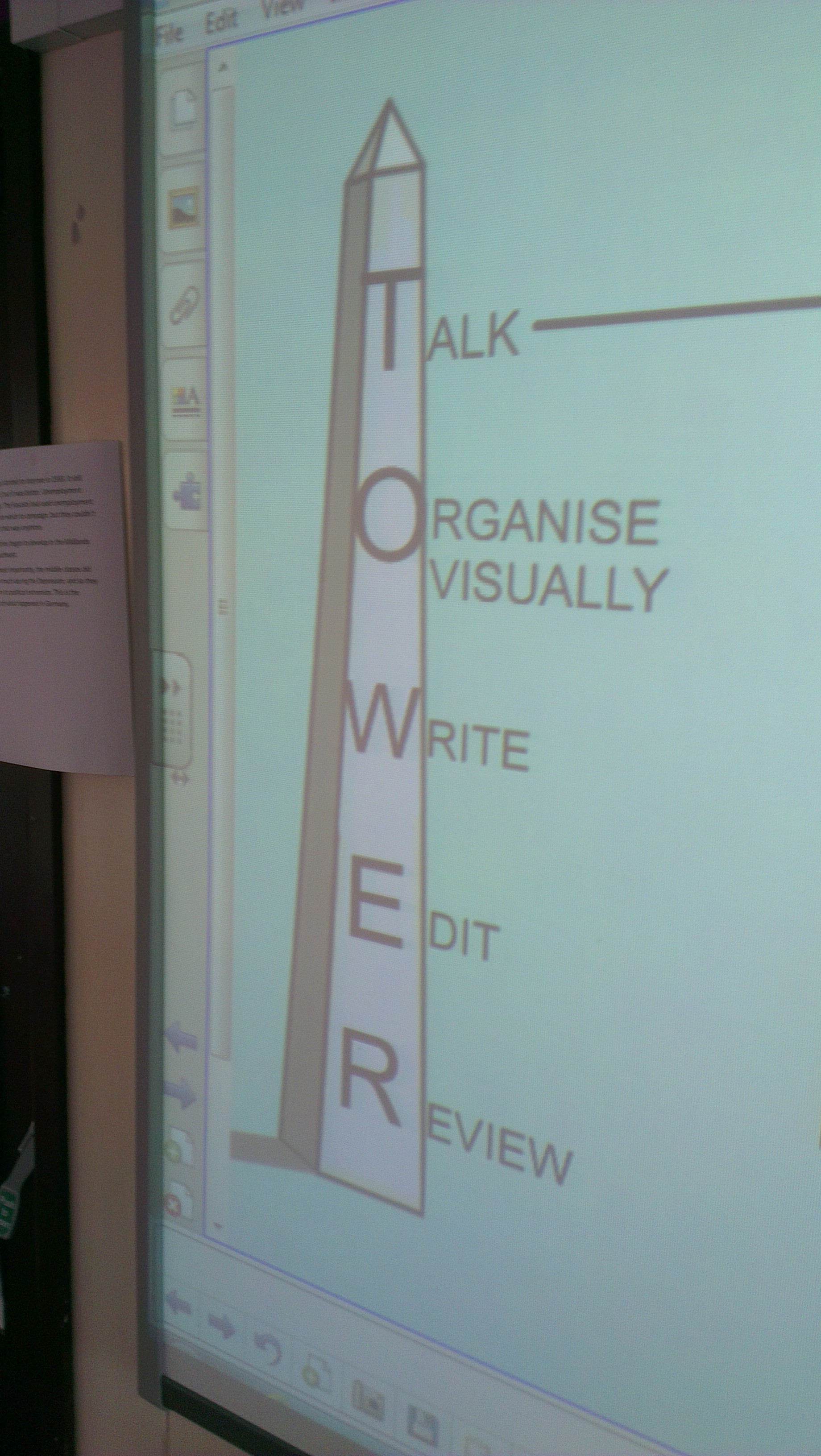
We look at strategies for supporting writing. TOWER: Talk, Organise visually, Write, Edit, Reflect. We discuss whether a statue is a better memorial than a George Cross, and then discuss whether discussion is an important part of the process! Neal finds that Y9 do not like this stage but we generally agree that explaining the topic helps students to understand it better. Neal sometimes records what they say, then the clip is watched back and critiqued by the class on the quality of the debate. This helps to develop historical questioning skills.

Then Neal talks about explorative strategies: freeze frame on an interesting word, margin narrator, role play – read aloud as the narrator, cross-cutting – look at all the different voices in the text, fast-forward and rewind… Look at Neal’s blog to access these in more detail.

Students then write and analyse their work.
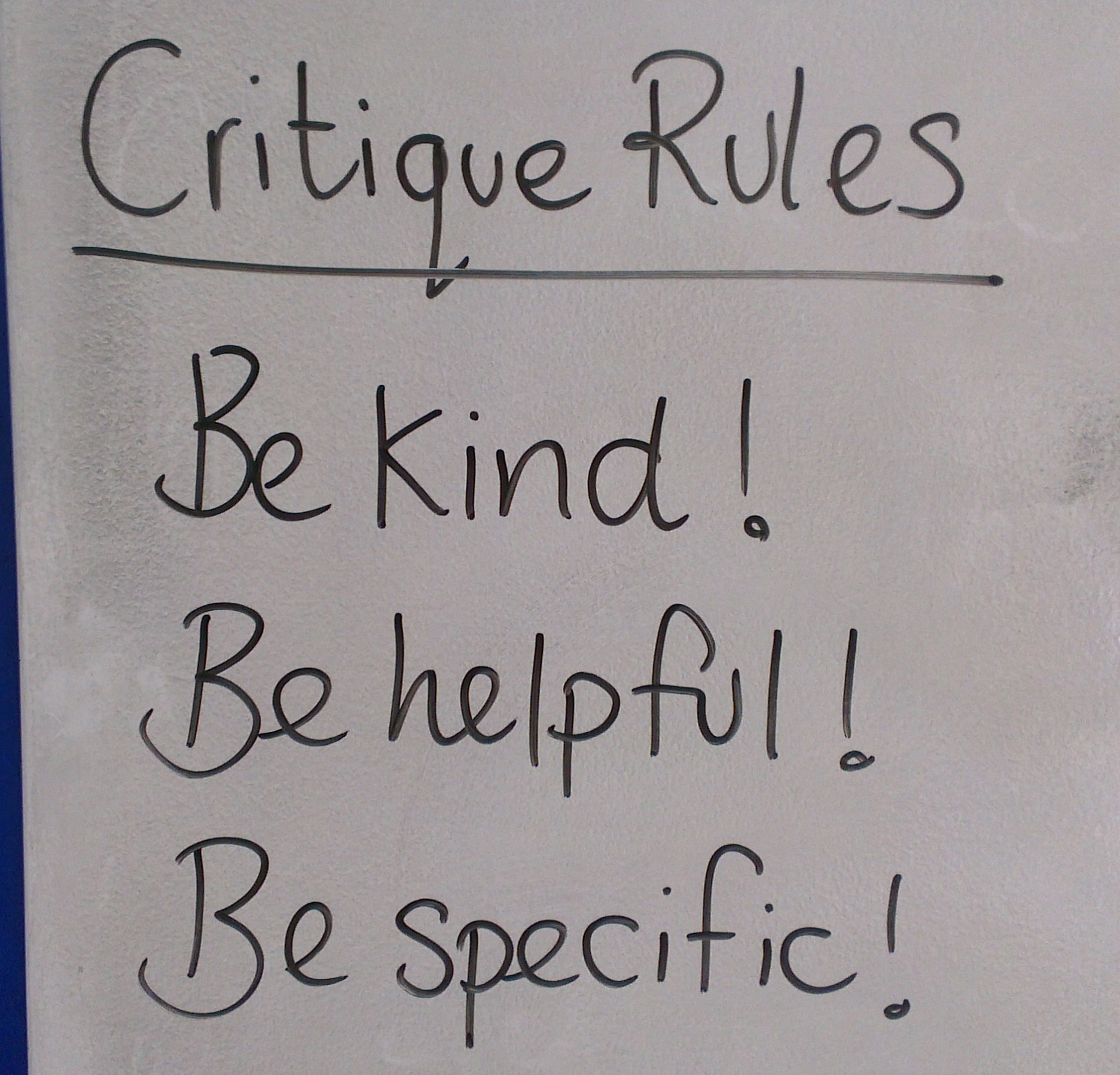
Hard on content, soft on people – critique the work, not the person.
Step up and comment, step back and let others comment.
Be kind, helpful and above all, specific.

Discuss what is good about a piece of writing and create a list of what features good writing has based on this feedback. Do the same for what to improve to create a list of pitfalls to avoid.

When marking, use different highlighters to show where students have achieved the different success criteria. Instead of a target, Neal asks them a question – because Qs require interaction from students whereas targets don’t.

He finishes by making it clear that it works because they have high expectations and promote them consistently from the start of the year. Consistency is coming up over and over again these days!

We have a discussion about what we like about it and how we might tweak it. There are no levels or nc criteria which Neal says is a deliberate, departmental decision – they don’t use levels at all, much to the chagrin of SLT, he says! Students could also critique the questions, and then adjust their essays to different questions. They could write just a cut down first draft instead of a full one. Classes could share their criteria lists to see if they match. Neal will set same Q for y8 and y12, for example, to promote discussion and show that the skills are basically the same.

ETA Sorry, Neal, for spelling your name wrong all the way through! Hopefully I have fixed them all now.

Posted in tlab13 | 1 Comment