ICTWilts: Oscar Stringer

Oscar is an Apple Distinguished Educator, speaking about exploring how the iPad can really help students learn and teachers teach. He helps teachers to get the most from their investment. Consider also, the paperless classroom.

Poetry and book reviews without paper. We begin by crowd sourcing a poem about the forest in autumn on Padlet which is lots of fun, with everyone putting up words on the big screen and then adding pictures. These can then be saved as pdfs which can be viewed in iBooks. On shared iPads these could be organised in collections for different classes.

Oscar moves on to Singing Fingers, to get younger students to think about letter sounds. It’s a combo of students putting fingers on the screen and speaking into the mic, allowing them to visualise letter sounds.

Type drawing – put a word in and then draw shapes with it. Word magnets – drag words around to create poems etc. – a more tactile way of manipulating language. Book creator – put together a book of text and pictures, audio files etc. These can be viewed through iBooks or on a PC via Chrome. Good for students to create something in class, or for teachers to put content together for lessons.

Book reviews without paper? Aurasma. Record a book review on the iPad that a activates when the iPad camera hovers over the book cover. Oscar shows us how quick and easy it is to set this up. It can be tied with a school account so that it’s totally private to the school.

Oscar then takes us through Explain Everything. Take a picture of a student’s work and then annotate/voice over the marking so that the assessment becomes more interactive. The video can be saved and then uploaded to YouTube or Foldr, a solution for sharing work via shared directories, for students to access. He doesn’t recommend emailing them out though because they can get quite big.

Wilts is running 4 half-day workshops with Oscar on teaching and learning with iPads for locals who’d like more training.
Posted in wiltsict | Leave a comment

ICTWilts: engaging children with learning difficulties using iPads

Andrew and Alison from Exeter House Special School.

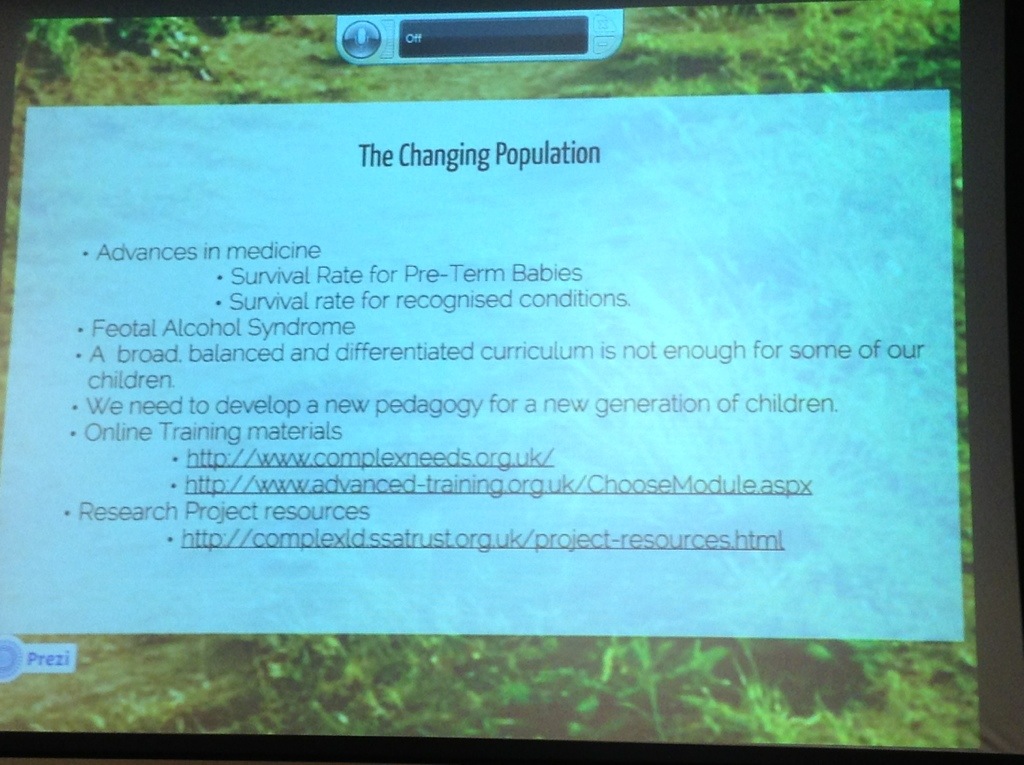
Six students were identified in the first instance that were disengaged with school. Alison was inspired by a talk she attended by Barry Carpenter about the changes in school populations, especially in SEN. Better survival rates among premature babies, for example, means some children’s brains develop differently and they don’t learn in the same way. Foetal Alcohol Syndrome is going to crop up more and we need to adjust curriculum pathways for those students.

Recommended training materials:

20131003-134122.jpg

Complex learning difficulties and disabilities: children might have a range of co-existing conditions. Attainment may be inconsistent and they can be working at any level. The key thing has to be personalisation, which develops from what the child wants to do. Meaningful learning only happens with engagement; but how do you measure engagement? SSAT do an engagement scale. It’s not an exact science but is helpful when you’re starting out.

Once planned, they identified project leaders and began to implement the project first by identifying students based on selection criteria, then base lining. They were insistent that it be blended in with everyday learning so encouraged teachers to drop something else to make room for it.

They share their successes with the kit they bought, including Eyegaze which allows for eye control of computers. This can be useful for dyslexic children to track where they are stumbling and how they read through a page. They also use the Kinect sensor which runs with an x box or a computer. He uses his with Visikord, a program used by nightclubs to creative psychedelic graphics of people dancing. This is very engaging for students and encourages collaboration. The Wii Music program gives students an opportunity to play musical instruments along to a computer generated track. Looper Dooper records sounds and then loops them, building up a sort of sound texture. This was helpful when engaging a student with cochlear implants. We also see an example of a student at the start and at the end of the project which demonstrated the increased engagement.

Really, really interesting to see the impact that well-planned intervention and personalised learning can have in a completely different setting.

20131003-140622.jpg

The biggest impact has been on mindset. If tech can engage the most complex pupils, what are he possibilities for the others? Find the right kit and think it through carefully. Concrete evidence is difficult to gather and case studies of the pupils were a more helpful way of measuring impact. The biggest outcome of this was that personalised learning is now at the heart of the school development plan, which is really great to hear – technology supporting pedagogy at its best!

Posted in wiltsict | Leave a comment

ICTWilts: iPadagogy

I’ve been looking forward to this one. Nicky Newbury teaches at one of our feeder primary schools and I have been down to see how she runs her digital leaders program. One of her DLs is in year 3 which is really inspiring.

Nicky has done quite a lot with iPads in school. She says, nobody who buys a drill wants a drill – they want a hole! And this is key for using iPads – it’s what you do with them that matters. Nicky began by researching all the engaging and motivating apps, but quickly realised it needs to be underpinned with pedagogy. The DLs were particularly good at asking where the learning was with various apps.

It’s worth trying new things because if you keep doing what you’ve always done, you’ll get what you’ve always got (Henry Ford). iPads allow for personalised learning, but they are a tool which needs to be used creatively. They allow enormous flexibility in teaching and stops the 1-to-30 knowledge transmission method in the classroom. Collaboration is arguably better than a one to one situation, so having only a few devices can help to develop this skill too. They promote independence. Improves connectivity and helps students to connect with peers and the wider world. It’s innovative and different.

We need to go beyond replacing pencil and paper with an app. Infuse the experience with creativity and encourage experimentation. Think about if the iPad is being used for consumption, creativity or discovery. Evaluate the apps and ask the students to do this in the classroom as well.

Why use iPads?

It’s blended learning – no need for ICT suites anymore. The tech is mobile and can go anywhere. Content can be consumed in innovative ways. It lends itself to typical classroom activities, motivates the disengaged and can help students to focus on deeper learning.
Some apps that fit: Epic Citadel for medieval town exploration; Explain Everything, a recording tool for creating explanations; Garage Band for creating music; Book Creator for student writing of books; Puppet Pals for easy animation (a personal favourite for me); and Comic Life.

It’s collaborative learning. Users can share ideas and content amongst themselves and around the country or world. Students can engage with a real audience in real time. Good apps for this: Dropbox; iBooks; Keynote; Popplet for mind mapping; Skype; Audioboo.

It’s Mobile Learning. Portability removes conventional limitations on where learning can take place. Nicky ran a contest for the most outlandish places learning with an iPad could take place, and found the students were very capable of coming up with exciting ways to use the iPads outside the classroom.

Did it have a positive impact? Nicky says yes. Students have developed critical thinking skills. It has n encouraged independent learning and helps students down the path to become well-practised digital natives.

Very inspiring, as anticipated. I totally agree with Nicky that the pedagogy has to underpin it and it’s clear that is the case with this project.

Posted in wiltsict | 1 Comment

ICTWilts: Visualisers

Luke and Linda have come from Westbury Infants to explain what they do with the Visualisers in class to show how powerful they can be.

Linda explains that writing, speaking and listening are what they target and it’s always been quite low, so that is what they decided to target. Apparently it is a problem faced by the cluster in Westbury (feel like I should know this already). Luke said that to begin with they put them into classrooms and left them for a month to see what happened, to try and iron out problems, though to begin with the reaction was quite negative. Early adopters found that it was a really helpful tool and could be used for everything, even ought the initial purpose was for students to improve their writing.

What the students in year 2 liked was their teacher having a book and doing the same thing and the same lesson. This is excellent modelling for them of things as simple as filling a line and writing on every page.

Students loved showing their work and it improved the quality of presentation. Students were really quick to learn how to use the visualiser so teachers could teach from the back of the class. They became more enthusiastic and made the learning more fun. They self-assessed the quality of their work because they all wanted it showed but wanted to make sure it was good enough, too. Handwriting has improved and they understand why handwriting is important.

It had a big impact on progress and students began to edit their own work, from year 1. Tey were able to mark their work and create next step targets.

Then they started to use them in other subjects – counting beads, leaves and live insects and burning candles in science lessons, masks and plays….it can be used for video and recording, green screen etc as well. Some models don’t do this so it’s worth thinking carefully about what they do. The school chose midrange ones which do everything they wanted. Linda says she likes the fact that they are dedicated machines, unlike iPads or similar, which are always wanted elsewhere. I am reminded that this is why I wanted Kindles.

Then we get a chance to play with a visualiser! Lots of fun. I’m impressed with how far they zoom in. Apparently one school had it set up zoomed in 200m on a robin’s nest. They play mystery object: zoom right in on a hidden object, what do you think this is?

They recommend making sure there’s space and that it stays plugged in so it is ready to go – good advice for any equipment really!

Posted in wiltsict | Leave a comment

ICTWilts: Russell Prue

Russell is talking about better learning through broadcasting. His handouts can be downloaded from his website andertontiger.com/Russell or you can text him for a link

20131003-102308.jpg

He talks about useful phones and how good Twitter is (laying it on thick about it being free) and how useful a moderated school Facebook group can be. Don’t be worried about people saying bad things – they say them anyway and you don’t insist on gaffer taping their mouths shut.

Russell has concerns about where ICT is going. Is technology becoming too techie for students? Then he shows a video clip of a toddler trying to interact with a magazine the way she does with an iPad. This is our next customer!

Russell set out to create the cheapest radio kit on the planet, because verbal communication is vital if students are going to learn to play the game they’re expected to play when they become adults. He talks about the positives of this and how it works in schools. He brings in the quote from Sugata Mitra: “children will learn to do what they want to learn to do” – he also makes sure we understand that he thinks independence, a self-organised learning environment, with staff refusing to answer any questions, is the very best way for children to learn. He also plugs @deputymitchell’s quadblogging as a way of ensuring student work has an audience. Radio ensures accountability and promotes living without a safety net/being accountable for one’s own safety, all valuable skills to use in the world. He also shares a positive quote from the British Dyslexic Association.

Russell has also created schoolradiocalendar.org which is a list of live broadcasts from schools all over the country. It’s very inspiring.

Russell finishes by recommending we check Innovate My School for reviews before we buy any other kit.

His summary? (Some of it, anyway)
1. Student ownership – no kit behind closed doors
2. Recognition of achievement
3. A good rewarding experience
4. Contemporary music
5. Fun!

Posted in wiltsict | Leave a comment

Inspire, Create, Teach – Wilts LA

Today’s conference at Center Parcs is focused on sharing good practice from the first phase of this project and inspiring those of us who are taking part in the second.

We begin with a keynote from Anne Casey on the changing landscape of ICT in schools. She’s the head of ICT at the Education Funding Agency.

She reminisces about the changes that have taken place in school IT – from Banda machines to the Internet to interactive whiteboards to memory sticks (sometimes the simplest things are the most powerful).

What we’re doing is inspiring, creative action research to maybe work out what the next phase of is development is. It’s important to get it right and quite hard to have an impact. “It’s much harder than rocket science.” There are also budget concerns, although this might be a blessing in disguise because people will less money probably make better decisions for their schools.

It’s important work because we’re going to need around 5 million more ICT experts coming out of education in the next few years, and they need to be taught and inspired in schools, not higher education.

Anne talks about it starting with Lego, to encourage creativity and building things. It doesn’t need to cost a fortune! She talks about the negative voices: it changes the relationship between teacher and pupil, it’s a distraction…if half the staff thinks this it’s really difficult to change the mindset. She shares Geoffrey Moore’s Crossing the Chasm diagram and talks about getting people on board.

We are moving away from big banks of computers and towards things like social media and mobile devices. Anne tells us that biros were banned in her primary school, and calculators in her secondary school. Now schools ban phones, yet this is the way we are naturally moving. The cloud is becoming more popular. Anne thinks we should spend more time improving use of interactive whiteboards in school because we haven’t got half our money’s worth yet. It’s important we don’t end up with dead technology that has no impact.

Anne shares a very cool augmented reality site allowing you to play with wind turbines online (ecomagination.com) but then points out that sometimes a picture or using a fan to blow their hair around can work better with students.

Posted in wiltsict | Leave a comment

ResearchEd 5: Becky Francis

Becky is talking about gender gaps and closing them: what doesn’t work and what might.

The current picture: the media reports that girls stretched the gap even further. The language, though, presents it as a competition, and a crisis. Becky reminds us that the research and focus in the 1980s, the research was focused on girls and improving their attainment. Although, surprisingly, not much has changed about this, girls have closed the uptake gap in maths and science. On the flip side, boys had not closed the gap in language and literacy.

Becky shares he gender gap which is around 10%, compared to 26% for FSM. so perhaps we should not talk about the girls and the boys, but think about which girls and which boys. She provides more evidence to illustrate that the biggest issue is in literacy.

The main explanations are: the feminization of schooling – boys should have more male teacher role models, a less feminised curriculum; essential differences between boys and girls; and the social construction of masculinity and femininity – expectations and societal messages transmitting the idea that gender is the key pillar of identity. There’s a lot of evidence around the final one, though less proving the others, and it is dangerous for us to apply strategies based on them in the classroom.

Becky takes us through some gender myths, including the importance of teacher gender. She thinks literacy is the key here and suggests some boy friendly strategies.

Reading boxes. Some schools have different book boxes for boys and girls to encourage reading – more non-fiction for boys, for example. This tells the pupils that reading is gendered, at boys aren’t reading, what teachers think is appropriate for them – princesses for girls etc – and this is all due to a method used without evidence.

The stats backing up a preference for non-fiction are a bit ropey. Many boys opt to read non-fiction because the pictures helped the strugglers to appear more literate. There’s no empirical evidence for learning styles, and gendered learning styles are even more problematic. We do know that there are preferences for learning styles – group work for girls, individual for boys, to generalise – but there is a danger of overplaying to this.

Short term and individual strategies don’t work here – we need a more holistic approach. Schools where gender constructions are less accentuated are the schools where boys do better. There needs to be a whole school approach tackling gender stereotypes, with high expectations of all, teaching strategies to encourage reflection on gender constructions.

She recommends, among others, Gender and Education: Mythbusters from the DCSF.

Posted in researched2013 | Leave a comment

ResearchEd 4: Tom Sherrington

Tom is talking about his school’s model. Every teacher is engaged with some sort of research – not in, but with. They have “A researched-engaged learning community” on their school sign. Some people are more engaged than others; half funding is offered for MAs and PhDs for the really enthusiastic which is great blue for money for the school. He talks about research as CPD, and CPD as research.

There is an outcome, a product which helps create the sense of being research engaged: a publication called Learning Lessons, written by one or more people and available in hard copy around the school or on the website. This helps to embed it in the school culture and shares good practice which was a problem identified in an earlier session. Tom shares specific examples: dialogic teaching, co-construction of learning and talking texts. He suggests this sharing vehicle is vital in setting up a research based culture.

He also recommends sharing through workshops – like the learning communities we used to have at school. There is workshop time on the calendar for people to use for their research, in twos or threes or more. Then there is market-place CPD for the workshops to share heir work, which helps people to focus their mind and write a summary of their findings. Tom provides examples of some workshops explorations: question spotting in Philosophy A level, physics marking, explorations into coaching, use of iPads in GCSE PE.

Is it research? Is it valid, transferable? Does it have an impact? It was valid: it had an impact in their classrooms and teachers experienced it which helped them to engage with research.

Tom talks about CamSTAR, a partnership with Cambridge university to facilitate action research in schools. Projects need a question – not a task. It needs an effective methodology – Tom shares an example of how a small sample size was very useful from the thesis of a colleague and reminds us that in data you lose detail. He then gives us some specific examples of projects: a French teacher and one student with Edmodo, a Maths teacher with flipped learning on three year groups, an MFL teacher with different student groupings.

He lists some methods. Assessment data, pre and post. Questionnaires, but take care over leading questions and question design. Qualitative observation and evaluation. Student interviews and teacher interviews, but be careful of confirmation bias.

Tom gives his own example: co-construction in year 10. He makes it sounds very desirable! Reminds, though, that not doing any harm is not a measure of success.

Be careful about what you’re looking for in action research. Education is value driven and imposing unproven theories on other teachers and classrooms can be quite dangerous. What works for you in your classroom is not the same as a solution for all. True in context is not the same as true.

In contrast with Laura it seems, Tom thinks there is no big question to answer out there, but that through action research we can come up with a body of experience upon which everyone can draw.

Posted in researched2013 | Leave a comment

ResearchEd 3: Laura McInerney

What problem in education would you pay £1,000,000 to solve? Laura talks about the Millennium Prize problems, and their predecessor, when the key 23 problems in maths were identified, the solving of which would have a huge impact. Hilbert thus reminded everyone what was important.

Education’s touch paper problems, then (because McInerney’s problems is too difficult to say). Laura has been considering what she needed to help her in the classroom. What can be done to help students learn? for example.

There needs to be some base of something, though – it can’t be all gut feeling. But, as a phd student in Missouri, Laura has found it difficult to work with schools due to timings, locations, a mismatch of methods and data and also of priorities – so randomised control tests aren’t the whole answer either.

Laura therefore thought that identifying seven problems, the solving of which would help teachers in the classroom and improve education. Others have done this: Australia and the cane toad, Feynman and the encyclopaedia on the head of a pin. But, it is the principles that are important. Not “there’s this computer program…” but “there are these principles on which I based is computer program…”. TedMed have some problems for solving on the cutting edge of practice but did not choose cancer because a lot is already known about it.

So, the problems…
– should be specifically focused on cognitive and or social development
– need to be about the principles and not the inventions
– need a defined end point. We’ll know when we’ve solved it that we’ve solved it.

We spend some time talking about what the problems might be. This is much harder than it thinks. Laura gives us a couple of suggestions, beginning with “What is the shortest time in which a person with dyslexia can be taught to spell the thousand most common words?” and “If a child needs to remember 20 chunks of knowledge from one lesson to the next, what are the most effective homework to set?” which is funny because it’s close to something I’ve been considering this week. They’re helpful because they provide a starting point, but there need to be more. Laura invites us to spend some time thinking about what they might be.

Posted in researched2013 | 1 Comment

ResearchEd 2: Kevin Stannard

Kevin is talking about the problems of educational research. He identifies, at the start, a lack of cumulative research and a lack of practical concerns. There is a poverty of educational theory. We lack an educational paradigm. Recent successful initiatives have run ahead of theory, such as 1:1 devices. There are lots of bandwagons and anecdotes but there is no theory. Similarly, much of the recent educational reform has not been based on theory.

We don’t lack evidence of what works. There are 1000s of articles, blogs, tweets etc on what works, and this has been incredibly useful for supporting initiatives, such as the Sutton Trust toolkit (have found this very useful in the past few years) and Hattie’s work. They’re evidence based and worth the discussion. There are, however, problems to be identified. A lot of the data is policy-driven which requires fast results. Evidence gets reduced to a narrow range of info that can be measured, completely ignoring the complexity of teaching and promoting a diminished vision of what teachers are there for.

Facts don’t interpret themselves. Kevin uses examples from Singapore and Finland, pointing out the respect and time allowance afford to teachers’ research in the latter.

Policy makers in a hurry need to be able to easily measure both the problem and the results. There is a danger of reducing things to a very simplistic level.

Small scale samples are really important. They’re very detailed, anthropological, but don’t receive funding or recognition like the meta analyses.

Rather than use data as a stick with which to beat teachers, we should encourage teachers to be the researchers. Kevin talks about the work of the GDST in encouraging teachers in their training and cpd. The problem is that research is not mentioned in the teachers standards, but supporting teachers to understand and interpret data and research is vital. Of course there need to be measured, but data provides an impoverished view, so value added and student achievement are important, but so are lesson observations, work scrutiny, student questionnaires etc. The lesson is only a snapshot of the process: planning and work scrutinies are important to the process too (hope Paul Clark reads this after last term’s T&L observations). The teacher’s role is multi faceted and can never be captured in a 20 minute observation, or even in an hour. Student voice is reliable, valid, and can be incredibly supportive.

Kevin shares a project of his own. It started a year early to embed with teachers before any results are measured. Teacher confidence is vital and was observable through lesson observations of various topics, the teachers moved away from seeing research as a threat and instead saw a process that would help them to improve their practice. Research should be seen as a peaceful garden of thought rather than the big stick.

I leave wishing that I worked for a GDST school.

Posted in researched2013 | Leave a comment