More Potatoes: following up on “Tough Reading”

(What is it in my brain that makes me always spell tough with a t at the end when I’m typing it?)

I have finished the potato lessons. I am a bit sick of potatoes now, if I’m honest. However, the cycle worked really nicely and helped me to get a good snapshot of progress to this point in year 8.

Having finished with the reading and the accompanying questions, we spent a quick five minutes discussing, variously, what famine is, what its consequences might be, what fallow means, how the agricultural cycle in Europe worked in the 17th century, why the potato is more productive, the benefits of the potato being calorie dense and how increased calorie consumption is linked to living standards. Phew. Across three different classes the discussion varied quite a bit.

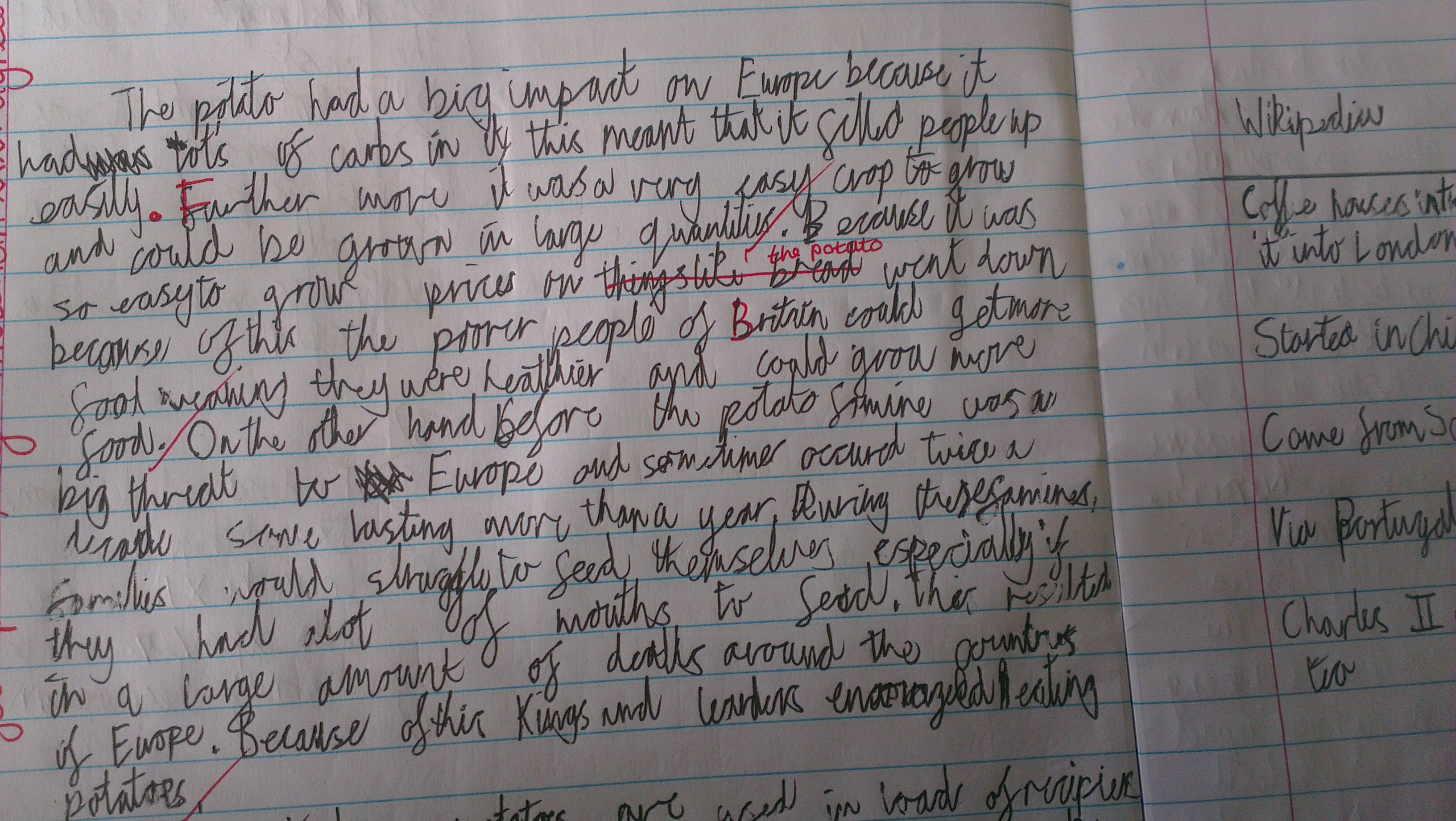
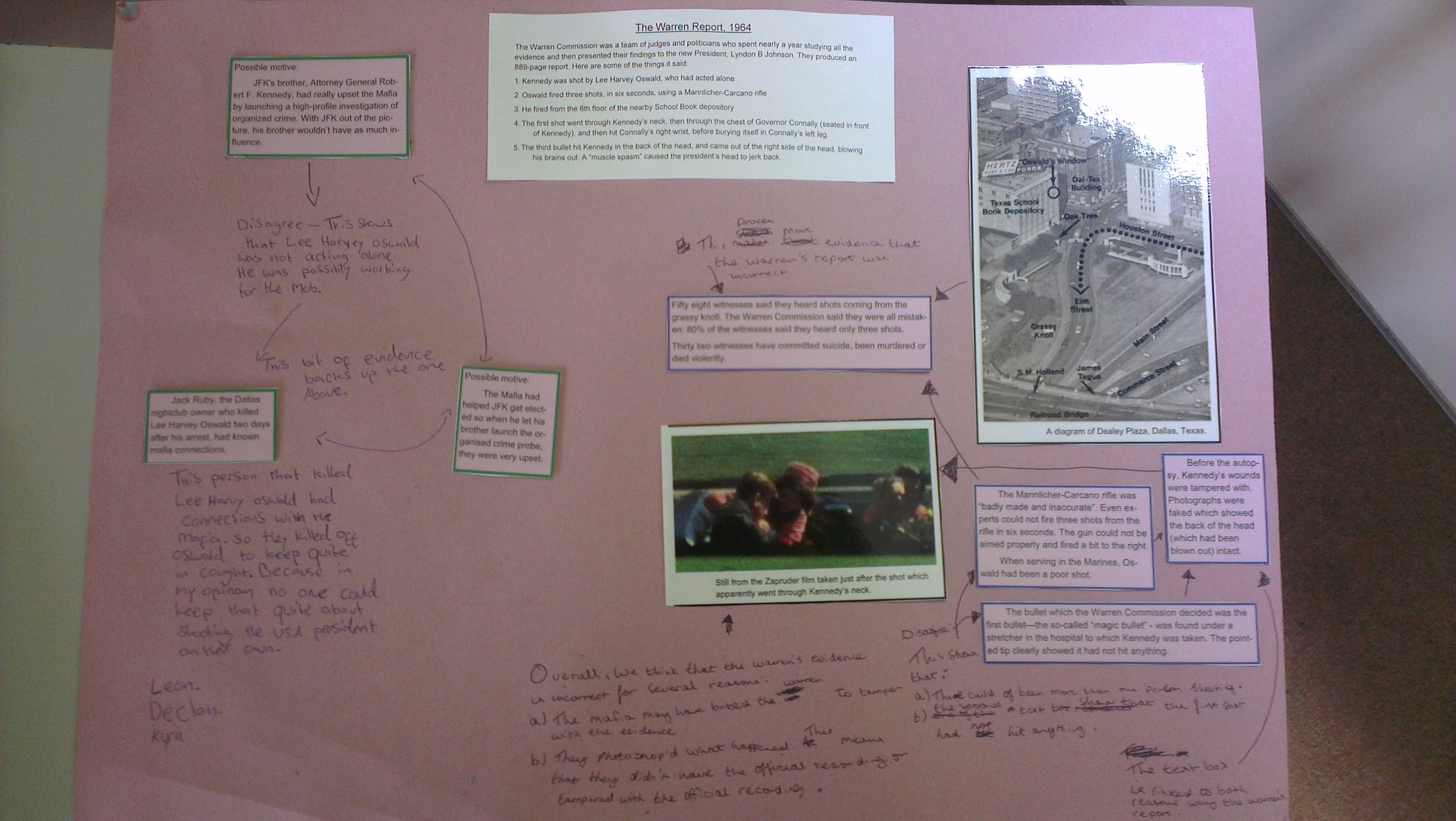
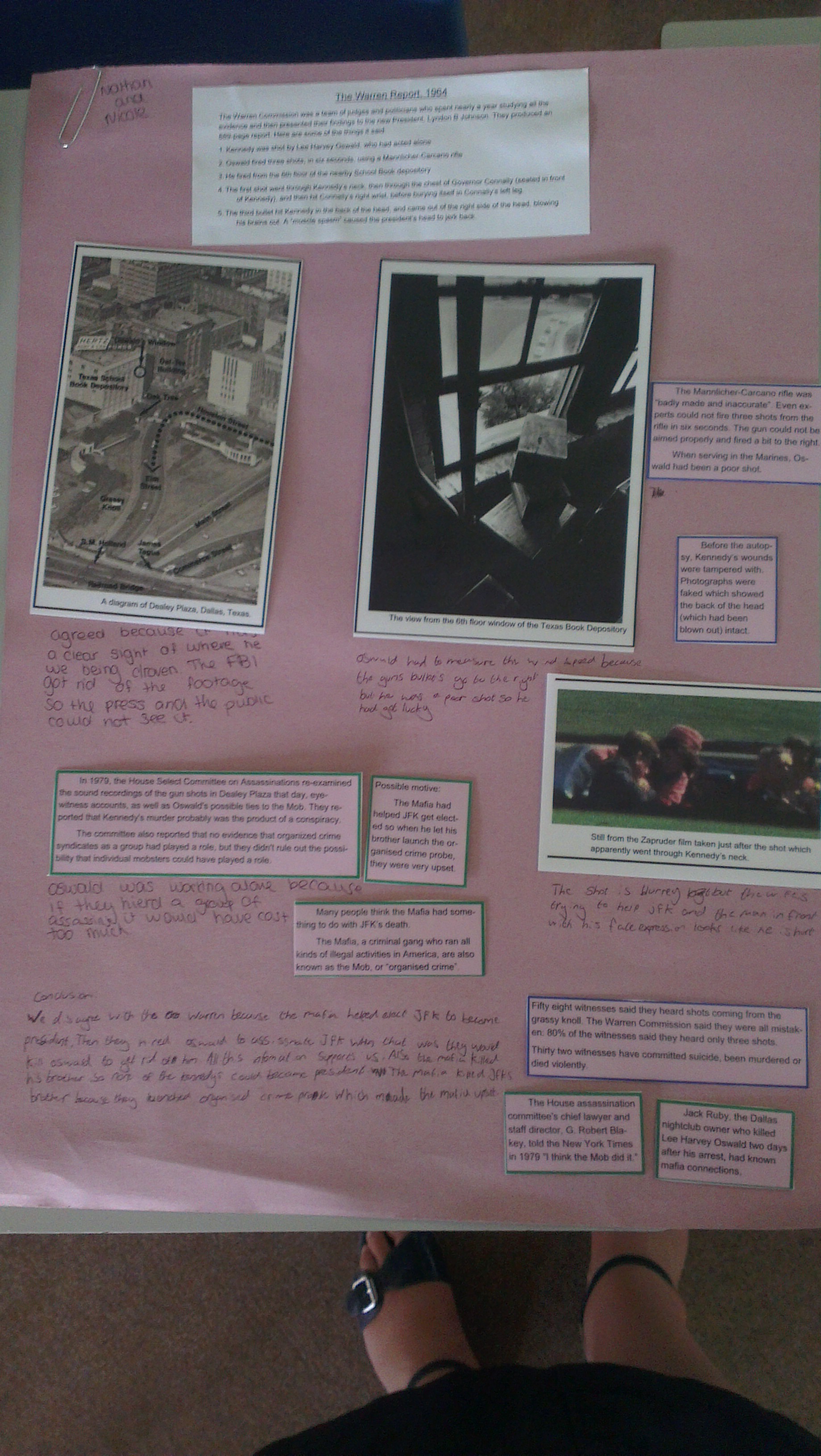
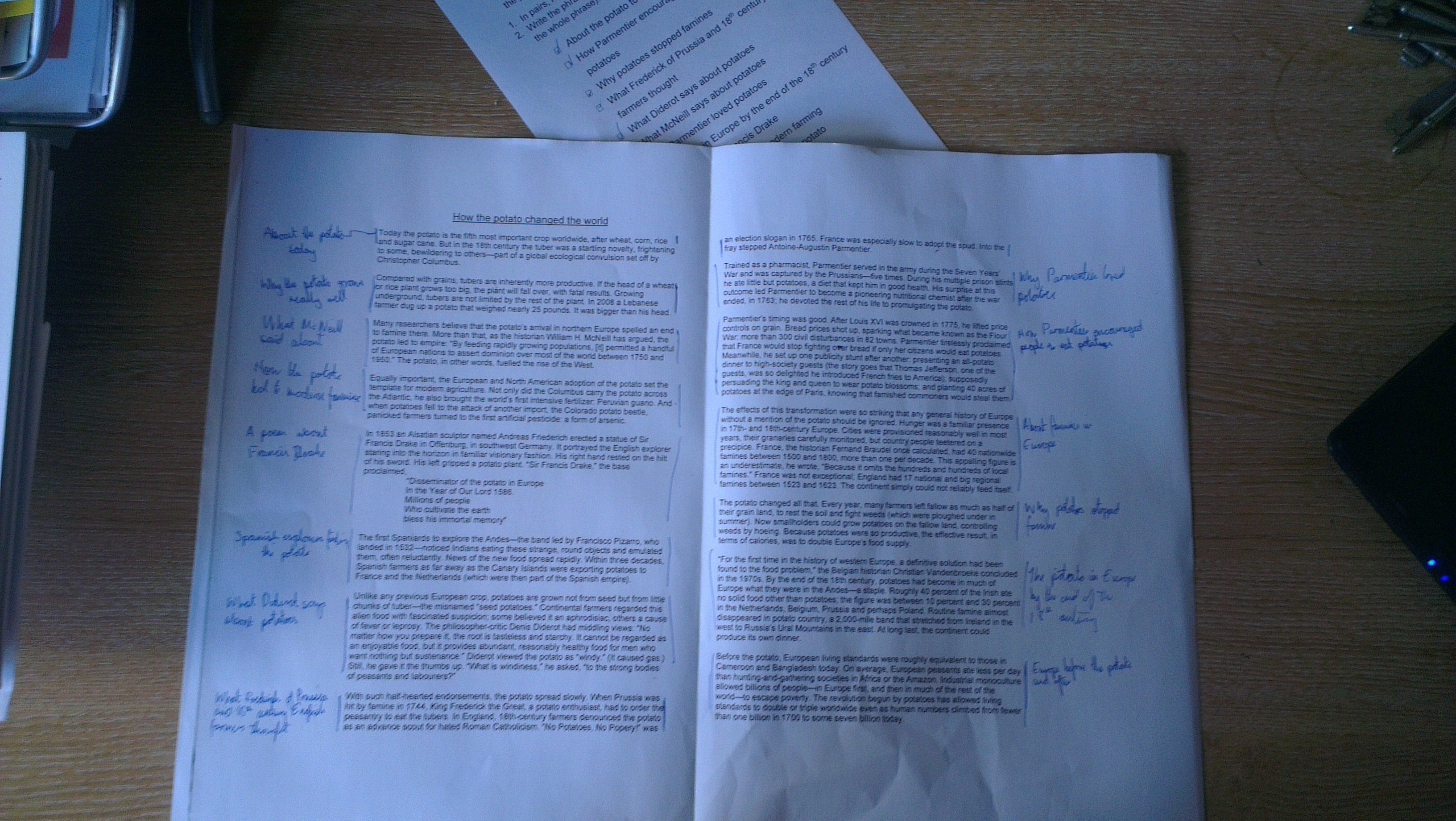
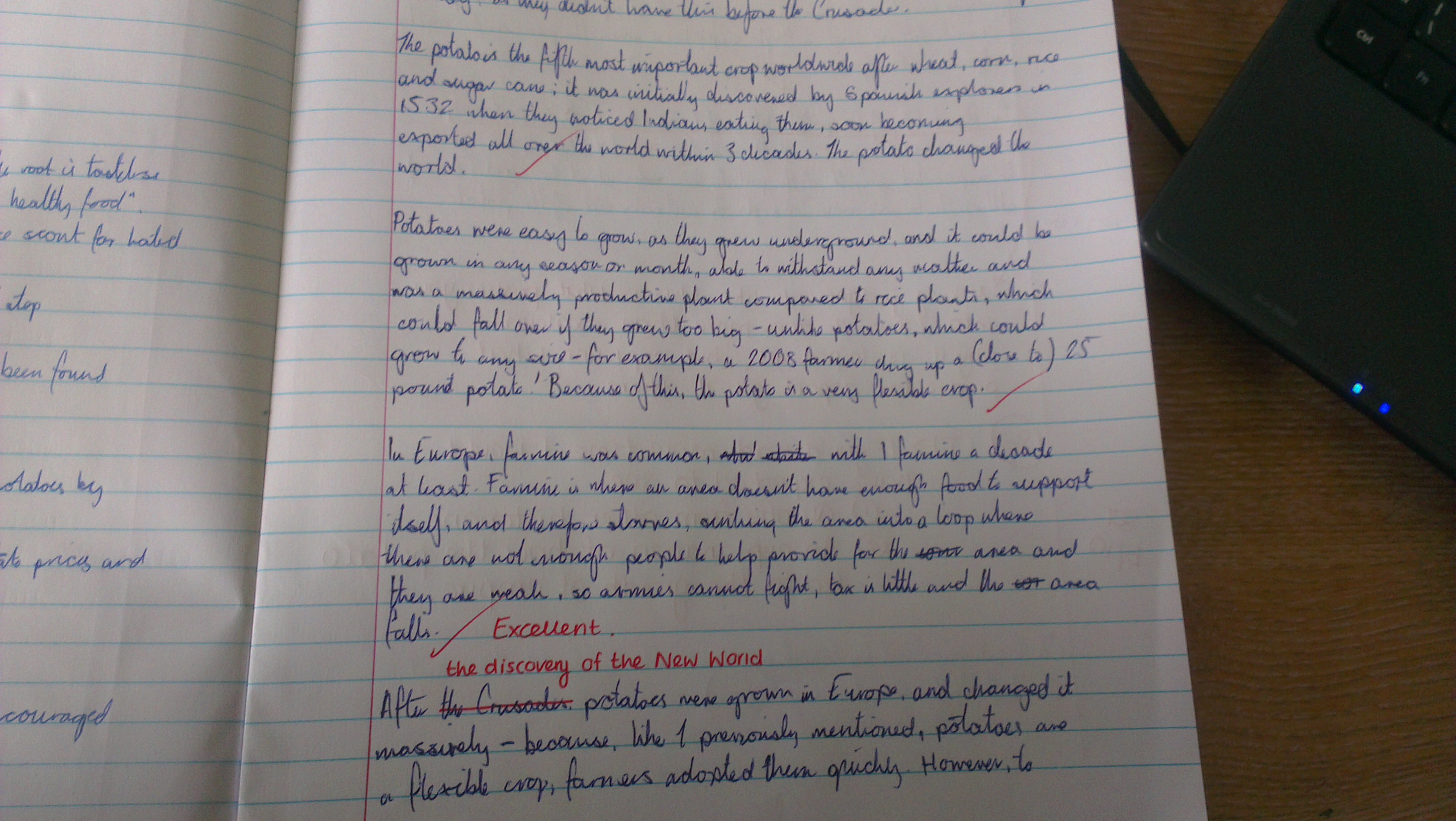
The assessment work varied quite a bit, too. IMAG1536 IMAG1537  IMAG1535 IMAG1532

These represent the full spectrum of the ability range I teach; I’ve just realised they’re all boys, too, which is probably not relevant, but interesting that they are the ones I picked to share. I feel quite happy that they were all able to get something meaningful from the exercise.

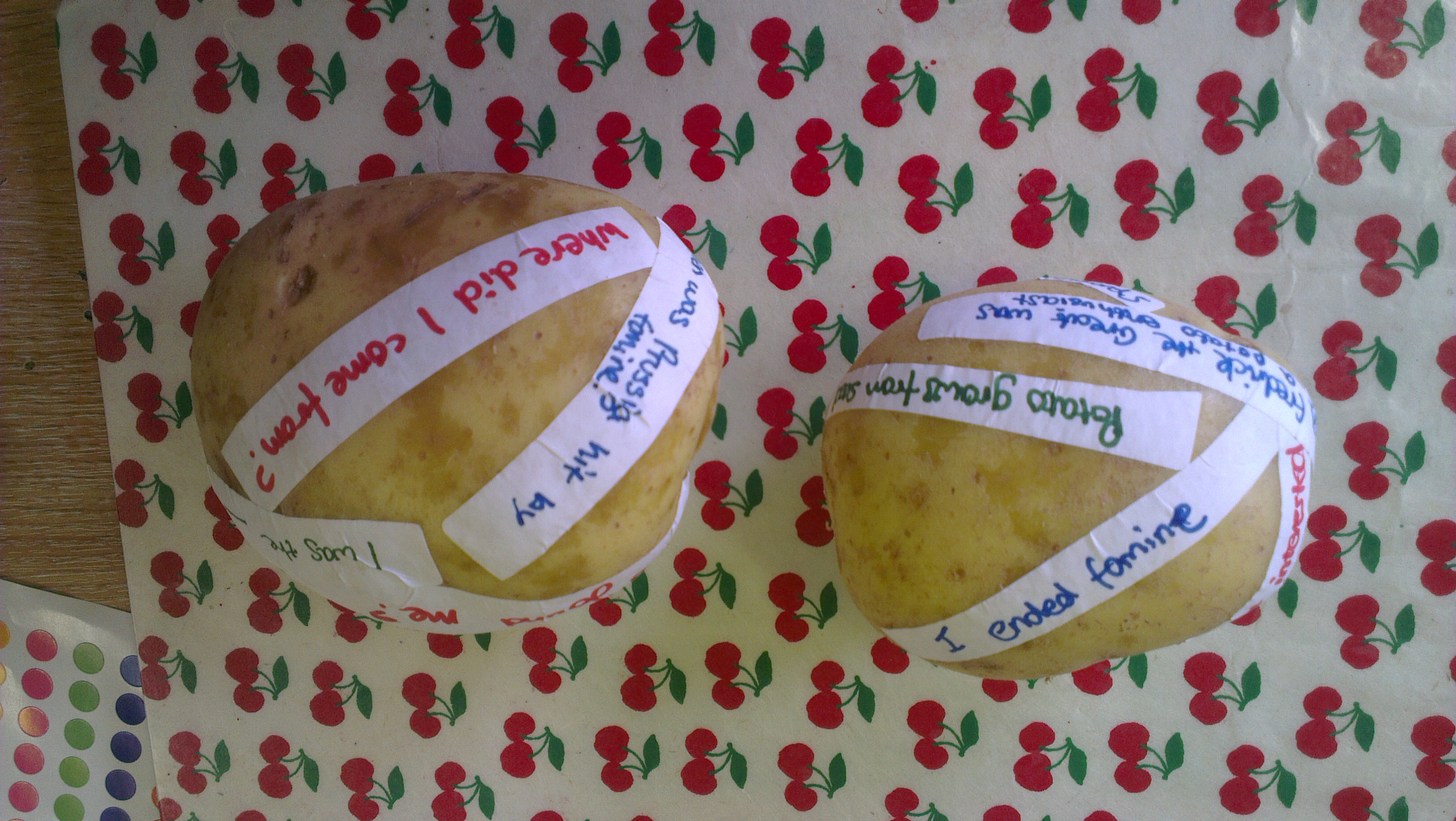
Our History NQT, whose main subject is Dance, taught these lessons to her Y8 classes too. She came up with this “Hot potatoes of facts” to pass around for a plenary and/or recap for a starter. One has “true or false?” facts on the potato that students discuss; the other has quick-answer questions; both helped to to check understanding of the reading. I liked this a lot.

Quiz Potato

When we are studying the rise of the British Empire later in the year I’m sure that the potato will be making a return. We moved on to look at tea, which also features quite heavily in the Empire unit. Interestingly, in the reading I’ve done for these lessons, Fernand Braudel has popped up in both cases. Perhaps he will be featuring too: I expect he has quite strong ideas about the reasons for the growth of European empires. Either that or he was obsessed with food.

For our study of tea, we looked at three different web sources and practised cross-referencing; now we’re looking at sugar, using a slightly less difficult reading I found (no Braudel in this one) and so I have asked them to create their own paragraph summaries, instead of providing them. It is going well. The secondary purpose of the sugar lesson is to get them to recap prior learning of the slave trade; there is a great quote from a Trinidadian historian in it, positing that slavery created racism, rather than it being the other way around. Cue a good discussion on whether that means sugar created racism, since the Transatlantic slave trade grew in the main due to the damn on the sugar plantation. I got some good “big picture” stuff going on with this, though we all agreed at the end of the lesson that it was a bit mind-blowing.

Posted in History, lesshelpful | 1 Comment

Less Teacher Talk

Last year, for my self-directed appraisal target, I picked to focus on talking less in class. I have a good teacher voice and I like to wax lyrical; sometimes I rely on this too heavily, particularly when I am tired. I should know better: my own mind wanders at an astonishing rate when I am just sitting and listening, which is why I take notes/blog at the CPD I attend – otherwise I can’t guarantee I’ll be able to maintain my focus.

I asked for help coming up with ideas to talk less from the Teaching & Learning Team at school. We talked about a few ideas and one of my Geography colleagues, Ghaz, talked about her mystery lessons. If you talk too much in a mystery lesson, it ruins the mystery, so it should be a really straightforward way to ensure one talks less. This reminded me of an exercise I once saw done at SHP with sources and so I decided to try it with my year 9s during their study of JFK.

I planned a three-lesson sequences focused on the alleged mystery surrounding the death of JFK. I’m not really one for conspiracy theories but we do this every year with Y9 towards the end of term, because it fits into our wider study of the 60s, it’s vaguely familiar (important with students who have had their final levels reported and might not be continuing with history at GCSE) and it’s a really good exercise in looking critically at sources.

In the first lesson, I introduced the topic with the iconic picture of JFK Jr saluting his father’s coffin, asking for inferences. I then expanded the picture to include Jackie and Caroline Kennedy, and explained that it was a funeral. They then did this task:

jfklesson1

I made the information into QR codes, which were printed onto coloured paper and stuck around the room; students used school iPods to go treasure seeking. I used my usual trick of telling them to read the instructions on the board and ask me only if they didn’t understand: everybody got it, so I barely spoke at all. At the end of the lesson we recapped the main events, according to the Warren Commission.

I started the second lesson like this.

jfklesson2starter

I do love a good “True or false?” starter. As I had hoped, it led to a lot of discussion, which was led by one of my laddish boys – less talk from me again. Then we moved onto this:

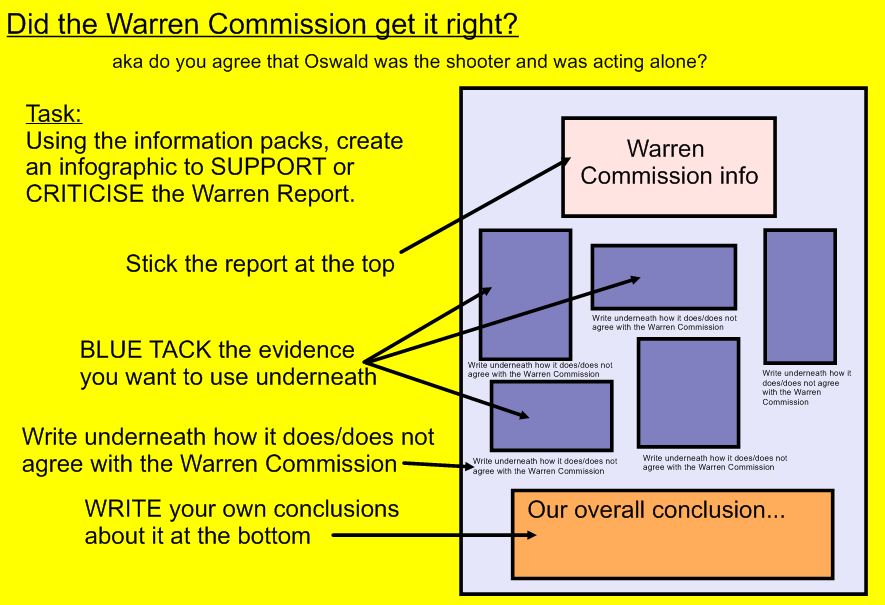
jfklesson2main

They completed this task in pairs, and using slightly different information packs.  They all had some of the same information, but the rest was intended to lead them in one particular direction. Some students had information that pointed towards a Mafia conspiracy; some pointed towards a government plot; the final set pointed towards a communist plot. I chose the pairs ahead of time and planned which pair would have which piece of evidence, which allowed me to differentiate as some of the evidence is more complicated. This was a bottom set; with a higher set I might have mixed the evidence up or provided two conflicting sets for my top achievers.

This section of the mystery was based on the activity I saw done by Dale Banham and Russell Hall a few years ago at SHP, which was about the murder of Kirov. Giving out different evidence ensures that each group will come to a different conclusion, which provokes valuable discussion, both of the topic (verbal rehearsal for writing up) and the nature of evidence.

The pairs were eager to get started. Again, nobody needed explanation after reading the instructions and checking with each other; I circulated the room prompting them to look at this piece of evidence or that. Nobody used all the evidence; I had purposefully provided too much to try and encourage them to be discerning about what they used. For people needing a bit more of a push, I provided a list of things to consider. Less talk from me again.

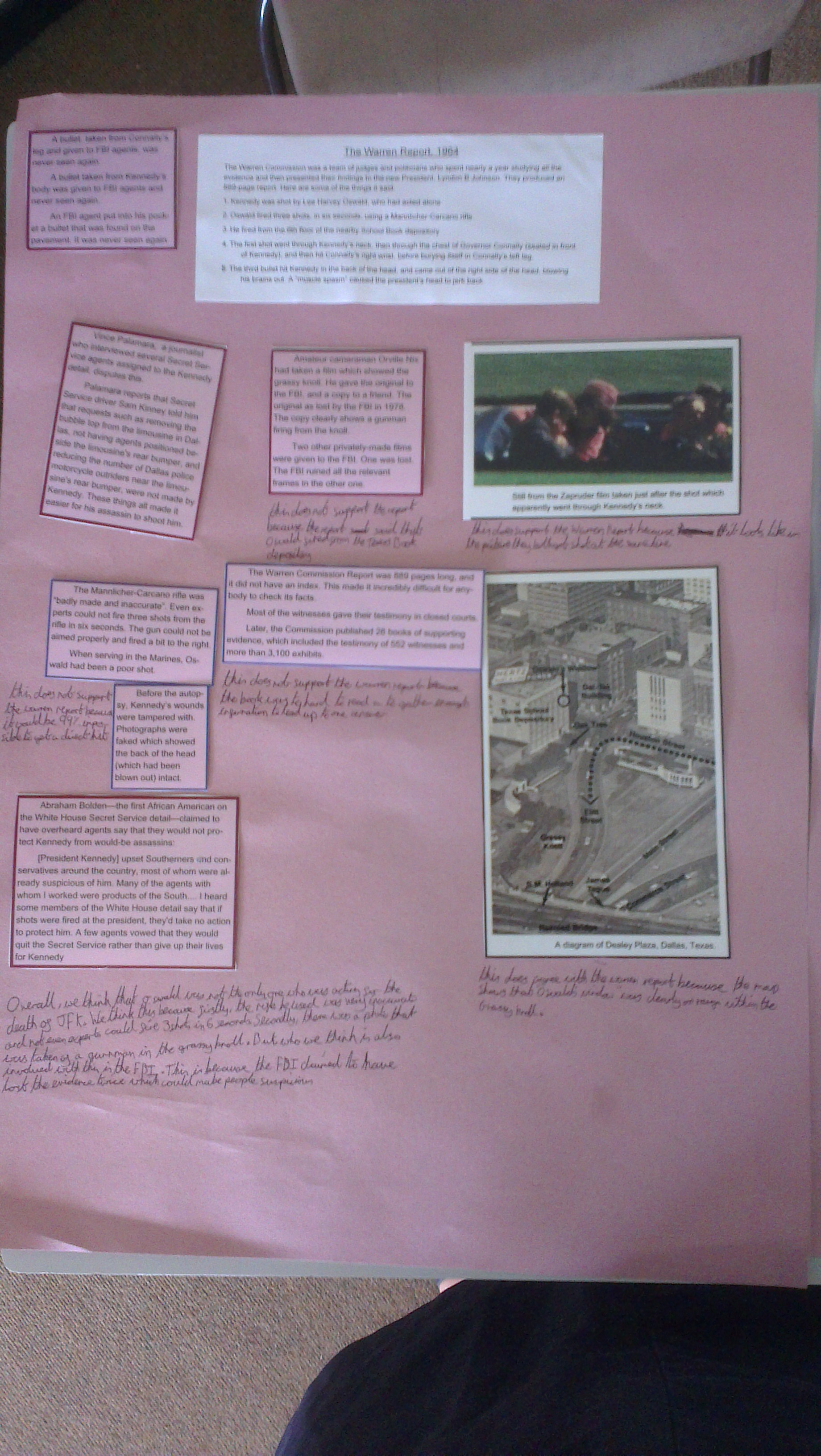
The activity took the rest of the lesson and half of the third lesson. At this point student pairs – now Expert Investigators – presented their infographics. For this I provided spectacles (3D ones with the lenses pushed out) and a magnifying glass, because, in the words of Sheldon Cooper, what’s life without whimsy? Some were dismayed to find convincing evidence that pointed in a completely different direction to theirs, which made them really think about whose evidence was more trustworthy.

IMAG1288

IMAG1285

IMAG1286

Bonus feet in that picture, sorry.

Overall? I barely talked at all, so in terms of my target, it was a winner. It created some really heated debate about who did what and the difference between circumstantial evidence and solid fact. It inspired a definite thirst for knowledge among my students, some of whom started badgering the observer (a fellow history teacher) for more facts they could use to win the debate. Some went home and found more information, off their own backs. A bottom set, most of whom were in the final throes of their history education. I was impressed! We’ve had a bit of discussion about what outstanding classroom behaviour looks like, with the suggestion being it is characterised by a certain “leaning-in” of students – they were definitely leaning quite a long way in with this one.

Drawbacks? Making the resources took a while but I will always have them now; and so will you, if you want them.

My resources –

Lesson 1 – fact-finding QR codes

Lesson 2 – evidence

Things to consider

The PDFs were Publisher files but WordPress objects to those – please contact me if you want the editable versions.

Posted in History | 1 Comment

The History Department at Open Evening

We’ve had some very successful History open evening activities in the past, my favourite being a version of Call My Bluff where students challenged visitors to guess what various artefacts were and what they were used for. I still have the outlandishly heavy canning machine my father in law loaned me for the occasion.

This year, we were assigned students from year 8 as helpers and, as year 8 are currently studying a new development unit, looking at the changes in the British diet since 1000 and the reasons for them (as mentioned in my previous post), we decided we’d challenge visitors to create a timeline of various foods.

I went to the supermarket. We labelled our pushed-together tables with four time periods: Present in Britain in the year 1000 (walnuts, grapes, peaches), Introduced by the Crusaders (spinach, raisins), Introduced from the New World (potatoes, tomatoes, chocolate) and Introduced in the last 200 years (pasta, bagels). The food was presented on plates and visitors had to guess three correctly in order to win a snack of their choice from the plates. Meanwhile, the year 8s were on hand to explain that grapes had been quite common in the year 1000 due to a slightly warmer climate (which they know from their reading of sections of this book), but that making raisins would have been very difficult without the heat of the Middle East; that potatoes rid Europe of famine; that people didn’t eat tomatoes in Europe for a long time because the leaves looked like those of the deadly nightshade plant; and so on.

It worked really well as an activity because the year 8s had plenty to say on the matter and were really eager to show off their knowledge; and surprisingly, not everybody picked chocolate as their prize.

I expect if we do the same next year I can come up with something a bit better than pasta and bagels for more modern introductions to the British diet. This is the problem with having not taught it all the way through yet – there might be something far more important and interesting when I finally get there.


Posted in History | 1 Comment

Tough reading

I have a pet hate about difficult readings in class. It is hearing teachers say, “Well that’s great, but my class would never cope with a reading that difficult”. Clearly I understand that context is all and tailoring a reading to your class is important; however, I believe that, given enough time and support, any pupil can access any reading. I also think it’s part of my job to provide strategies for tackling difficult readings, not least because, with a tierless History GCSE that includes a source paper comprising several (often wordy) written sources, I can’t risk them going into the exam and losing their mind in panic.

We’re trialling a new unit in year 8 looking at the British diet since the year 1000 and how exploration and migration has changed it, and this week we reached the Tudor explorers and, most importantly, the potato. I did a bit of background reading about the humble spud and came across this article, which essentially suggests it changed the world by wiping out famine in Europe. Mind. Blown. This is just the sort of history I like for KS3 – seemingly routine facts (the potato arrives in Europe) that lead to big ideas and changes (the growth of western Imperialism, population increase and the Industrial Revolution).

The article is long and verbose. I cut out all the superfluous detail – the section on guano is great but probably not vital for the task – but I was still left with two pages at what Word told me was a Y11 reading age. I remembered that lesson right before Christmas in my PGCE year, when my mentor took the information sheet I had been up until 1am preparing, gave it to a student with a highlighter and an instruction to highlight unknown words, and presented it to me at the end, a riot of colour. More than a decade on and the lesson is still fresh.

Instead of rewriting in easier language, though, I employed a trick our Head of Geography shared at a Hums faculty meeting years ago. I read the paragraphs carefully and wrote a statement that more or less summarised each one. I looked for names and dates, which I find easier to pick out when I’m scanning text.

I presented the task with this slide. (Climbing a mountain is a good simile for doing this reading, but I’d be lying if I said my choice of pictures had nothing to do with the imminent start of the snow sport season.)

Tough Reading Slide

I provided the reading in the centre of an A3 sheet and the summary statements on a tick sheet; they did this in pairs. We talked about reading strategies and I taught them my capital-letters-and-numbers trick. One of the students pointed out that names are easier to find in an article like this because they won’t be very common. Brilliant.

I taught it to a top, middle and bottom group within the space of two days, and the results were startling. I really felt it was one of those lessons that might just fall over, and had a second task prepared, but, without exception, they all did a great job. Given half an hour to do the task, my brightest students got about half way through the accompanying questions; they all learned that, when faced with a long and difficult reading, just reading it is not always the best way to go. “I didn’t actually read it, Miss,” said one girl, after answering the questions on the text correctly. “I just picked out the bits you were asking about.” Indeed. Totally not reading it.

jbwork

Some notes:

1. Not good for cover. I had to go and be in the Y11 photo with my tutor group which took longer than I thought, and I came back to find the poor Maths teacher had resorted to reading the text aloud to a stunned-looking class. They need take-up time and the modelling of applying a statement to the reading.

2. Some words still need explaining. I challenged my lower set to identify the words they didn’t know that were preventing them from doing the task. We were able to agree that not knowing words like Lebanese and promulgating were not holding them back; but famine was one that was quite important. They were able to work this meaning out from questioning about the context, much as they did with the word tuber.

3. This will be followed up with a mini-assessment task on the impact of the potato on Europe. I hope the answers will range from description of who liked the potato and the impact it had on famine, to analysis supported by quotes from modern and contemporary sources. I think this is a benefit of using a more complex reading: it can provide the appropriate level of challenge for all.

Posted in lesshelpful, wins | 1 Comment

Tata, Gove

Watching the news of the cabinet reshuffle tick across the BBC website this morning felt a bit like a slightly more middle class version of watching the contestants go into the Big Brother house. Each newbie was duly inspected in a cursory fashion on theyworkforyou.com and possible future impact considered….and then the Gove news broke and that was it, really. It was very exciting to make it up to the staffroom at break time and find there were people who hadn’t already had the news. I felt like Santa.

There was a bit of the usual snidery on Twitter about how he wasn’t that bad and it won’t make any difference and teaching didn’t suddenly get easier overnight, and so on, but I don’t really agree with much of that. I didn’t agree when people said he has never said anything negative about teachers, either; saying lots of positive things about individual teachers in various speeches does not make up for that dire piece in the Daily Mail (of all papers), in my book, especially when the vast majority of those individual teachers have moved out of the profession to work for some sort of right-wind organisation or come from some other context that is completely alien to my own. I haven’t seen anything to prove that he values teachers en masse.

I agree that it might not make much difference to policy. Change is hard for everyone, let alone for a profession that stakes its professional reputation on being right, but now we’re on that road I can’t see there being a straight turn back.

However, I do think it will have an impact, and that impact will be on our relationships within the profession. I feel quite strongly that he has been very divisive among teachers, in a way that no Ed Sec has been during my time as a teacher; I’ve started to wonder if it’s a deliberate divide-and-conquer he’s been running or just a happy accident. He has caused us to pull in different directions over the past couple of years, in the same way that a class with a very critical teacher will become more critical of each other, and we are the poorer for it. The best joke I read about the change is that he’s left a note, a la the departing Labour government in 2010, except that his said, “Good luck – there is no morale.” That rings quite true.

So I am quite pleased he’s gone, though I feel a bit sorry for him, that the news is reporting it as a step down in spite of Downing St saying it’s not. Also it must be frustrating to not be allowed to see it all through, like a headteacher removed from a school placed in Special Measures before his/her new ideas can really take root and flourish. But, I must remember the email conversation I had with Radio 4’s PM program earlier this year, when they got the wrong end of the stick and thought I was so disgusted with Gove I wanted to leave teaching. “I love my job and I’m not going to leave,” I replied, “because I’m pretty sure I can outlast him.”

And this, too, has passed. It’s moments like this that make me grateful I always keep prosecco in the fridge.

Posted in Uncategorized | Leave a comment

SHP2014: Christine Counsell

Christine is speaking about knowledge. We don’t spend a lot of time talking about it which gives us bad PR as a profession. We should attend to it much more explicitly and not be frightened of it. The reaction from the middle of last century about the focus on high politics and memorisation, which turned children off and proved inaccessible, is now firmly in the past. SHP was about moving away to a broader range of content and engaging children with the raw materials of history: many good things, although perhaps some babies were thrown away with the bath water.

Therefore, Christine has been thinking about equipping children with enough knowledge to be able to do history really well, and what is enough to go out into the world as an educated historian.

We read an extract from Schama, underlining the words that have a meaning to use due to us having historical knowledge. Recognition and resonance are really bound up with knowledge, and as Hirsch says, a knowledge-rich experience allows for a better understanding of the words. So, when students struggle with a piece of reading, it’s not just a literacy problem – it’s a knowledge problem, too.

We look at some examples of student work and consider why one is better than the other. They are both very good and it is difficult to pin point exactly why one is better than the other. One provides better context, and shows good temporal agility – the ability to whizz around the topic and move back and forth through the timeline. Secure knowledge helps with this and also enables students to step back and be able to look at the whole picture which means they can work with concepts such as (in this case) “the public” and their place in the story. Someone comes up with a good football metaphor, that student A is like a Brazilian footballer in the recent World Cup match who has to concentrate hard on the skill of footballing and showing it off (or the knowledge in the history case) whereas student B is a German footballer who can pass and show their skill without thinking about it and so can instead look forward to where they are going instead of demonstrating the basics. This gets a round of applause….I hope I have characterised it correctly.

Christine makes the point that there is a certain amount of knowledge for each lesson, for the teacher to identify and consider, that cannot be outsourced: things that they need to learn and to know in order to access the rest of the lesson. This is why we need to think of a curriculum design culture, rather than an intervention culture. We need to establish an end point and ongoing content repertoire that helps us to measure what students have learned and ensure they finish key stage three with a clear picture that they can take forward. Patterns of resonance build up: as history teachers, when we see the word Renaissance, it resonates with a thousand stories, and this should be our aim with the students.

Christine talks about fingertip knowledge and residue knowledge. She admits to having a terrible memory for dates (this is comforting because I am also in that boat) and gives us an example of her own: when she taught late 19th century political history, she know all the dates and details of Gladstone and Disraeli, and although she has now forgotten the detail – the fingertip knowledge – but it has left a glorious residue in the sieve of the brain that gives her an enriched understanding of the 19th century and helps her to better understand the 20th century, going forward. What do we need to enable this? Saturation in glorious knowledge. She talks about Ians Dawson and Luff and their role plays and story telling, which give us an enormous amount of knowledge that is necessary in order to make judgements about, for example, Bannockburn’s significance. As teachers, we need to attend to the poverty of students’ brains.

We consider a 17th century enquiry of our choice and identify pieces of knowledge that might be necessary to be successful in studying this topic. Then we consider what knowledge they will need to bring with them: what prior learning will they be pulling on? Then we attempt to classify e types of knowledge: phenomena, people, events…? Categories of our choosing. We struggle with this, having a discussion about knowledge that transcends the time periods, eg treason and conspiracy, and knowledge that needs context, eg the relationship between Catholics and Protestants at the start of the 17th century. Someone else suggests bits and isms.

Christine suggests five:
1. Chronological frameworks
2. Substantive concepts
3. Particular stories
4. Particular personalities
5. Contextual knowledge of the period before

We look at some of Christine’s examples. She said that in her previous department, they decided that they wanted assessment to be driven by what the students needed to know. Thus, a no-revision, no-books timeline as a low-stakes, “fun” test – can you timeline everything we have learned so far this term? Secondly, a timeline done based on revision, with an analytic comment linked into change over time. Finally, a no-notice essay, based on prior learning. These things are also useful things when it comes to checking knowledge. Think about, though, what is useful to you and to them?

A mixed constitution is important for assessment. Timeline tests, and of enquiry substantive outcome activities, mini tasks to show fluency in substantive concepts, routine little checks (I think this would be the scaffolded marking I do in lessons). She reminds us that levels were never intended to be used on individual pieces of work, or even at the end of a year. Using them like this makes it difficult to judge the knowledge in a piece of work, because if you only look at marks you can’t see the knowledge sitting underneath it. For example, when working through piano grades a students might get a pass, a distinction, a merit, another distinction, and then a pass on the the next four grades; so her marks graph will not show progress in terms of marks, but she WILL have a better knowledge of piano playing and have made huge progress in this area. That’s why the levels don’t really work, because it makes it very difficult for us to judge a student’s knowledge.

There is a bit of hope, though, in the form of an end of year exam, which can be quite knowledge focused but can be given a percentage, thus pleasing SLT. We look at some examples from Christine’s pizza assessment group.

Christine finishes with a quote from Daniel Koretz: “Teach to the domain, not the test”. This is a good excuse not to endlessly practice the types of questions on the test: the test just measures the domain, dipping into it, rather than being the point of the learning. Finally, knowledge matters at key stage three because it provides a breadth of understanding that is a vital platform on which to build GCSE knowledge.
Posted in shp14 | 1 Comment

SHP2014: Teachmeet

Ed Podesta first. He’s making a plea for teachers to come and help answer questions and provide advice for students on the student forum section of the schoolhistory.co.uk forum.

Luke Mayhew second, talking about GCSE Classical civilisation. He pitches it as a way to appeal to students across the ability range – there is a foundation and higher paper – and those who are more interested in the ancient side of history. There are plenty of supportive societies that are willing to help with funding, an excellent text book, accessible questions on the exam paper, and plenty ideas for independent and collaborative learning.

John Heffernan third. He shares information about the Digital Public Library of America, which allows museums and libraries to share their resources all in one place. It’s a great resource site for history teachers, with a huge collection of stuff from all over the world. He shows us a few of the collections.

Phil Mctigue (?) speaking next, he provides words to help students scaffold their work on cause and consequence.

20140712-174700.jpg

Lesley Ann speaking next, on speaking for literacy. One idea is to chop up a key word on two sticky labels, and once they’ve found their other half they have to come up with a definition; then she references Manglish and the strategies in them to encourage fluency. Time students discussing a topic they are good at and challenge them to do it without fillers, hesitation, ellipsis and elision.

Stuart speaks about causes. When we talk about causes as teachers, sometimes you see eyes glaze over; and sometimes students struggle to grasp the concept of multi-causal. Stuart came up with the idea of multi-causal whacking stick. “If you can find a cause of xyz in this text book then you can hit me on the head with a rolled up piece of A3 paper”. Or they could smash up a stack of cardboard boxes.

Siggi Pickles shares an idea she pinched from a science teacher – purple pages of progress (I like this, it sounds like my purple pens idea). Students receive a differentiated sheet to help them improve their work and act on feedback immediately to improve their work.

Dale Banham talks next about a homework that involved finding funny misspelled signs, to help them focus on the importance of good literacy. If students are struggling with their writing, use the idea of the black box: there needs to be a stage of the lesson where you’re really challenged, when you’re in the pit; afterwards students can go to the black box and record what their problem was and how they got out of it, so that other students can use that in future.

Izzy speaks about building learning muscles, habits and skills. They ran a cross-curricular project about Medieval castles: good historical design from history, correct building materials etc from science.

Emma talks about her work with flipped learning. Emma created work books for her students to use at home instead of creating videos. There were three differentiated tasks within the workbook, and this allowed students to cover the content at home and then do more analytical and evaluative stuff in class. It improved student confidence and engagement, and made them much more resilient.

Richard Kennett rounds things off by talking about Poundland pedagogy. He used window pens to create different/similar word walls for his A level students. He dissected a rubber pig filled with felt organs to demonstrate Galen’s work on medicine.

Posted in shp14, teachmeet | Leave a comment

SHP2014: Neil Smith and Simon Orth

Neil and Simon are explaining the Harkness idea of collaborative learning.

It involves a bit of the flipped learning idea, where students read and complete tasks before the lesson and then discuss it in class, tackling tasks set by the teacher. This encourages co-construction within the course of the lesson: students are passing ideas around and building them up in the classroom. The teacher acts as the facilitator and inquisitor – they are not there to deliver knowledge. One example of a teacher task would be to map the contributions made to the discussion, possibly identifying connections or discussions between each pair of students, and then feeding back to students on their contributions at the end of the lesson. The teacher might be directly involved in the debate, asking questions and adding their own ideas.

Why do it? It helps to create better historians, for a start. Chris Husbands, director of the IoE, in Great teaching and how to get it; Hattie; EEF Toolkit all provide educational research to back up the benefits of following the Harkness method, in terms of promoting things like collaborative learning, peer feedback, meta cognition etc. It solves perennial A-level problems: not enough reading, difficulty in constructing analysis and evaluation. It provides opportunities for different types of feedback, builds in modelling of good work and develops greater independence of thought and action. Finally, it increases student accountability.

We role play the method by reading a few extracts (not a proper example of a Harkness lesson, we are told, but necessary to model the method in a short time slot). Reading should be purposeful: read and annotate with a question in mind. Then we have a discussion in which we all take on different roles, while one member of the group maps the connections between the participants and notes down what sort of contributions they are making. This is helpful for identifying which students perhaps haven’t done the reading/work or who, perhaps, is not feeling especially confident about participating in the discussion. Suggestions about this include doing it by passing a ball of string around and apparently now there is an app you can use to do the mapping.

Groups of 12ish work for this, but a class could be split into 2 groups, or two circles, with the outer circle being observers or navigators. Neil has used it lower down the school, splitting classes into groups of eight and having a student moderator within each group. When it comes to ensuring students prepared, they tied it to essays to give it a really clear point; practice and training helped too, because after a lesson or two students found they didn’t really like having nothing to say in the discussion.

In its purest form, students would use Harkness in every lesson, necessitating 3 or 4 hours of reading every night, which is not really realistic. At MGS, units were planned and the Harkness session was built in to each section of the SoW, so that the reading was more likely to happen and had a clear point to it at the end. It allowed for the summing up of each section in a meaningful way and for consolidation prior to writing a practice response.

St Philips Exeter, where this method originated, runs a week’s course on this every year, which provides intense CPD (week in America to study a pedagogical idea – remind me to request that from the inset budget next year). MGS sent a member of staff there this year, who gathered information about the impact that the method had. There is a lot of anecdotal evidence, plus some suggestion based on scores on essays that using this method helps students to achieve better grades. It does help them to formulate an argument,; as my current method of balloon debates does.

There are variations on the Harkness theme. Chairmen lessons; policy advisers; thesis statements – come with an argument and be prepared to defend it; student takeover; standard essay prep. Using ICT can help a lot too – Padlet, Edmodo, Twitter etc.

With younger students, several seminar groups based on adapted reading and images. It can be difficult to manage as the teacher, but by providing roles, such as setting four questions and asking students to chair in turn for five minutes, students can carry out some really profitable discussion.

As I replan what I’m teaching year 12 next year, this has been very helpful.

Posted in shp14 | Leave a comment

SHP2014: Christine Counsell

Christine is talking about the curriculum jewel of interpretations and its protection.

Christine uses a variety of examples: an association of little ships from Dunkirk, a Facebook page dedicated to a destroyed mural commemorating the Chartists in Newport, a 19th century book of verse painting past kings in a distinctly negative lit. These are all equivalent in that they are all representations of the past that our students might come across. Across the curriculum, students need to cover a range of interpretations in order to understand how the past has been constructed.

Christine reminds us of McAleavy’s principles of interpretation: subsequentness, real interpretations, range of types including scholarship, a constructive, analytic approach, and focus on the process and context of construction. It’s also important to remember that it must be interpretations, plural. Christine suggests some possible enquiry questions, including, “What is Niall Ferguson trying to say?”

In 2004, Christine, Michael and Jamie reported on interpretations in the history classroom and Christine now updates these:

20140712-143319.jpg

Get students curious ban out the construction process. She highlights the differences between witness testimony and an account of an event constructed by someone who wasn’t there, suggesting that it is the second one we need to be more focused on in the history classroom. Christine shares an account of Nero by Anthony Kamm, and then some primary sources from which this interpretation might have been constructed.

We have a bit of body carrying, inspired by Wedgwood’s 1964 description of the execution of Charles I. She described the body being carried reverently and we consider what this might look like; we replace it with bodies being carried weirdly, incompetently, reluctantly…
Then we look at her subordinate clauses and think about how we might replace them: Christine gets the students to write two replacements in huge style of Wedgwood, and one very much NOT in her style.

When it comes to contextual knowledge, Christine suggests that the best time to cover interpretations is when studying to subsequent period, eg Elizabeth I as interpreted by the Victorians, as this recaps prior learning and applies current learning.

There were lots of other excellent points in this session. I was engrossed; it is always a pleasure to listen to Christine on this topic. Consequently this post is very short!

Posted in CPD Notes, shp14 | Leave a comment

SHP2014: Sally Burnham

Sally is talking about rigorous historical thinking in the mixed ability classroom.

We start by thinking about the challenges and the joys of mixed ability. Sally says she spent so much time doing different activities and differentiated sheets that she lost what she loved: whole class teaching. She then offers some strategies that have worked in her context that we might find adaptable to our situations.

Sally references Berger, saying that after she read Ethic of Excellence she started to question whether she really had the highest expectations of her students. She started by insisting that work was only handed in when it was the absolute best that the student could do. It was time consuming, and work came in in dribs and drabs, but slowly the quality of the work started to improve. Sally started to show the students an example: the epitome of success for the tasks she was setting, so that students are able to see what they are aiming for. For example when year 9s created political cartoons to show the outbreak of WW2, they looked at some political cartoons from the time to give them an idea of what it might look like. Peer critique can also help with that. Students present their work to each other, which can give the lower ability students some ideas for improving their own work: “Which piece of work did you really like? Why? What can you take from that to add to yours?” Sally also shows a picture of her school wow wall, which has examples of excellent work from across the whole school, as an example of a reward for producing excellent work whilst also modelling expectations and good practice.

We move onto hooks. Sally talks about a homework at the start of the British empire: ask students to get opinions from home, and then write them on post it notes to show how different they are. She sets up the students who might not have anybody at home who will have this discussion with them, by asking them to talk to their form tutors or the head teacher. When students realised how different the opinions are, they started to want to know why people felt so differently about this. There was also a helpful article from the local paper about someone who gave back their MBE because they were ashamed of the British Empire.

Another type of hook is outrage. We read an extract from Stannard’s Uniqueness as Denial: The Politics of Genocide Scholarship, which contains some unpalatable views on genocide of indigenous peoples, which she uses at the start of the American West course when looking at the Plains Indians. This is timely, as I’m changing the way I teach this unit next year and wanted to start with the Plains conflict. We talk about getting them to find the argument, or start with the words they don’t know, or break it down into different opinions. Sally uses it to show that it is a big, massive debate going on among academic historians, which hooks them in and makes them want to know more so that they can argue. Although they won’t get an exam question “was this genocide?” but they will have done the arguing and have the knowledge to answer what is, in fact, a much easier question.

Getting students to ask their own enquiry questions. Why is this good in a mixed ability classroom? We look at a simple map of Europe, North Africa and the Middle East, indicating the Islamic empire in 644, and again by 750. Students are challenged to come up with a list of questions they would ask about the two maps. This was followed up by a series of images, from which students are invited to come up with even more questions. This gives them ownership of the learning, because the best question is taken forward to shape the rest of the enquiry. It also provides excellent training for history study later in their school life, as well as giving them some language that helps them to think.

I have noticed a few times over the past couple of weeks, since attending edfest, that some of my students know what they want to say – I can see it from their lit up faces and hands reaching up high – but they just lack the words to be able to say it out loud. They know they know, but they need some more language to be able to express their knowledge. Sally uses these Alphonse the Camel story to help students get their heads around causation vocab –

20140712-120914.jpg

She uses a picture of an eruption, a snowy scene, a wiggly river and a flash flood to encourage students to think about words that can be used to describe change. This moves them forward in the language they are using to develop their analysis. Sally also talks about tentative langue – the hedging words that Richard mentioned this morning and Don mentioned yesterday.

She moves in to talk a bit about knowledge. She plays pass the hat, with a hat full of questions to test knowledge passed in huge same way as pass the parcel, accompanied by some relevant music. This encourages students to recap their knowledge to ensure they can answer the question if the hat stops on them.

Finally, extended writing. We consider positives and negatives of the writing frame; Sally suggests using card sorts to help students organise facts and topics into essay sections, or causes and consequences. This helps them to structure and plan before they start writing, but doesn’t restrict them to a paragraph plan.

Lots of ideas here!

Posted in shp14 | Leave a comment