Policing other people’s teaching

When December rolls around, I get annoyed by the inevitable complaints of people proclaiming that it is too early to put up the Christmas tree. Why does it matter to people so much? There is no rule about this. If you don’t want yours up, don’t put it up. If you do, do. I was particularly tickled by this article on the Daily Mash, which I now make a point of sharing with people who make a fuss.

Unfortunately, a lot of this goes on in teaching, as well. I’m not talking about the big stuff: of course if someone’s teaching methods are (a) hindering student progress or (b), arguably as bad, not creating progress whilst at the same time being a massive time suck for the teacher or (c), being arbitrarily imposed on them with no basis in evidence, then it’s worth a discussion. However, I do come back to the leaving speech of an AHT, who reminded us that, once we’re in the classroom and we’ve kicked the door shut, it’s just us and them and we can do what we need to (that sounds a lot more threatening in type…it was quite motivational and moving at the time). We make dozens of professional decisions every day about the best way to teach, and that is what we have been trained for.

To wit: using PowerPoint. I use Smartnotes because I hate ppt, and it has considerably lightened my workload in the long term because the starters, assessment scaffolds and key words are already there, saving me writing them up every time, and the writing I add to the slides in the lessons remains for me to refer back to in subsequent lessons. Don’t want to use PowerPoint (or equivalent)? Don’t. Do? Do. Want to tell me what I should do? Not advisable.

Similarly, learning styles. Adopted wildly out of context and clearly scarred some teachers for life, particularly if they’d had to reference them in lesson plans (see b above). I’ve read a lot about them. I never bought into the idea that lessons should match learning styles because I’ve never really been in the business of removing what I see as reasonable obstacles in learning: your university lecturer isn’t going to provide a role play for you so you’d better get used to all the styles, kind of thing. However, I did, and continue to, plan activities that speak to a variety of learning styles so that my classes get a good smorgasboard of different things. This is partly to help them work out what activities help them learn best, which I think is vital self-knowledge to have before any serious revision kicks in, and partly because I prefer wondrous variety.

Want to use learning styles? Do. Don’t want to? Don’t. Want to tell me what I should think, why I’m wrong? Really, really don’t.

The frustrating thing about seeing these debates play out over and over again is how trivial it all is. I know it doesn’t feel trivial to the (seemingly very aggrieved) people who have found themselves under attack for not doing things they didn’t agree with – I get that – but in the grand scheme of things, as a profession we have bigger fish to fry. I am tired of seeing teachers attacking other teachers, like there aren’t enough people out there attacking us already. I’d prefer it if we recognised that teaching well is the work of an entire career; picked up bits and pieces from each other that we liked without needing to comment on what we didn’t; and, above all, supported one another’s professional judgement about what is best in our own classrooms.


Posted in Reflections | 4 Comments

A Tale of Two Year 11s

I inherited two year 11 groups upon my arrival at the new school. It was the best of times, it was the worst of times. The best: sparky students, quicker relationship building due to seeing them more often, the promise of future down time. The worst: two sets of mocks, two sets of coursework that they handed in in June and therefore desperately want back, two sets of lessons to plan: to begin with I had to finish off the Germany course with one set and begin Medicine with the other. To add to the confusion, the school is following this course for the first and last time this year, having adhered strictly to Modern World previously. So, a dearth of resources too. Fun.

I thought, however, that once I stopped teaching Germany to group A, I could start reusing my lessons from group B to teach them Medicine. A few tweaks needed, maybe, but the same basic activities and so on. It has quickly become evident that this is not the case, in a way that helpfully demonstrates why I think pragmatism in the classroom, rather than a strict adherence to the church of trad or prog, is the best way to go.

In November I had a performance management lesson observation with group B. I wheeled out one of my favourite prog activities. It involved answering questions from a video, group work, animation (Commoncraft-style, which is one of the few I’ve found where the knowledge building isn’t subsumed by the process of animating) and using iPods. The class loved it. The observer loved it. I loved it. We all loved the resulting revision videos. It was a lot of love.

When the time came to try this with group A, it quickly became apparent that this was not going to fly with them. Group A like being told things. I apologised once, at the end of a lesson where we had timelined a period from the Medicine course on the board and I had spoken for nearly 45 minutes, for too much copying from the board. “Please keep doing this Miss,” they replied. “We like it. It means we have stuff to revise from. Most teachers don’t put enough on the board.” They did not like the video lesson. We sacked it off and I told them the stuff.

I duly planned more traditional lessons for group A, going forward. They overtook group B as they have an extra lesson a fortnight, so in the last week of term I recycled one of group A’s lessons for group B. “Miiiiissss we’ve done soooooo much writing from the board today! Can’t we do something else?”

Going forward then, a more pragmatic approach and different activities for each class, it seems.

A caveat: I’m not advocating that everybody doubles their workload to ensure the activities are tailored to class preference. In this case, I’m going to do that as far as possible, because this is year 11 – they’ve had a year of building a relationship with one teacher, only to find themselves with a new one at the most critical time. I think I owe it to them to make this transition as smooth as possible. I’m the professional, after all. They’re stressed teenagers. I’m not pandering to their preferences to extract good behaviour from them. I’m packaging the topics in the way they will find most accessible, to build their confidence and knowledge of the course. I’ve been teaching a while and know Medicine inside out, so this is not a significant commitment of time for me. I also enjoy planning lessons…

However, I do favour a mixed economy across the board, which is why my KS3 lessons have a broad variety of activities in that cater to a range of preferences. A diet of fudge sickens the stomach, after all. Was it Tebbit who said that?

Posted in History, Reflections | Leave a comment

WLFS History conference: Tamizian

Narrative construction.

Vartan begins with two questions:

What makes a good narrative?

What was the last narrative you read and enjoyed?

Definition. A story? Yes, but chronologically ordered and limited by evidence. An underrated skill – Lang, 2003. A form of text/thinking – Bruner. 

Or – the art or technique of narrating. 

Megill suggests narrative blends description and explanation, whereas Tosh suggests it blends description and analysis, sitting between them. 

It is the type of history that most of us choose to read when we have the time. 

Vartan talks about some narratives, referencing Narration, Identity and Historical Consciousness (Straub) as a good read on the problems of leaving out the narrative. He recommends some good narratives – Holland; Schama’s Citizens; Gombrich’s a Little History of the World; Larson’s Dead Wake, on the sinking of the Lusitania. He also recommends several TH articles. 

Vartan explains how students begin to construct narrative, to consolidate the knowledge before completing something a little more nuanced. They repeat this with KS4, pointing out that the narrative that construct – a bit at a time, over a couple of terms – provides their revision tool. Vartan has also done this with ks5 as a revision exercise.

Pick out context, characters, then timeline. This helps to connect slightly forced distinctions, eg domestic and foreign policies. Agree a narrative. 

It provides a bridge – fun for them to write but leads to analysis. Students can use to consolidate, transform their knowledge and revise. Teachers can use to engage, challenge (or access) and evaluate – helpful diagnostic that helps with intervention planning. 

Vartan then shares lots of examples from across the year groups and from History and RS. There’s a wealth of suggestions and ideas here on why to do it and how it contributes. Vartan warns that there is a time commitment and that some students might use it as an excuse to avoid other homework they find more challenging, but the arguments to include this sort of thing are strongly made. 

A good one to end with – write it as a film script; choose pictures/staging to go with it. 

Though these are probably my least coherent notes, the session was absolutely jammed with ideas. So much to take back with me. 

Posted in CPD Notes, wlfs | 2 Comments

WLFS History Conference: Walsh

Prosopographical! This is the term of the session for me. Definitely need to go and do some reading

Sources and interps for ordinary pupils in ordinary classrooms. 

Ben begins by talking about his experience of students as an examiner. Some ask for a C, or tweet that he is a prick. Some write long essays in their exam papers about why the system is broken. He says both approaches are common – from my previous examining experience, I strongly concur. 

The mindset he presents – that sources are difficult and not a fair test – comes from the idea that history is just stuff, and that sources are just unhelpful versions of the textbook – something that doesn’t agree with what they’ve been taught. They consider sources as information – unnuanced, factual and not open to interpretation. 

Why do they find it difficult to adopt the historian’s mindset?

(After Jim’s session, I wonder if this is because they are so rarely encouraged to adopt it)

Because it’s difficult. Building an argument is hard, particularly when you haven’t seen many examples of it.

‘You are not entitled to your opinion in this classroom. You are entitled to make an argument.’ I’d like to put this up in my classroom but I think there would be student uproar: maybe that’s a good reason to do it.

This is threatening – you have to open up and say what you think. 

It’s different from other subjects, which are often ‘Here is stuff. Write stuff down’ whereas we’re doing ‘Here is stuff. What’s the important bit of stuff?’ – Ben suggests we are against the signature pedagogy of the classroom. 

Finally, it flies against binary thinking – there’s not always black and white – and confirmation bias – the source does not say what they think it should. Historians ask why it disagrees, whereas students tend to dismiss it or ‘torture the source until it does agree’.

Ben makes an argument for using a simplified pyramid instead of exam board markschemes with students, to show the hierarchy or how to tackle a source – comprehension, inference, the story *of* the source rather than in it. 

He shares his favourite source ever – a weight change diagram of a year in the life of school children in 1906. He uses it as a source that enables a clear inference generator, but also encourages us to consider how the publication of the source itself is important: why was it made? What had changed to enable it to be made?

An interesting side conversation occurs this point about teaching to the test, in which Ben points out two things I strongly agree with – that exams and marlshemes should not inform lessons and that if the exam asks them to go a mile, you make them go two in a lesson.

The dreaded useful question. Ben gave his students sources and asked then to consider – what are they useful for? Bringing their knowledge of the period will help them to make this assessment. He gives us a couple of source examples, showing how content and provenance can both be pulled in by simply asking students to assess what they are useful for, rather than just if they are useful. Giving students source collections can help them when considering this question because they can begin to create a hierarchy.

A good way of characterising it is to give students sources and tell them they’re going to sell them on eBay. How much would you charge – which ones would have the highest starting price? 

We tend to have a view of history and struggle when a source does not meet it: a picture of a medieval woman cutting someone’s head off; a conscription appeal for someone who wasn’t a CO. Can consider *why* these things are surprising/shocking – what’s skewed about our view of history?

Just after Ben recommends that we look at Putin’s rehashed interpretations of Stalin, the projector goes blank so we are forced off to lunch. Ben finishes by saying that he doesn’t think students need to construct their own interpretations to critique historians: why get into the ring with a grizzly bear when you can choose another grizzly bear to fight back? But, I guess you have to know a few grizzlies for this to work. 

Posted in CPD Notes, wlfs | 1 Comment

WLFS History Conference: Carroll

Jim Carroll on, how can we get students writing more like historians? 

History is an argumentative discipline. 

Scrap “I think/believe” – don’t encourage then that beliefs are important, because it’s about evidence, not belief. 

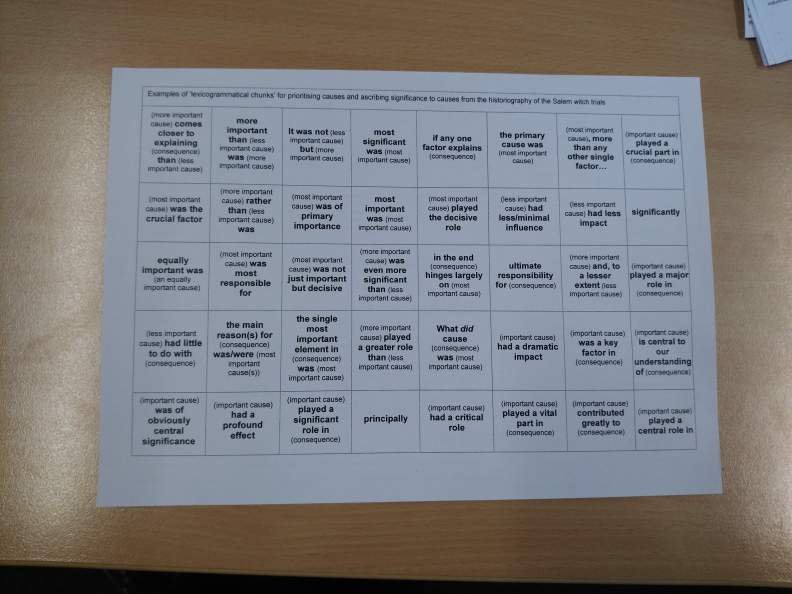
Make the cause the subject of the clause, where it will begin to act as the agent. “One reason” gives no indication of the relative importance of clauses. Similarly, “because” gives no indication of the role of the cause. (Fig 1)


Having picked out some problems, Jim returned to scholarship to look for solutions. How does Kershaw do it? He talks us through a paragraph to model. He packs in an enormous amount in a small space, bundling up events into abstract phrases like “consequent government stalemate” and uses verbs instead of connectives to link and characterise causes – adds nuance and flavour. 

Having considered academic historical writing, it’s hard! Key tenets?

Literacy can’t be ‘bolted on’ to history. 

Construction of argument must be explicit. Even writing a narrative is an argument, says Jim. 

Create writers from readers. Give them scholarship and teach them to read it. 

Don’t model language that a historian wouldn’t realistically use; avoid heuristics that shut down scope for argument. 

Lexicogrammar. Jim started with just providing vocabulary but then started to think about sentence structure: you can’t write a counterfactual without knowing how to structure a counterfactual clause, for example. 

Secure substantive knowledge enabled students to think about argument construction. I like to point out to students, when they ask me how much they need to write, that they should think about how much they could write about themselves in half an hour – because that’s how well they should know the topics. They can then focus on modelling their clay, so to speak. 

Consider the different linguistic demands of specific second order concepts, and make them clear to the students. 

Abstract generalisation also needs to be made explicit to students. 

Support working memory in essay planning to help students avoid ‘knowledge vomit’ where they just blurt out all they know without considering relevance. 

We look at some examples of abstract generalisations by students and I am struck by the difference between a student who can do this from a place of knowledge, and students who trot out the generalisations that clearly are not underpinned, and the very subtle differences in language that indicate the two. Something to think further one. I find students will argue well with logic and struggle to see why this isn’t enough: I wonder whether I can get onto abstract generalisations until they can understand how to use knowledge to construct an argument.

We do a cardsort and I get too busy to take notes. We have to organise the cards into groups and then make a generalisation about them. A favourite activity of mine: just did this with year 8 on why the British Empire grew, but I begin by giving them two categories and challenging them to place as many of their cards in categories of their own choosing as possible – this seems to provide a place of safety for the confused.

Jim circulates like a good teacher should and at one point asks the insightful question, what changed to create the cause?

A great session, providing lots to think about. Here are the handouts: 


Posted in CPD Notes, wlfs | Leave a comment

WLFS History Conference: Counsell

The odds are stacked against the poor. They have little chance of climbing into the corridors of power. And the odds are also stacked against peace. In many countries, history is about knowing a particular story and being able to shout that story loudest. This can lead to a lot of rock throwing. 

It is difficult to create a fixed, agreed story that keeps everybody happy – Christine talks about her experiences working with history teachers in Beirut, trying to organise a history curriculum change for the first time since 1968. They look to the British history community as a model of how to come up with a curriculum that acknowledges difference and disagreement, and encompasses it. 

Christine talks about changes in school history in the 20th century and the marginalisation of substantive knowledge. We need to unpack what sits under our own proficiency and fluency, if we are going to be able to prepare particularly the poorest children, to join the speech community at the very least, and then the educated community. 

The responsibility of the history community in this country is colossal – our students, our country, the world – and we must measure up. What locus of authority should we look to as our lead? We should look to academe, and SLT should support that. 

Arguments for knowledge. 

Christine shares a passage from Schama about 1066 (‘bones under the buttercups’). We have plenty of memory space and a fluency that enables us to understand it. This is coffee table history – most people should be able to leave school understanding it. Christine breaks the extract down into words we need substantive knowledge to understand and words related to the second order concept, pointing out that we need to understand the former to help us with the latter. This is a clear argument for specific teaching of knowledge. 

Christine references an article from TH157 by Kate Hammond, which points out a lack of discriminatory markschemes from exam boards. Always worth noting that those are written to go alongside examiner training. Anyway – this led to a masters project on the reasons why some good students collapse in the exam due to a lack of substantive knowledge. 

A critical mass of knowledge is vital to crafting a nuanced judgement; when I explain to parents how their children are doing I say that it’s like clay work. You need to know your clay really well to be able to shape it into the request of the examiner: children often acquire plenty of clay but then present it as a lump, rather than shaping it appropriately. This seems to fit what Christine is sharing (I think). 

Hirsch. Read ch2, says Christine, though the rest is optional. He’s a valuable starting point, because he explains beautifully the psychological structure of background knowledge. He reminds us that we can interpret a text because we can bring schemata to bear on a text within a microsecond. We don’t even know we are doing it. This I’d what we need to teach and foster as we teach. 

Implications? Fingertip knowledge and residual knowledge: consider how they are different, what they are for each lesson and how you can best teach both. 

It’s important to be clear on the fingertip and residual knowledge and what they are in each topic. This goes beyond knowledge organisers. 

Regular, varied, low-stakes assessment, ensuring steady and cumulative mastery of knowledge, in the context of disciplinary processes. 

Threats?

Genericism – what works for one subject does not necessarily fit all.

Gaming the system.

Grumble, grouse and grievance – it’s hard, yes, but in the end it will make it easier. 

Christine finishes with a comment about the damaging view that the knowledge camp comprises neo-con restorationists. She states that she is not a lackey of the Tories, that the focus on knowledge is much broader than that. Understanding the canon helps us to critique it, so let’s teach it to them. 

What are our responsibilities? Be scholarly.  Model being scholarly. Make it possible for other teachers to be scholarly. Pass on moral courage to enable children to challenge that with which they disagree. Make the child want to be part of the conversation, and provide them with the ability to join it.

(Once again, just a flavour…too much good stuff to write it all down).

Posted in CPD Notes, wlfs | 1 Comment

Preparing for Assessment: the Verbal Rehearsal

A few years ago, inspired by some excellent CPD, I introduced the verbal rehearsal to my KS3 students before they completed their assessments. I wrote a little about it here. I did this in a variety of ways – heavily planned questioning, argument tunnels, paired discussion, whole class verbal assessment, group verbal assessment, using the diary room – with varying degrees of success. I found that the most significant impact it had was on the quality of the supporting knowledge students provided in later written responses: having squirmed through the scrutiny of their peers and found the it-just-does-ok? argument to be lacking, they went back to the facts with a vigour that was new to me.

In spite of the success, my verbal rehearsals had rather fallen by the wayside of late, and finding myself with half the curriculum time in my new post I was not convinced I could spare the time for it. However, finding myself with an extra lesson with one year 8 group before Christmas, thanks to a quirk of timetabling, I went back to it and I have regained my enthusiasm.

In that case, students were preparing their answer to the question of whether the action of Charles I or Parliament were more to blame for the outbreak of the Civil War. Having given them prep time, I asked the students to divide in the classroom – Parliament to the window, King to the wall. One student could not make up her mind. “I can see both sides!” she wailed. I couldn’t have planned this better, as both sides then had to attempt to win her by making their arguments. This was so successful we overran into break and nobody noticed. The written up responses were robust: more so than those of the group with whom I did not verbally rehearse.

So, today I gave over part of a lesson to the quietest year 8 class I teach, and we completed an argument tunnel.  It was period 1 and they were silent: I was a bit nervous that nobody would say anything, but I needn’t have worried. It was a good sign when, after the first pass, all the students who’d left their books on their desks got up and fetched them. After about 10 minutes of arguing, they went back to their seats and wrote in silence for the final half of the lesson. Marking is yet to take place, but my in-lesson peeks suggested success.

The other thing that has inspired me to revisit this is a student in my year 11 class. She wrote nothing but her name in the mock, which I surmised was fear of failure rather than lack of knowledge, so we sat down together to do the first three questions. It quickly became obvious that she knew a great deal but was not able to articulate it: she literally did not have the words to be able to write it down. Her KS2 scores are at the lower end but she has no specific need: she’s just very quiet. Talking through the answers with me helped her to find the words she needed to be successful.

Reading would obviously help with this too, but I don’t think we should underestimate the value of class discussion here either. How many of us have read a student’s conclusion and been unable to find a single historical fact in it? That sort of thing does not pass muster with a gang of mardy teenagers who are just itching to win, and using discussion and argument in the classroom is the best way I have found to demonstrate what really makes a strong argument to students. I think teenagers are naturals when it comes to arguing, but using evidence to support their points is an area for development.

Posted in Assessment, Reflections | Tagged , , , | Leave a comment

Nurture 16/17

Time to review the past year and look forward to the new one.

1. Teaching
I began the year as Head of History at the school where I had worked since I was an NQT, a post which had been made permanent but from which it was becoming abundantly clear that I need to move on. I had reached the point where I was starting to wonder if teaching was really what I would be doing for the rest of my life. Luckily, I applied for a new job – a sideways move but that was exactly what I wanted and I was delighted when they agreed to take me on.

Leaving the school that grew me as a teacher and that enabled me to pursue a dozen other roles outside of teaching at the same time as doing the job I loved was terrifying but I haven’t looked back. Sometimes I miss it but I don’t regret it and I feel like my teaching has a whole new lease of life.

There are some challenges: I’ve got new-to-me courses in Y10/11/12/13 and I’ve finally had to engage with the Tudors (I knew I couldn’t run from them forever) after a career of 20th century A-level teaching; I no longer have my own classroom so I am constantly missing bits and pieces I’m used to having to hand; but I am enjoying all of them.

2. Writing
In January I was going through the (sometimes painful) edits on the GCSE textbook I was writing. That was finally published in August and I am immensely proud. I even managed to smuggle my 92 year old gran in as a source. My new favourite thing to read on the internet is people complaining that it has too much detail. Like, who wants to drop nearly £20 on a textbook that has just the bare minimum in it?
I use it with my students. Some of them bought their own copies and had me sign them – surreal. I like the fact that most of the activities in it are ones I would plan for my own lessons – it has really helped cut down on my planning time.

I also wrote a Cunning Plan for June’s Teaching History on teaching the new thematic unit.

3. Presenting
#Bristhist finished its second year of gossiping about History teaching with a Teachmeet inset on sourcework in June, where I spoke very briefly about what I’d managed to do with sources last year.

I spoke at SHP this summer on the theme of Stickability, and in June I re-ran the Philip Allan “Preparing the Teach the new GCSE” that I first ran in October 2015. I was surprised by how many people attended this one: I anticipated that it would be cancelled due to lack of interest. As I mentioned last year, presenting to peers, especially those who have paid money for the privilege, is never going to get any easier. In October I was really pleased to be invited to run a session on assessment for the PGCE keeners at Bristol University. I’m really hoping we’ll be able to host a PGCE student next year.

Perhaps my proudest speaking achievement of the year, though, was speaking for Pearson on the new thematic studies at an HA conference in June, at the British Museum. The British Museum! My uni was just up the road from here so I am very familiar with the place. Here is a glamour shot of me being stupidly pleased with myself about it.

img_20160610_193632

This is after I’d finished, of course. Before, I was the obligatory bag of nerves.

4. Examining
As well as completing my 7th series as Assistant Principal, a job I have come to really enjoy, I applied for, was interviewed for, was offered and accepted a new role for the new GCSE. In a year of proud achievements, it feels like a big one to say this tops the list, but I think it might. The act of having to go through my first non-teaching interview since I’m-embarrassed-to-think-about-when (What? Only an hour? Don’t you need to watch me do something?) was quite nerve-racking. It was nice that all of that time I spent completing training courses last year actually paid off. I’m really excited about the new role, although I will miss being AP for my current Principal. I think I’ve held this examining role the longest out of any.

5. Other
What else? I staffed three foreign trips in the space of 12 weeks – Berlin in February, skiing and Naples in April. I ran the first two. My colleague Tom attended them as my senior staff member and ran the third. In April we only spent about 30 hours and the final weekend apart. I’m not sure how I’ll run another foreign trip without him.

img_20160407_102305

Easyjet FTW. Italian tans and it’s-nearly-time-to-rest expressions.

I did a few local trips with students at my old school: Parliament with Y9 and Y10; Farleigh Hungerford with Y7; the New Room in Bristol with Y12. I went on personal holidays to southern Italy (Normans), Vietnam (Cu Chi Tunnels; war museum; Communist art in Hanoi), Singapore (shopping) and France (Bayeux Tapestry, FINALLY) and got myself a National Trust membership.

I kept on thinking about assessment. I still don’t really like using 9-1 for assessing KS3 but I am getting closer to understanding what this really looks like.

The SHP website relaunched and I’ve been managing that this year.

CPD? I managed to get a ticket for TLT in October (stayed up until midnight to bag one, only to find they’d changed the ticket launch time to 6am…sigh) which was very enjoyable. I went to the Life After Levels conference in Sheffield in May, which was interesting but felt a bit too primary-focused to be relevant. The SHP conference in July was an obvious highlight: so good to share practice and hang out with like-minded History geeks.

Since moving to a school based in Bristol, and much closer to home, I’ve also been able to take advantage of some local resources, attending a twilight inset on teaching sensitive subjects at Bristol Museum and meeting with the local Heritage Schools rep to discuss building local history into the curriculum. This is how I found out Elizabeth I entered the city of Bristol down the same road I get the bus to school along every morning. This is a great comfort to me at 6.50am, as I wave regally out of the window.

Best of all, as was my hope last year, I have worked a bit less. I look back on last autumn and am mystified as to how I managed to squeeze in everything I did. I have consciously withdrawn from things this year, to the point where I said no to a writing project I really, really wanted to say yes to. It was the right choice: I have really enjoyed the headspace afforded by not juggling about 17 different deadlines.

So, onto 2017!

I have a couple of writing projects in the works, both of which I need to get moving with. I anticipated this sort of thing might dry up now that the new GCSE is basically resourced, but seemingly not. I’ve also got plans for a longer Teaching History article, though maybe 2017 will just be about prepping for it.

For the first time, I will not be examining GCSE this summer. I gave it a lot of thought, and decided I needed a break before the new role kicks in in 2018. It will be really weird. I have signed up to mark A-level, on the basis that this will be the first and last time I’ll be able to, but they haven’t offered me a role yet, so I might not be doing any extra marking. I will not know what to do with those long June evenings to myself. Between this and not having to mark Y13 coursework on May Bank Holiday weekend for the first time since 2010, I will not know I am born. My husband will be sick of the sight of me.

For the rest, I’m just working on my practice. Nailing down a great KS3 program of study and fleshing out the assessment mapping; developing and resourcing new schemes of work that feed into the new GCSE and A-level; reading even more about the Tudors; preparing the department for hopefully applying for the HA quality mark; building a solid enrichment program. It’s a really exciting (” “) time to be a teacher and I am really pleased to be refreshed with time and energy to put into it.

I’ll finish with a couple of pictures. The first is sunrise from my old classroom, which overlooked the school field to the White Horse. The second is sunrise from my new office, which overlooks Bristol. Both gorgeous in their own way; both make getting up in the dark a bit more worthwhile.

img_20151125_074441

img_20161207_074458

Posted in Reflections | Tagged | Leave a comment

The Knowledge

I’m coming clean now and admitting I thought the knowledge vs skills thing a false dichotomy (and an enormous distraction, but that’s for another time). This is a conclusion I came to after spending a great deal of time mystified as to how anybody can think history teachers don’t teach knowledge. I have always placed myself at the progressive end of the spectrum: I love a good card sort and have witnessed first-hand the effectiveness of a well-planned role play in tethering knowledge to a student’s brain. But then I see the sorts of things the other end of the spectrum favour – detailed fingertip knowledge, reading in depth, among other things – and I like and do those too. They’re not mutually exclusive in my classroom. Rich Kennett wrote about this a couple of weeks ago. I felt pedagogically confused.

The thing that was most confusing, though, was the whole knowledge issue. I could not understand the claims that an entire sector of the history teaching community didn’t teach it. I started to suspect that, in a number of discussions that masquerade as trad vs prog, it was what knowledge was being taught, rather than knowledge in general that fuelled the fire: the tired old stereotypes about the horror of children not knowing, for example, who Winston Churchill was. But what knowledge is a political beast. Nobody tells us what knowledge: that’s the whole point of the National Curriculum. Surely dictating what knowledge is just intellectual snobbery?

Well. Then I started working in a new school. My year 9s started to ask questions like, “Miss, when are we going to study Titanic?” I had to say it was not on the curriculum for this year. They looked disappointed. I looked at my one hour a week and knew it couldn’t be justified. But, I went to Twitter anyway, to see if there was something I was missing. I mean, I’d teach Vlad the Impaler as an interpretations study – there are no stones to be left unturned around this glass house.

Unfortunately, Twitter left me unconvinced. I don’t see how it can fill the twin requirements of providing a good second-order concept focus AND fit into the big picture of history that I want my students to have by the end of year 9. ‘Why did it sink?’ – causation? Maybe – but there are tonnes of causation studies that I think fit the bill better, and I’m recently of the opinion that we could all spend a lot less time on causation at KS3 anyway, because I think it has become the path of least resistance. Societal structure at the start of the 20th century? Mmm. I don’t teach it, but if I did I’d do it with the Liberal Reforms. It’s fun and engaging? ALL History is fun and engaging, isn’t it? That’s not a valid argument in my book.

This leaves me twitchy, though. It’s not up to me to dictate the content of everybody’s KS3 curriculum. I don’t see the rigour or benefit of teaching the Titanic, so I won’t teach it. Why isn’t it OK if other people do? Isn’t that intellectual snobbery? Isn’t that like when an outgoing HoD said to me during a job interview, “Medicine Through Time might work in state schools but our students need something that will prepare them for History at degree level”? (No, I was not offered that job. Would love to know what she thinks of the new GCSE.) That’s not ‘knowledge vs skills’. That’s ‘knowledge I value vs knowledge I don’t but you clearly do, for some reason’. And that’s not the same debate.

It is, however, up to me to decide on the KS3 curriculum for my school. That is my role as a HoD. That is the product of more than 13 years of teaching, averaging a teaching load of 41/fortnight. I’ve done my 10,000 hours, if you like that sort of theory. I am employed to make decisions about what is best. Here are some things I teach at KS3 that most people probably don’t:

  1. British Diet Through Time. It helps me cover some key events and themes in British history whilst practising change/continuity: society in 1000, the Crusades, the slave trade, the rise of the Empire. I’ve had a lot of flak for my obsession with the potato but it’s an important consequence of Tudor exploration and a herald of the Agricultural Revolution. It’s part of the big picture. And I am obsessed, and I’m not sorry about it.
  2. WW1 as a social study. My colleague has a politics background and is fresh from teaching the Modern World GCSE for several years; she taught a Y9 WW1 study that included the Schlieffen Plan, which I’d heard of, and the July Crisis, which I hadn’t. Mine was about soldier motivation, propaganda, conscription and conscientious objectors. I squeezed in some change over time. We read some Harry Patch, who’s a localish boy. Both of these are valid approaches: students need some understanding of WW1 to underpin future study, but the devil really isn’t in the detail here. If it was, we’d probably need to spend most of Y9 on it, sacrificing breadth for depth.
  3. Interpretations of Harold Godwinson’s death. This doubles as my favourite G&T History taster for primary students. We do Hastings in a more traditional sense as well, but I chuck in a comparison of the Bayeux Tapestry and the Carmen at the end. This was our A-level coursework for a short time before the 2009 revamp.#
  4. Impact of the British Empire on Britain. Surprisingly difficult to resource. I do miss the more traditional British Empire bits – the plate, the excursions of the East India Company, the scramble for Africa – but this study fits more neatly into our survey unit of what had changed Britain by 1900 and picks up the Slave Trade study from Y7 and the arrival of tea and sugar from the diet study.

I think it is also up to me – as it is to all of us – to be the critical friend here. I might be picking up students at GCSE and beyond that have followed a history curriculum elsewhere that has not adequately prepared them for further study, and it makes me ache when I hear about history departments staffed by non-specialists teaching good stories without any thought for the important concepts that should underpin them. Those are the tricky conversations we should all be having to check that our curriculum is the best it possibly can be for our students – and with each other, unless we have the benefit of subject-specific line management. This can be awkward because, as I’m fond of pointing out, teachers build their entire careers on being right all the time and that makes it all the more difficult to face up to making changes. But there’s fun in the rigour, the challenge and the high expectations, and this is the kind of fun that can’t be provided by Horrible Histories. So, this is the kind we need to step up to provide.

In short: I think we should be wary of people telling us what we should be teaching, but shouldn’t get complacent with it. There’s always room for improvement.

[This post sort of ran away with me. As always, writing about it has helped me to get it straight in my head. I was thinking about it so hard whilst walking home last night that I apparently ignored my husband, stuck in traffic and waving at me, and walked right past him, oblivious. I made Rich read it and give me feedback: super helpful as always, thank you.]

Posted in History, Reflections | Leave a comment

#youreallyshouldteach…Vlad the Impaler

Ben Newmark and Mike Stuchbery over on Twitter have been hoping to highlight some obscure bits of history that are worth teaching. I’m going to bang my Vlad the Impaler drum again.

In my final year at university I took an excellent module on travel writing and perceptions of east and west in Europe. It was marvellous. I vividly remember finding a book on Vlad and his more famous alter-ego, Dracula, in the course of my wider reading and making a point of finding it after uni when relevance was no longer top of the list when book choosing. As a peachy keen NQT and having attended an HA/Christine Counsell weekend on interpretations, I wrote a whole unit for year 7 about him; but I’m a little longer in the tooth now and think six weeks on an obscure Wallachian prince might be a bit of an indulgence.

Vlad would make a great one off for World Book Day or something similar, though. Ruler of a country on the dynamic border between the Holy Roman and Ottoman empires in the 15th century, Vlad had seen his brother and father buried alive for upsetting the Sultan and his countrymen pushed into poverty by monopolising German merchants. If he was extremely tough, it was because he needed to be.  This was the 15th century, after all – England was witnessing the brutality of the Wars of the Roses. Brutality got one’s point across.

It was the conversion of Vlad to blood-sucking monster that interested me the most. It seems those German merchants, banished to their homelands, carried tales of their ejector back with them where they seeped into the folklore and found their way into the British Library. Bram Stoker came across them there, at a time when suicide victims in Britain were still sometimes buried with stakes through their hearts to prevent blood-seeking resurrection, and the rest is history. So, while Romania celebrate him on a stamp, in the west he’s the stuff of nightmares.

This made a great interpretations study for me and helped my year 7s to understand how important it is to understand the context of the people telling the history.

You really should teach about him, because he is much maligned and misunderstood, and he provides a gory introduction into how history is written by, if not the winners, then the people who could make their stories travel furthest.

Here are some resources: character cards, a writing frame and a newsflash (How do these people feel about Vlad the Impaler?) and a card sort of four stories, found in both Romanian and German chronicles and therefore told from two different points of view. I loved using this for a literacy exercise: how does the language make you feel about Vlad?

Next time…the assassination of Tsar Alexander II: is this the most d’oh moment in history?

Posted in History, Planning | Leave a comment