SHP: third workshop

Christopher Edwards on planning for higher order historical thinking at ks3.

We start by discussing what makes a good or outstanding history lesson as a group and then feeding back to everyone. Chris suggests that Ofsted has a view on this, but it might not be the definitive view. Perhaps I misunderstand this, but don’t these labels belong to them?

Anyway. Some suggestions of engagement and higher order thinking and how these contribute to an excellent lesson.

Begin by thinking about how you see history, how you see learning and what it means to be better at history. Chris shares some examples of facts that were taught in the 19th century and asks what’s wrong with them. I think that it makes you ask more questions than you can answer, and that some of these facts are supremely dodgy in that they stand alone, uncontested, and are in part extremely one sided. Someone suggests that learning it does not offer any understanding of it. It only gives them half the tools they need: only knowledge. It’s just a memory exercise: it’s not really history because it could be anything. What is the purpose of the text, asks Chris? There’s a political agenda within. It is written to promote a particular point of view. It does give an overview of the key events and ideas of the time, which is useful.

You can look a history as a fixed narrative or as a foreign country: challenge, puzzle, engage. The known versus the unknown. It’s difficult to do HOT with the former because it reduces history to a memory, when it is strange and mysterious and it’s impossible to know what it was really like.

We look at a photo from 1914 of a large family group and talk about how you might use it to promote higher order thinking in the classroom. Lots of ideas about making inferences and considering how this picture might be different in 1918, or doing a more in depth enquiry by assigning characters to pupils to research.

Donovan and Bransford, How Students Learn, is recommended as “one of the best books available to the history teacher”. Chris talks about the fable of the fish as a metaphor for children in school. Children don’t bring empty minds and are constantly interpreting what you’re saying into their own realities, and it’s important to engage with that. He also recommends Steve Weinberg on historical thinking, telling the story of Primo Levy. Students translate experiences – hence, “why don’t you just escape?” Or “why don’t we just blow them all up?” Which seems to pop up quite often.

We look at some enquiry questions and discuss their relative merits. I’m feeling quite confident about this now. Someone suggests that all the questions lack a certain amount of quirkiness and that this is key when setting up the enquiry. We talk about involving students in the process of forming enquiry questions. Someone says no, because they don’t have the prior knowledge they need to come up with a good question. Good point. Chris suggests asking them how they would extend their learning at the end of the unit. Someone else suggests that there is no such thing as a bad enquiry question if the students have come up with it, because it’s what they want to know. Hmm. I might be misunderstanding something here, too.

We consider some questions on the Treaty of Versailles and which promote rigorous historical thinking. Chris references Dylan Wiliams – the quality of the questions you ask pupils is key. We look at the question that promotes historiography. It’s important to remember that history is an account, written by a person.

We move on to measuring student progress in lessons and what it means to get better at history. To me, they become more subtle and vague in their language and talk less in absolutes: things are no longer black and white, nor do they change completely and instantly. Chris talks about the core knowledge curriculum at the Pimlico Academy. The y7 assessment is 50% multiple choice and 50% mini essays – no levels, but measured on the quality of knowledge within. The view is that the understanding cannot come until later. Chris does not seem to subscribe to this methodology.

Suggestion that progress can be assessed through the learning objectives. Thinking about my gold/silver/bronze success criteria and how I could better use these in my lessons, perhaps with the pegs I use instead of lolly sticks – where do you think you have reached? Place your peg on the line on your way out and I’ll confirm when I mark your book.

Chris shows how the levels can be used to map put student understanding of the key concepts, eg cause and consequence. It’s a useful map of how children learn to use as a starting point. Chris suggests that Gove wants to dump the levels because he likes knowledge and doesn’t think students are capable of doing the analysis promoted within the levels, and that what they needs is a steady diet of facts. He recommends Googling for Lee and Shemilt (sp?) “A scaffold not a cage” to help when considering how student learning progresses in history. It is more sophisticated than the levels and will help you to map out progression. Also consider the students in your classroom and what their prior knowledge is and challenge their misconceptions.

Final thoughts. Chris wonders, what is Gove’s intention for how history will be assessed? War will he do with the second level concepts? Make sure you explain to students the importance of what you are teaching them (we are learning…so that…). Make sure your units fit into a bigger picture.
Posted in shp25 | Leave a comment

SHP: second workshop

Michael Riley and Jamie Byrom talking about creative and rigorous planning through a case study of the Mughal Empire. Feel like I’m back on my PGCE.

We start with a picture of the Taj Mahal. Jamie wonders, do we ever ask students if they’ve been to the places we teach them about? Michael encourages students to make a list of places they study in history that they would love to go. Using beautiful pictures helps students to get a feel for a place, and the human stories connected with them will give them better context.

We look at a picture of the builder of the Taj Mahal on his 15th birthday, who is being weighed on a huge gold scale. Beneath him are gifts wrapped in colourful silks and holy men are attending. His dad is weighing him and his weight in gold and jewels will be distributed to the holy men and the poor. Imagine the wealth! This is a lovely activity but it needs to be sequenced purposefully so that there is a clear outcome at the end.

Four principals of planning:

1. Teaching with a purpose – why study…? How many jobs can you choose what you do? This is one if the joys of teaching.
2. Engaging with subject knowledge – that’s us as teachers. Read, watch TV, visit somewhere on holiday…
3. Wrestling with the enquiry
4. Exploiting the particular – it only really sings when there’s a key person or event or picture that you can hang it all on.

1.
We talk about the reasons to study the Mughal empire. They ruled over 100 million people at a time when Elizabeth I ruled over 3 million – makes a good precursor to the British empire? Many reasons are provided – depends on your school context.
We discuss the difficulty of teaching something we know little about. Michael says if we don’t read around we’re missing out on one of the joys of history teaching.
We need to be more confident in explaining why we’re teaching what we’re teaching. There should be real clarity about this.

2.
Jamie shares an animation to show how Mughal control changed over time. We discuss what questions we have – why does it expand? Move? What does the different shading mean? How does the geography play a part? Encourage a disposition for wondering.
When you’re engaging with subject knowledge, consider stuff, issues and nuggets. Exhibitions are a good way in. We organise some key Mughal emperors into chronological order – stuff. This isn’t enough on its own – “stuff is not enough”. We need to look at the issues, controversies, conceptual focus – causes, or consequences, or diversity of experience, etc. What is omitted from the exhibitions – how we got the settings, the stories of the conquered people, etc – is just as important as what is displayed.
We are recommended some books, including Will Dalrymple’s The Last Mughal as a different interpretation of the “Indian Mutiny”. It’s important to look for the interesting way in.
Nuggets, or gems? Often found in footnotes in books, bizarrely. Jamie uses and example of the carrier pigeons the Mughals used to keep in touch.

3.
Pinning down the enquiry is a difficult thing, and much more easily done as a group within a department. We look at a range of enquiry questions related to the study of the Mughals and discuss their relative merits. Knowing what the end product is is really important when organising the sequence of lessons and enquiry questions. The really key thing is getting the big overall question, on which you hang all the other lessons, to ensure coherence throughout the unit.
Some concern over maintaining this when the time for history at ks3 has been squeezed. Jamie thinks that if the launch is strong enough, the excitement can be maintained. Michael thinks that the writing en route should be used to help them to build the writing at the end. I like this, because it fits with what I have done with some of my units this year – building the essay over the unit.

4.
Do we need particular people? Places? Times? They picked key moments and emperors to study to give a sense of change in the empire and a contextual understanding of life within it. An analytical narrative. We look at a picture of Akbar building a new city and discuss what it shows and how it can be used in class. Links are made to early variants of the Grand Tour and the first English visitors, with Thomas Coryate and his letters home from the Mughal empire in the 17th century. There’s also a reference to the impact of the 19th century evangelical movement on relationships with and opinions about the Mughals. This ends up being quite a depressing end to both the Mughals and the session, but very powerful. The importance of the human stories in the history really comes through.

I think this session is going to fit really nicely with my next pick, which is also about planning enquiries for key stage three.

Posted in shp25 | Leave a comment

SHP: second plenary

Panel discussion on Looking forward to the new NC and GCSE, with Katherine Burn, Steve Mastin, Michael Riley and Esther Arnott.

Lesley Ann kicks off – should we be worried about school history?
K: no! It’s taught by historians! There are signs that there needs to be a bit more listening to teachers, and the loss of levels means we can have a proper conversation about what good learning looks like. My only concern is defending the right of students to do history, with the squeezed key stage three and the prevention of non-C+ students from doing GCSE.
M: I agree. I am less worried about the future of history now than I was 5 years ago, with a New Labour government. The potential now is for the framework to be much stronger. There has been a massive dip in progression at GCSE but now, with the revised criteria, hopefully it will be stronger. My concerns are maintains the appeal of history to all students, regardless of ability, and ITT, where there have been some very damaging developments.
S: I’m not worried in the slightest. History has always been a political football – do we want a Secretary of State who cares passionately about our subject, or not? I’d be more worried if I taught Art, or Music. The new NC – I will ignore it. Nobody checks anyway. Was it just a way of making more schools into academies, maybe?
E: we’re all here, and we are still having an ongoing dialogue which is very supportive. We’ve been here before and we’ve conquered before, thanks to our strong sense of community.

Martin asks, when Gove announced his proposal, why didn’t history teachers take to the streets?
E: too busy planning?! No – I think we did, actually. There was a huge spike in discussion, people contributed to surveys and consultations, and the reaction was significant.
K: here’s the reaction to the HA survey (from Teaching History) so you can see that people engaged. Gove was faced with key historians thanks to teachers lobbying across communities. The Internet has been key in helping to extend the dialogue.
M: there is still a need to take to the streets from time to time. If the new one is no improvement we really should be marching. The fury of the online response was passionate and really well-informed, and I was impressed by the individual blogs that were being written.
E: I have concerns about taking to the streets. You look like hysterics. (No histrionics for history teachers?)

Some discussion on the relative merits of this course of action.

Jane: does the panel think that the changes to GCSE from this September an unreasonable imposition?
E: yes. They re short-sighted, and it’s unfair to say there shouldn’t be a cross over of time periods. We’ve been tweaking controlled assessment and trying to sort out our American unit, and now we also have to rewrite due to the overlap. I wish they could have just given us the benefit of the doubt and waited for the new GCSE in 2015.
S: I agree. In principal I am in favour of GCSE reform, but the consultation should be longer. Accreditation has been really slow too, and I feel for the exam boards.
M: I am outraged. We haven’t a clue what we’re teaching from September and it’s July. The problem started with some misjudgements among awarding bodies about their training and they, along with Ofqual and the government, should share the responsibility. I think it’s a terrible imposition.

A comment from the floor: it really hits the bottom end and makes it more elitist. I’m worried about the accessibility of the paper.

M: I think some of the changes are worthwhile, but to get our head round new knowledge and assessment criteria for 2 years is a significant pressure.

Janine: is the renewed guidance from the DfE good for progress at 14-16?
Would it matter if SHP specs disappeared in 2015?
K: I think the changes are really positive. The current SHP is owned by the exam boards, really. There is a great spread of ideas in the new specs and I feel very positive about it, with the exception of the toughening up stuff
E: I support the principals of the GCSE but I am concerned about the for that the assessment will take. There is an emphasis on reading and writing in a very formal way and I worry that it will be a barrier for an even greater number of students, due to the literacy issue.
M: I think yes (Q1). Prescribed diversity is the way forward. SHP has had concerns for years about students focusing solely on the 20th century and I liked the entitlement to several time periods provided by the new guidance. So many SHP principals are enshrined therein. I don’t know about terminal examination and this will not assist on developing historical enquiry, and we will be feeding back on that. If we don’t get that, we’ll need really creative thinking about that terminal examination. Next year is a crucial opportunity to reform GCSE history and awarding bodies must work with stakeholders to develop something really special.
A: we don’t agree about politics, but we agree about GCSE.

Jason: does school history place enough emphasis on knowledge?
S: depends on your department. There is plenty of emphasis on knowledge but there is still work to be done, and Ofsted backs this up, so I’ll trust them.
K: my concern is for those departments where time has been squeezed. History is so much better when you have good knowledge! We need to provide enough time.
M: I don’t think we do. Let’s grasp this opportunity and develop our thinking about criteria for knowledge selection. It’s been ignored for too long. I’m wary of history departments who do things “because the kids like it”. History needs to be meaningful for students and we need to think more carefully about the topics we select for them. The danger is inertia and we need to make the most of this.

From the floor: teachers are immensely busy and we need to think about how we can sustain teacher knowledge so they can feed that forward. Most people here are converted and do it already for the love of it, but we need to work out how to reach those that don’t do it.

Simon: if you could pick any method of torture or execution for Gove, what?
(Tis is all very light-hearted)
M: rack him. Henchmen turning the rack. But I’d spare his life on the ground that he’s listened, as long as he promised never to above anything to do with education again.
K: a scold’s bridle, to shut him up. I don’t approve of torture but it would jut him up and make him listen. Or many people screaming!
S: this isn’t being recorded, is it? (sorry Steve….) marking 350 paper 2s for OCR.
E: every time I meet him he smells really keenly of Cussons soap, and has really soft hands. I’d send him to be a medieval peasant as he clearly has a high standard of hygiene. Then teach in a comp for a year, so he can really see what it’s like.

Posted in shp25 | Leave a comment

SHP25: first plenary

Back at the SHP conference for its silver anniversary! First up – Dale Banham and Russell Hall on raising achievement at GCSE and A-Level.

Before that, Michael identifies and thanks everyone associated with making SHP a success since it began. Lots of people on their feet as current or previous workshop leaders, authors and examiners.

Using recent research to establish five key principals.

We start with a Mandela quote – we’re all here because we want to be better. Then onto Hattie and the importance of seeing learning from a student perspective.

What has the greatest influence on student learning? Russell shares the results of the Sutton Trust. The top is feedback. We should focus on creating a dialogue when doing the. Russell recommends An Ethic of Excellence by Ron Berger and the types of critique that he suggests: Gallery Critique and In Depth Critique. Encourage students to use the three golden rules when critiquing each other’s work: be kind, be helpful, be specific.

Dale talks about his work improving the level of interaction between staff and pupils. The dialogue gives both parties the feedback they need to improve. Students struggle with the review to begin with but get used to it after a short while.

Dale wonders, do you use your department time to discuss what feedback really helps students to move forward? And what will you do differently as a result of what has been shared?

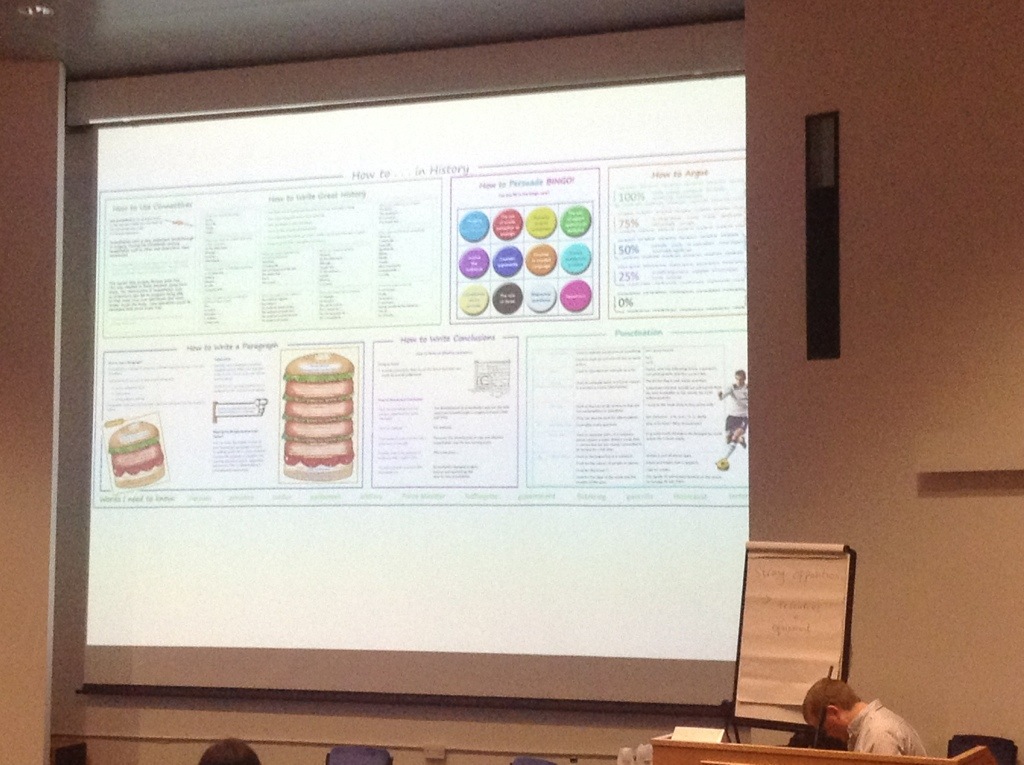
Activities now. Here’s the story of the Battle of the Little Bighorn: put the steps in the right order. Put the class in 2 groups and pit them against each other: the competition makes all the difference. Meanwhile, set gate keepers under big statements that will help them to answer and exam question. The steps pick a gate where they think they belong while the gate keepers have to decide whether to let them in. Thus a walking essay is created. Additional facts can be pulled in where necessary, because there is competition between them to create the best paragraph. Dale uses How-to mats to give students advice on building a good historical argument.

Russell talks about Models of Excellence. Save the works of previous students as examples of what can be achieved.

20130705-144424.jpg

The how-to maps above have language boxes and advice on writing to persuade that have benefited from the partnership between Dale and Russell.

Collaboration is also very important. Russell shows a clip of the end of Blackadder explained by the producers who made it, about how their collaboration led to the final scene. Collaboration in writing is important – the discussion and debate helps to make the whole process really visible to students. Position a debate before a piece of writing.

Snowball revision. Tests should include stuff from all the modules they’ve studied so far. Create a toolkit to help students select the best revision technique to help them with the various bits of information they have to remember. Homework – sum up xxx in a picture. Bring in a prop to help us role play xxx – then, the following lesson, remember the story from just the props. Revision should be the most interesting fun part of the course because you have all the info and you can start to play with it.

Independent learning and homework.

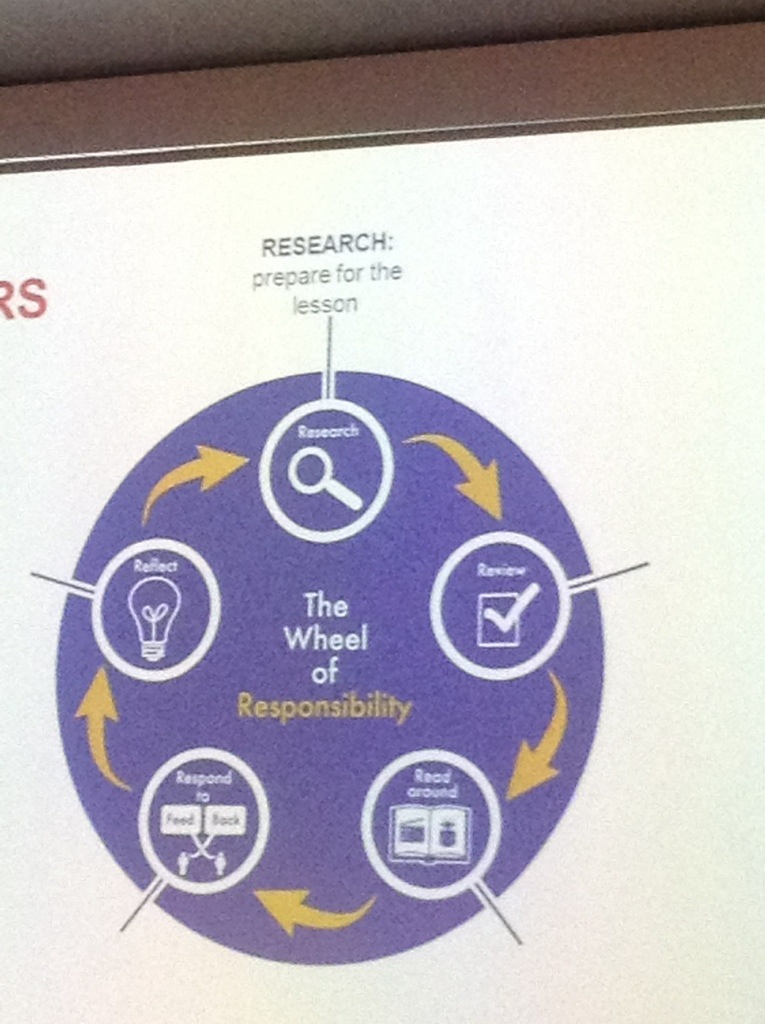
20130705-150252.jpg

(For the past two years I’ve been trying to nail these down but I can never note them down quick enough!)

Use learning logs to record what they do for the 5 Rs. Give them YouTube watch lists for homework. Use shoot outs to do knowledge tests – with a grid on the board of correct answers as necessary. Lots more examples on the SHP website. Adding competition to revision improves engagement.

What a great start to the conference!

Posted in shp25 | Leave a comment

Edfest: E.D.Hirsch

Speaking on Skype about a conservative curriculum for disadvantaged children. He realised that a certain amount of background knowledge is assumed and called this cultural literacy, and that this is what should be taught in American high schools.

Lindsay Johns is sitting in the seat directly in front of me in this one. Daisy Christodolou is across the aisle. If I can spot one more I can call bingo.

Hirsch says it’s important to have this cultural literacy to achieve economic fairness and carry out you duties as a citizen of a democracy. Bad communication holds people back. We have to narrow the achievement gap between advantaged and disadvantaged.

How do you feel that your ideas have been adopted by the conservative side of the debate than the liberal? The reason for this is because what I suggested looked like an old fashioned curriculum. It was American centric and seen as a throw back, and that was correct. If you’re socially progressive, you have to be conservative in education, though not necessarily in politics.

Is this not just the ruling class’s promotion of their story? Yes, but if you teach the serfs the habits and knowledge of the ruling class, you allow them access to it.

It’s all very well for the more able students, but it alienates the weaker…? The evidence is all against that. All abilities are absorbing this with enthusiasm where we have trailed it. Students need information before they can think critically. What alternative is being offered to this by the liberal wing, that is different to what you’re already doing, which isn’t working?

Interviewer answers this by saying the suggestion is to teach the skills alone and they will choose their knowledge. Hirsch says it doesn’t work. How are the kids going to access the information if they can’t access it with understanding? Hirsch talks about the nature of the skills themselves, the study of which shows that you can’t extract the skills from the context. He cites chess players as an example. The skills are domain specific and you need knowledge in order to be skilled in any field. If you want to be a skilled person, you have to be deeply factually knowledgable. It’s reminds me of what Tm said this morning about teachers needing to have excellent subject knowledge in order to be able to teach is effectively.

You set up the core knowledge foundation and was that a bit of a departure for you? Yes, it was a big departure. I intended to remain a theorist of hermeneutics, but the more I read the more ideal aid relevant background knowledge is absolutely critical and I felt I had an obligation to tell people and bring the news from the research front. What pushed me over the edge was coming across university students who could only read well in familiar topics and it was disorienting to me. That and an observation that schools was not doing their jobs got me started.

Have your schools provided a robust data set to advance your cause? Yes, although it is hard to make comparisons and there’s not a huge body of it. We have highly positive research, but we should not disparage the lab research that led is here in the first place.

Why do you think the educational establishment are irrationally resistant? In America, here, France? In the US, there are historical reasons why everyone thinks the same way. The teachers all came our with a similar progressive orientation and it was enforced. Dissent is not encouraged. In education schools. It’s like betraying the group if you are heterodox and you are drummed out of the group, which is scary if you want tenure. The orthodoxy took hold.

It’s a paradox that the profs who are against the knowledge agenda don’t think critically about their own practice and are more susceptible to group think, yes? Well, there’s a theory, by a psychics prof, that professors never change their minds and you have to wait for them to be replaced. I hope that the wider public become more knowledgable about cognitive science and agitates for change.

Do you enjoy playing devil’s advocate? This isn’t what I set out to be. I thought I would write about cultural literacy and then go back to hermeneutics.

Finally, how optimistic are you that your ideas will be taken up and the argument will be won? More or less than the start of your career? I guess a little more than in the early 90s, when we couldn’t be having this conversation. It’s heartening to think it might one day win the day.

See it on nosacredcows.co.uk

Posted in edfest | Leave a comment

Edfest: What children should know debate

Fergal Keane chairs.

Toby Young first, free school founder and journalist. He thinks there should be less emphasis on skills and more emphasis on knowledge. Forget the child-centred stuff! We should break down what children ought to know, even from the age of 2, and focus on teaching them that. Asked about child-centred learning, he quotes something from Rousseau which seems to completely miss the point of the question. He gets some mutters. He doesn’t appear to be doing this side any favours.

Lindsay Johns now, works in Peckham with a group called Leaders of Tomorrow (I think) They should know what it means to be a good human being, and given the sills to live in the world of today. Fully-functioning moral compass. More dead white men – they are out intellectual birthright. The alphabet was developed by a dead white man (echoes something from yesterday). Proper grammar and command of English – language is power and words are the best weapon children have at their disposal. It is patronising to dumb it down, and quite racist. Poverty of aspirations is harbour students. Nobody has ever suffered from be talked up to. He gets a huge clap, and a lot of love on Twitter.

Mark Thompson, LibDem activist and software developer. He thinks ICT education is vital and children need to be motivated to learn how to use them and how they work. He loses me a bit by suggesting that people in the tent looking at these devices are not listening to him. What does he think I am doing?! Since when can one not listen and type? Or is 19th century clerk work really dead? He finishes by saying, we need to prepare children for the global economy. He gets a clap.

Anastasia de Waal next, a policy maker. She chooses to talk about why the question is important. She points out that the dichotomy of skills vs knowledge, and prescription vs autonomy, is moot because there needs to be a blend of both. Schools need to make the decision based on their knowledge of their students. Another well-beaten drum this weekend. She gets a clap.

Shame Tristram Hunt is not here.

Lindsay says didactic is not bad and shy away from intellectual cowardice or bowing down to student pressure. They don’t know best and we’re not helping them.

Toby talks about the work of Hirsch and the impact it has had on closing the achievement gap in the US. More muttering from the people around me. He talks about 30 years of evidence and research but fails to adequately reference it, which lessens the power of his argument. Mark says the move back to tradition will disadvantage some young people and will not prepare them for the world we live in.

Anastasia wonders why we have to talk about the knowledge based approach as going back to… because it doesn’t have to be going backwards to learning by rote or the Victorian classroom.

Katie gets the first question. Knowledge is the best way to help increase social mobility but it is pitched as an ideology. How can we make it clear this approach a about the kids too? Tony says the only way to win the argument is to test it and track the impact, as the Curriculum Centre is doing. Anastasia says you have to bother engaging with teachers and the education community to explain why you believe in it – winning hearts and minds.

Matthew next. Has education become leftie? Mark says it is used as a political football and we mustn’t lose sight of the focus on children. Tony says he can’t understand how the left and the unions are opposite to Lindsay’s ideas when they should be on the same side.

The next comments are disagreeing with some of the panel comments. Ghetto grammar makes someone uneasy. Child-centred learning being crap is your opinion and you’ve offended me (what did you expect? Have your views challenged, please). Lindsay upsets me a bit by saying he wants children to know that the Battle of Hastings was in 1066, not how Harold felt when shot in the eye. They all know the former thanks to that insurance company advert and the latter, well, he probably wasn’t and I’d rather they knew that! #historyteacherwoes Anastasia wins hearts and minds by saying we need more teacher voices in the debate.

Posted in edfest | Leave a comment

Edfest: Tom Sherrington

The room is packed for @headguruteacher speaking on Rigour, Agility, Awe and Joy. Ten great lessons he has seen. Effectiveness, excitement, high quality. The room is rammed, with people crowded round the door to hear it.

Tom shares pictures of lessons from his school. A History lesson about Dresden: different questioning styles, peer assessment, identifying narrative and evaluation, and a written task that builds on all of this; traditional learning with modern approaches to interaction and resourcing. Global perspectives on research: a pre-U course, involving a y13 to help with the questioning. A food lesson, focused on skills. Student taught ICT lessons – programming skills that the teachers don’t have.

His ten habits

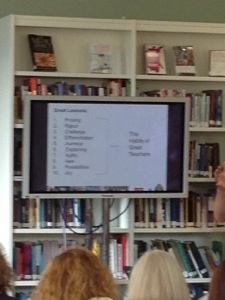
20130622-100658.jpg

(These undoubtedly on his blog if you don’t want to squint!)

Great teachers develop these habits over time and become better as a results. Forget tricks and strategies. It’s the habits, the things you do “on a cold and wet Tuesday afternoon when you’ve forgotten you had a lesson at all”

Probing. The way you do questioning: weaker teachers spread their questions and worry about inclusivity and positivity whereas stronger teachers challenge and really get to the heart of the matter and challenge the students to defend their answers. “That’s not right – but let’s talk about why you thought that”

Rigour. We need to reclaim the word because it can be really powerful. Teachers need to have confidence in their knowledge of the material, so that they know what level to pitch the lesson and can insist on students getting it right. Being correct is important and the message is that we shouldn’t shy away from pushing students to get it right and work at it and practise and refine. I agree with Tom that rigour is important, and we shouldn’t accept mediocrity. ‘Is it right?’ ‘Almost, Miss.’ ‘OK, so not right then.’

Challenge. You can teach yourself some things, eg skateboarding, better than you can be taught them, and we need to remember this in the classroom, because sometimes teachers get in the way. Don’t limit to the task because students will conform, because that’s what they do (echoes from our Ofsted report…). Have high expectations! Allow and encourage them. I think it’s important to be fully aware of what teenagers are capable of at various ages, so you know how it can look. This is why I’ve been using more historians’ work, in its original form, with y8 this year. It is comforting to know I have some of these habits, sometimes!

Differentiation. Most lessons are designed for one group and adjusted, and that’s usually the middle group, but Tom recommend top-down planning. He is speaking my language again! This will stretch the most able every time and pull to the ceiling instead of into the middle. Differentiation can be implicit, based on teacher knowledge of the students. Echoes what Dylan Wiliam said yesterday.

Journeys. Students are on their own learning journey and they need the support to learn in between lessons. Tom points out we’ve had flipped learning since we had libraries. Homework should be prep for the next lesson, and don’t tell them off for not doing it, because then it become a chore. The opportunity should be there for the kids who want to do it. Give them the tools to study for themselves and prep for learning. On levels – Tom says the language of the levels is a code students don’t understand. They don’t help on the journey.

Explaining. A good explanation forms part of excellent teaching. Tom says his science department have conversations among themselves about difficult concepts to discuss how to explain it. Don’t waste time in department meetings on bureaucracy if you can help it – have conversations about teaching if that is what you want to improve. Didactic isn’t bad. It doesn’t necessarily make them better learner or like the subject, but it works in terms of outcomes.

Agility. Be prepared to go off piste. That’s the responsiveness of a really great teacher. Mini whiteboards can be overwhelming because you get so many variables in answer, but good responsiveness can make it really powerful, as long as the teacher is confident in thei subject knowledge.

Awe. Ofsted compatible! Get the students excited every lesson. Tom talks about a picture taken by the Hubble telescope and the existential crisis it can create. Before you hack the poem to death with analysis, read it and enjoy the words. Don’t always be too functional in your approach – “stop and smell the flowers”!

Possibilities. Show them what they could do. Sow an amazing piece of work from a previous year to make it seem doable, and help them plan the journey to that amazing possibility.

Joy. Plan for your own enjoyment and love it, because it is infectious. If you think it’s great, they will too. What a great motto to end with.

Posted in edfest | 1 Comment

Edfest: Gove

Not too many notes for this one: too busy listening!

Gove succinctly summarises the current debate in education, between knowledge and skills, saying that he feels the more traditional agenda has had a resurgence of late, that the child-centred approach has let children down and stunted social mobility, and that he sees their point. He says siding with either camp would create conflict, though Aaronovitch suggests he’d have been less unpopular by going with the child-centred approach.

Asked if the reason why the best schools are in deprived areas these days, echoing Wilshaw this morning, and whether this is because the conservatives traditionally don’t care about poor children and so the Labour areas are doing well, he says no – those areas have the most sponsored academies and have benefited from Teach First and independent-state collaboration, all initiatives supported by the Tories.

He says many independent schools can learn from state schools, but have things like excellent alumni connections that they can use to make a difference in state schools.

He is asked why we don’t abolish GCSEs since students have to stay on until they’re 18. He points out that schools can choose not to sit AS now as an experiment, but where should there be a break point where students can choose to specialise?

He admits there were many issues with the history curriculum suggested and says that there will be changes. Aaronovitch won’t let it go and forces the point that too much content will make it difficult to teach the necessary skills in history, but is told not to worry. He is picking up on his comments from this article – http://www.thetimes.co.uk/tto/opinion/columnists/davidaaronovitch/article3701329.ece

Melody, CEO of InspirEngage (and also from the Apprentice) introduces questions from students. He talks about encouraging active citizenship. He says teachers should play a bigger role at every level to drive school improvement. A y13 asks him if he would reconsider his position on January resists, because everyone deserves a second chance. He says that by doing this we spend less time on exam preparation and more on deep learning, that there is inadequate prep for university because of this.

First question from the audience is about political bias in the history draft. He denies any. Feel like he has a different understanding of political bias to me. The questions quickly become statements about perceived holes in policies.

Ryan asked “is it true you’re taking away extra time in exams for dyslexic children?” Gove: “No.” Ryan: “OK!” It’s gets the biggest laugh of the session. Good question, and brief, too. Some of the agenda pushers here today should take note.

Primary school governor asks why Gove can’t praise teachers more. “You can never praise teachers enough.”

He recognises that there are limits to what can be done for students from the most difficult backgrounds, but schools can achieve amazing things for them with great teaching and support.

What has he most learnt so far? What would he do differently? It’s getting a bit trite now: “listen to Dr Seldon” – who asked the question. He wishes he had explained his agenda more clearly and been more open to constructive criticism. He’s pleased that academies, free schools and idealistic young teachers have led to better teaching.

Posted in edfest | Leave a comment

Edfest: Dylan Wiliam

Dylan is talking about leadership for better teaching.

He starts by pointing out issues with educational research: it tells you what was, not what might be, and mostly doesn’t consider the conditions under which the research is carried out.

20130621-145530.jpg

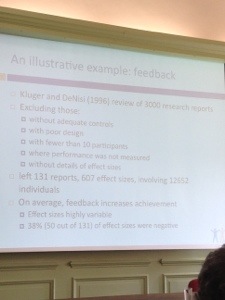
Feedback requires the teacher knowing the students, and the students to trust the teacher, to be effective. Feedback might be an important part of teaching but it is dependent on teacher and class. Teacher quality is more important than many other factors, eg smaller class sizes don’t work if you end up allowing the bottom 10% of teachers to teach them.

There is a high correlation between teacher quality and student learning. What school you go to in this country doesn’t matter much, but what teachers you get has a massive impact. The best teachers see the same progress among advantaged and disadvantaged students, though it isn’t clear why.

There’s no correlation between degree classification and teacher ability. We can’t tell a good teacher by looking at them, either – which makes inspections pretty worthless. The slides Dylan presents provide evidence for this and are on his website, http://www.dylanwiliam.net/
They’re enlightening. Classroom enrichment and instruction have a marginal I,pact, whereas planning and operation don’t. The problem with saying his is that it could easily be used by a poor teacher to avoid planning their lessons, couldn’t it?

Expertise in teaching is similar to expertise in other areas. Practice makes perfect. 10,000 hours is referenced. once a great violinist has reached a certain amount of practice, it is impossible for others to catch up. Deliberate practice is vital. A teacher with 20 years experience may just have one year of experience repeated 20 times, which doesn’t lead to mastery. Most teachers stop improving in year 2 or 3 of teaching so getting the brightest and best through the door isn’t going to help. Teaching is so hard to begin with, that you have to improve to survive, but by 2nd or 3rd year, having figured that out, there is no incentive to improve. Teachers should have a moral commitment to wanting to improve their practice until, they either retire or die. Commit to improve your teaching and focus on those things that make a difference to students, not because you’re not good enough, but because you can be even better.

He who would be a leader must be a bridge – a Welsh proverb, provides a good motto for leaders. Provide time for teacher learning and support them in taking risks.

I enjoyed this one a lot.

Posted in edfest | Leave a comment

Edfest: debate – the future for schools

This promises to be interesting. Claxton on skills vs Christodoulou on knowledge vs Jan Hodges, CEO of a vocational education foundation.

Where are schools going to be in 15-20 years time, asks Ian Fordham, chairing.

Daisy starts by being optimistic. There have been a lot of innovations which have had a positive impact. She’d like to see teacher training reformed to included cognitive psychology and the difference between working memory and long term memory. Secondly classroom practice should be at the heart of what education is about. There should be a greater recognition of the importance of knowledge for all cognition, and practice for mastery. She also hopes to see more research based practice with empirical support.

Jan now talks about the importance of a strong education core to vocational courses… She’s speaking the language of my accompanying colleague, Louise. It’s not just for the thick kids! Employers who help devise the curriculum give students valuable life and employment skills.

Guy agrees with a lot of this. He says the “valued residues” of curricula in other countries are life skills and that we are behind because we have no clear sense of educational goal. He quotes Ken Robinson (and I imagine half the room mentally wincing). We are still captured, he says, by the idea that education is prep for university. What about the 50% who don’t go? Discourse on content and assessment is a mischievous irrelevance. Brightness is measured by a narrow set of criteria.

Questions now. How can we change things if education continues to be politicised? Who should be responsible for changing things? And Sir Cyril Taylor, again, making a self-promoting statement, again (3rd time today, I think). I didn’t follow it his question, which was apparently in there somewhere.

Jan says there is a link between better vocational education (Cyril insists “technological” is better) and high youth employment. Guy says some of his most successful schools have fomented a conversation about the purpose of the school with all stake-holders. That culture provides a nutrient for improving progress. Flexibility in time periods is also vital – 3 day lessons, 10 minute lessons etc

Daisy picks up Annie’s question about politics and indicates academies as a place free of central government intervention, allowing schools to do really innovative things.

More questions: how do we develop skills? How do young teachers promote it against middle leader resistance? What is the place of higher education?

Daisy agrees that we need a clear vision, but we need a route map to get there. Knowledge is really important. Schools can be resistant to change but leading by example is good. Reminded of what Martin Bean said earlier: enthusiastic teachers lead, become the rock stars; fence sitters want a piece of it and follow; the curmudgeons? Forget about them.

Claxton tries to answer the higher ed Q but doesn’t have a prepared answer and is ribbed for it by Ian following his earlier comments about BLP preparing students for unexpected questions, which he doesn’t seem to take well.

Hodges says she is surprised that the higher education system has lasted in its current incarnation as long as it has, and talks about the Edge Hotel, a hotel that students run as their course. She also says that the rate of funding for 16-18yos is a scandal and holding them back.

Another question about preparing students for jobs we are unaware of allows Jan to say that vocational skills are transferable and provides a variety of examples. It is for everyone and can bring enormous benefits to the students and the country. Louise wants to hug her, and Louise is not a hugger.

Daisy is a bit more sceptical about the unknown future jobs. Letters and numbers are ancient, but vital tools. Good general knowledge is useful for all jobs. Look anew at knowledge and remember that it makes up a lot of what we think is valuable.

Guy would rather be a grass roots activist than haunt the corridors of power.

Posted in edfest | Leave a comment