Edfest: Adonis

I was sorry I missed Adonis last year, so pleased to have made it for this year’s talk on “Where next?”

Back in the mid 1990s with the first national key stage 2 tests, there was a big sense of crisis about standards in schools. Performance ratings were pitiful; inner city comps no go areas for middle class parents; problems with teacher quality, teaching standards, recruiting enough teachers for the training places, let alone the schools; huge issues of governance, leadership, quality and investment. So the three objectives were:
1. Better quality teacher recruits
2. Cracking the problem of governance – systems, mainly
3. Big investment – getting rid of the old rosla blocks etc

Adonis thinks there was reasonable progress in all three of those areas. Better pay, golden hellos, GTP and Teach First all dramatically improved the quality and quantity of people going into teaching; but it was a WIP. There were barely 2 applicants per training vacancy in 2010: it is nearer 10 in countries with famous education systems, but in 1997 there was barely 1, which meant teaching was barely selective.

He moves on to talk about the academies policy, underlining that is was never about privatisation. High capacity governance is important but the kind of governors he had in mind would not want to be micromanaged by the LA, so they needed to have more freedom within the system. Weak governance and leadership also led to poor quality buildings and environment, so this needed to be addressed before there was any major capital investment to ensure good value. Adonis says that if he had been running free schools he would have ensured they did this by starting with a robust governance structure. Some of the free schools that have failed have been missing this: it’s vital to sustain the school leader, even if they are a brilliant and inspirational leader.

Adonis believed that the next priority should have been even more push towards better quality and more teachers; systematic removal of weak governance and relentless pursuit of the old academies system; much stronger work, training and technical routes for young people not intending to go to university. There should be clearer routes and career paths for these students, but the focus was on reforming the universities and their funding, and the push to get more young people into them. More apprenticeships and better careers advice; 35% go on to university, but only 8% go into apprenticeships. There should be more investment here, but Adonis admits they were too focused on raising school standards and reforming universities. There needs to be a dramatic improvement in the quality and quantity of apprenticeships, both in the public and private sector, and better careers advice and guidance, whereas the current government is dismantling even the very poor system that currently exists. Schools need to take unambiguous responsibility for the career paths of all their your people. Adonis thinks that every secondary school needs a senior leader, who won’t be a teacher, but who has really good knowledge of the local jobs market and excellent relationships with local businesses, to be able to encourage them to offer apprenticeships.

Work and train routes need to be created for the young people who are being systematically failed at the moment. More apprenticeships – pull; better advice and guidance – push. Endless focus on the curriculum and the assessment system recently has meant there is now a forgotten 50% who have very poor opportunities.
Posted in edfest | Leave a comment

Edfest: Gove

Seventy five minutes late, and looking hot and bothered.

Did he ever expect to be education secretary? No. He never expected to go into politics, but was treated to a call to arms by David Cameron as a journalist critical of the status quo. He is fascinated by how countries make themselves successful and fair, and he thinks it comes down to education.

Why is he so high profile? He says it’s because education touches so many people deeply, both in terms of their own family and their feelings about the purpose of education. It inspires passionate feelings, which attracts controversy.

How does he cope with being unpopular? He always tries to rely on a range of broadly sympathetic people to keep him anchored, who are sufficiently robust to tell him where he has gone wrong, who can be used as sounding boards.

Does he accept that his initial vision, with a narrow focus on literacy and numeracy, was perhaps wrong? He thinks he always believed that the arts, sport etc always had a strong place on the curriculum. His life was apparently transformed when, at 16, he saw Henry V in Stratford on Avon, but his enthusiasm was not communicated when he put in place changes to the accountability system to make it fairer.
In the past we haven’t considered all children capable of all things; he references Dweck’s Growth Mindset here; this is not acceptable. Basics must be grasped firmly at primary school in order to be able to make the most of secondary school. More than 30% of children leave school without a C pass in English and Maths at GCSE (something Gove considers achievable by all “except those with quite a significant learning disability”) and a majority of those are FSM, and this is no good for social mobility.

@HeyMissSmith gets the first question in, wonders if Gove’s unrelenting negativity towards particularly experienced teachers is helpful for children. Gove wonders about evidence (again – like when he questioned the existence of evidence that some teachers don’t like him) and says he’s never said anything negative about teachers. Instead, he has been ambitious for the children. There’s some debate about this and lots of scoffing on Twitter.

He would consider a second term as education secretary, but isn’t interested in being prime minister.

A question from the floor about how he will help other regions of the country make the accelerated progress that London schools have made. He references Teach First starting in London as having made a difference there.

He thinks that we are impoverished when it comes to accurate and detailed research about what has a positive impact in the classroom: we need a rich evidence base, and more randomised control groups.

A question about ring fencing FE budgets. Gove says he would do many thing he could to raise the budget available for schools. Then a questioner stating that, having worked in both sectors, smaller class sizes and more free time to plan and assess are the things that really make the difference, and these things would erode the difference between state and private. Seldon polls the crowd on their opinion of the importance of class size, and I feel able to participate having recently read Gladwell’s explanation of the bell curve of class size impact in David and Goliath (no less than 15 or so). Gove says that there are plenty of super successful state schools and we should look at what they are doing rather than what private schools are doing.

Sending his daughter to a state school? It was right for them. Context again. He’d never criticise anybody for sending their child to their choice of school. Quite glad I am not going to be Miss Gove’s tutor next year, I must say.

During the next answer Gove gives an example of an outstanding primary in London and uses an example of a lesson about Shakespeare to demonstrate its outstanding…ness. Curious negative murmuring from many teachers who clearly do not think his example is, I’m guessing, realistic, or outstanding, or something.

Somebody from an educational company bleating about how they reintroduced Hattie and Dweck to Britain but who fails to actually ask a question. SIT DOWN.

Does he support fining parents for not participating in parents evenings?
He will be discussing the mechanics of this with Wilshaw.

What does he mean by British values?
There’s a 2011 definition of this – rule of law, liberty, tolerance, more that I am too slow to type.

Phonics pass mark being published before the test?
He doesn’t think this is necessary to publish this. I know nothing about this debate but this is wildly unpopular, at least in my section of the audience.

Gove makes the mistake of saying that the best teachers are happy at the demise of NC levels, which inspires a large amount of cat calls and yelling. This is a difference of opinion, in his opinion. This crowd is definitely feistier than last year’s. It’s a slightly uncomfortable end.

Posted in edfest | Leave a comment

Edfest: Swinson

Jeremy Swinson is speaking to a packed room about his research on reducing low level disruption, specifically the relationship between teacher verbal feedback and pupil engagement. His research showed that there were small variations between urban and rural schools; wider variations among areas; and considerable variation among teachers within the same school. However, this variation is not to do with the students, but seem to be related to teacher feedback.

High rates of positive feedback have high engagement and low disruptive incidents (Paula Loro, sitting by me, points out this is the halo effect). Positive feedback, though, is generally related to work; behaviour receives mostly negative feedback. Jeremy references Harrop (1974), Wheldal and Merrit’s Batpack and Batsack, and his own work carrying out research on Assertive Discipline from 1995. He found that if teachers applied the positive feedback, they didn’t need to use the disciplinary element of the program. With his colleagues, Melling and Cording, he published the four essential steps.

To begin with, ensure whole school commitment with the full backing of SLT and an established behaviour policy. Then, assess current performance by observing classes. Then the steps:

1. Make your instructions and directions absolutely clear.

2. Look for the students who are doing what they’re told, and acknowledge them.
Remember to repeat the instructions as part of the acknowledgement. Whole class acknowledgement and praise works particularly well with difficult groups.

3. Frequently acknowledge them.
Make sure the feedback is descriptive and individualised. Tour the class. Give more positive feedback if a class becomes unsettled, rather than reverting to negative feedback. Telling kids off does not work, so why bother?

4. Always know how to deal with inappropriate behaviour.
This falls into three categories: non-disruptive, low-level and severe. Non-disruptive is off task, looking out of the window and so on. It can be easily dealt with by a look, proximity, proximity praise (repeating the desired behaviour whilst praising students either side of the student off task). It’s important to keep calm.

Jeremy shares data to show improvements in on-task behaviour following the implementation of these steps, from 70%ish to 90%ish, and shares details of his book, Positive Psychology for Teachers.

Posted in edfest | Leave a comment

Edfest: Kynaston Panel

I come late to the panel about breaking down the Berlin Wall between private and state education, in times to hear James O’Shaughnessy suggest that non-pupil-premium parents might want to donate a similar amount of funding (£1300) to their child’s school. I have a view on this. It is similar to my husband wondering why we now have to pay for our green wheelie bin to be emptied, when we already pay council tax. Perhaps I misunderstood his meaning.

A question from the floor asks, how do we define private education? Munira Mirza says that state schools need to work more closely with private schools to raise their game and win back particularly middle class parents. Parents pay for all the extras at private schools, and the state simply cannot meet these costs (a crowd member suggests private schools save the state £3b).

Becky Francis talks about dis incentivising private education, removing charitable status because it is not charity to educate the elite to maintain the social hierarchy (not her word but I think this was the gist). James suggests that private schools would wither if there state sector was brilliant; many disagree, though.

A student suggests that removing the private sector whilst still insisting on a system of meritocracy would create another “Berlin Wall” in education. Interesting point. Next, a teacher from a prep school that deals with a diverse group of students takes exception to the suggestion that teachers are not held to the same standards in private schools as in state schools; Becky suggests that applying the Progress 8 measure to ALL schools will improve transparency and possibly be a fairer measure when judging quality of teaching, giving parents a more genuine choice.

Charlotte Fear from the GSA professes dismay that the Berlin Wall she and colleagues have worked so hard to remove is being rebuilt; she goes on to admit that the independent sector is horribly divided among its various associations and wonders, is there a communication problem? The responses to this reference the the suggestion that the Attlee government could have got rid of private education and I am prompted by my recent attendance at a Richard Evans lecture on counter factual history at Bristol Festival of Ideas to wonder if anybody has ever written an essay about the impact this might have had on the UK. I feel like that would help me to understand the Dante better, but given that Evans suggested that the left generally rejects counterfactual history, I think it might turn out to be difficult to find one that remains politically neutral. There is also a suggestion that social inequality needs to be tackled everywhere, not just in education – first class train travel, for example.

Munira suggests that the private/state debate is a distraction from improving state schools across the board.

Very interesting discussions: I don’t feel like my write up is particularly coherent, apologies. Missing the first half probably didn’t help.

Posted in edfest | Leave a comment

Edfest: Rob Coe

Rob is speaking on getting teachers better.

We begin with what does better look like? Rob asks whether the teachers in the room know what they need to do to improve, how to do it, why to do it, and how to judge it. We might start with the teacher standards; there’s also the Danielson framework to help us. However, Rob thinks that a good set of professional standards should be evidence based (ruling out the English set, he says wryly), will reflect diversity and allow us to judge when they have been met: what needs to happen for a person to demonstrate this? What is required? It must be clear that achieving these standards means being able to say “I am a better teacher than you”.

Where to get the evidence for these standards? We need evidence of the relationship between teacher behaviours and learning outcomes, of what can be changed and based on strong pedagogical theory. Most importantly, we need to consider whether these things have a positive impact on learner outcomes.

20140620-114102.jpg

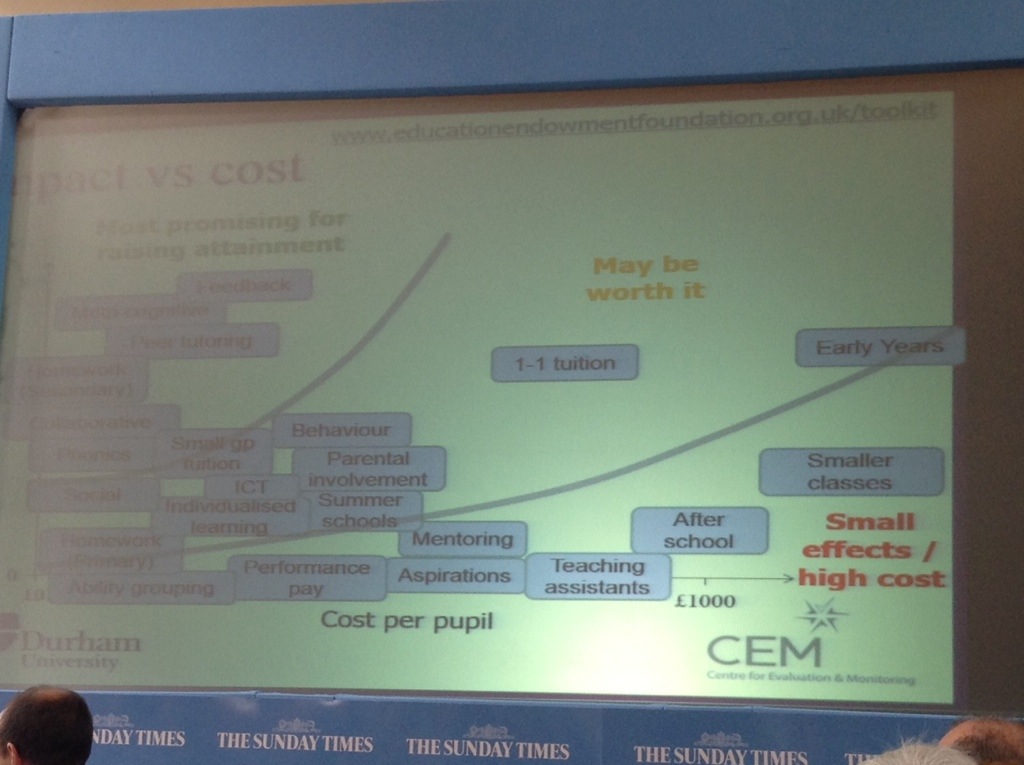
Graphical version of the Education Endowment Foundation toolkit – a couple of our governors did a course on this recently and they are big fans now. Rob says it is slightly out of date because the use of TAs has been proved to have an impact of 1 month now – that’s not to say TAs can’t be more effective in certain contexts.

Why is knowledge of research important? Rob sets us a quiz, to order a series of strategies in terms of effectiveness. The highest is a focus on training teachers to be more effective, while the donkey is the strategy focused on getting kids interested in order to improve attainment. Rob says it is the other way around – get them achieving and they will become more engaged.

We move on to considering learning theory, and Rob poses one of my favourite problems: how can teachers make it most likely that students will remember what they have been taught?
Do teachers need to understand research on learning theory? Maybe, if it’s good and it has an impact on learning.

Rob introduces part 2 of his talk – the broader argument for being better. Teachers learn just like everyone else and they need to understand the outcomes before they are able to know what to do to get there. Teacher effectiveness needs to be assessed, as student effectiveness is daily. For students, we have a whole framework of how to get them to learn hard things; for teachers, most CPD fails at this, doing nothing other than explaining what to do once: no encouragement to practice, no formative feedback, no assessment.

How will we know when we get there? Performance feedback, target setting and accountability – while unpopular, this is a necessary measure. Teachers typically plateau after 3 to 5 years: observation, student ratings, parental feedback, work scrutiny and colleague perceptions are all methods to judge teaching quality that can help teachers to avoid this. Rob qualifies student voice by making it clear that the right questions must be asked for this to be effective. Be cautious, and evaluate – does it work in your context?

Context, context, context – I feel like everyone is singing from my hymn sheet today.

20140620-115926.jpg

In questioning, Rob says he thinks there is some evidence that teachers really should engage with, but it is a tiny, tiny fraction of what is available. He considers ethical issues when carrying out action research on groups of students who might be unaware that they are being researched, or who might, as part of a control group, might miss out on something that might really benefit them: but, equally, it is unethical NOT to do trials because implementing bad research is unethical. Also, teachers experiment all the time without asking the students for permission; and schools are intrinsically unethical places anyway!

Posted in edfest | Leave a comment

Edfest: Sherrington

Tom’s first session is about great teaching: mechanics with soul.

He says his message is about mixing traditional and progressive pedagogy, rather than seeing them as separate poles. There are various websites that try to compare the two, but largely fail by clearly expressing bias. He speaks about the benefits of either side, bringing in examples from his experience: lessons in Chinese schools vs learning skateboarding: it is hard to recreate the latter in a physics lesson, for example. He thinks that schools leaders should encourage learning to be like a rainforest, rather than a predetermined plantation – clear goals but with less micromanaging of how.

Tom shows off his pedagogy tree. It needs to be in an environment where it can flourish, but it needs rigour and structure in order to be able to grow. A rich, fertilised environment and structure creates all sorts of possibilities; sometimes we spend too long thinking about the nutrients and not enough about the structure. Rigour is important: but high expectations, excellent subject knowledge, challenging wrong answers and so on are not separate from creating awe and wonder, which are essential for insisting on the rigour. A virtuous circle.

He cites his technology department as an example of this: discipline and old fashioned learning in year 7 provides the skills and structure that students can then apply to designing and making items higher a up the school. He describes a history lesson that began with group discussions and ended with a more traditional written task.

Tom talks about students at his grammar school, many of whom have been schooled in independent learning at home from an early age, and therefore come from a wider culture to the school environment, and how teaching needs to be adjusted for students not coming from a background like this. Some people need an education more focused on their intrinsic motivators. Making a maths hat for homework, for example, might create a softer motivator for the right kind of person, whereas another might prefer a sheet of difficult algebra problems. We need to find certain hooks to encourage students to see that learning can be an enjoyable thing.

This chimes in with something I have been thinking about recently about education being an unfortunate inconvenience for some children, and not viewed as a way of achieving success in life for some families (the former from a friend who is a school governor, the latter from the news recently, I think) and whether this could help with those students. Play, for example, can help with language acquisition that for some students might already have happened within the home learning environment. It bridges a gap. But it depends on CONTEXT! Amen to that!

Tom also talks about co-construction: a progressive idea that often mixes with traditional ideas like didactic teaching and testing to create learning with a buzz.

20140620-103106.jpg

He then talks about history teaching, where the synthesis of knowledge and skills is very apparent (very, very true) and where teaching persistent pursuit of lines of enquiry is very important. He also talks about rote learning and its value in certain areas of the curriculum, for example poetry, which is written to be spoken.

Tom makes a good case for a mixed economy when it comes to teaching. Sometimes traditional teaching needs to be deliberate: rote learning, strong teacher expertise; but a nourishing and supportive environment is very important to encourage students and make it accessible for all. That is great teaching, in Tom’s opinion.

Posted in edfest | 2 Comments

EdFest: Wilshaw

Wilshaw begins by likening the marquee to the Star Chamber, with its twinkly ceiling. He is speaking about comprehensive education and competitive sport. He wants to reclaim and celebrate the comprehensive ideal. He disagrees that the best way to address the problems of the comprehensive system is to bring back the grammar school system. A country will only progress if it provides an excellent education for all children, not just some of them.

He was disheartened to hear many voices last year nay saying the idea that comprehensives can provide stretch and challenge for the most able. He thinks that this is now much rarer than it used to be; comprehensives should be proudly academic, promoting the idea that all children should be provided with an intellectually stimulating education.

What happened to Wilson’s grammar school for all? Toleration of poor behaviour, disdain for competitive sport, half hearted pursuit of academic excellence and occasional disrespect for authority are all painful legacies of the system that we need to face up to. The original school model had been based on sound principles, but became the school parents sought to avoid. Why? He thinks a loss of authority at all levels. Teachers didn’t respect the head, pupils didn’t respect the teachers and nobody had respect for academic principles. Middle class ideologues were busy reinforcing class barriers with threadbare education. Intellectual excellence was a sacrificed on the altar of equality.

At this point the mic went off. One of those ideologues!

To show respect was craven. Pandering was encouraged, heads expected to be friends rather than leaders. There was no external support from LAs to help heads resist this. Management was conditioned to concede. Those few who did manage to resist saw their comprehensives flourish.

Good leaders today must refuse to concede and must challenge the orthodoxies that have damaged education over the past 40 years. Tired teaching orthodoxies must go: a demanding intellectual curriculum must be imposed. Academic rigour is undervalued and this problem must be addressed, along with resistance to exams. There can be no suggestion that academic achievement is limited by class background.

Leaders must also confront parents who are not willing to take responsibility. Their engagement is critical to the success of the school and too many comprehensives have ignored this concept, infantilising parents. Poverty or wealth does not excuse parents from engaging and supporting the school.

Thirdly, good leaders challenge the idea that competition is a dirty word. Competitive sport was, for many, tainted with the old ideals of grammar schools. But learning to deal with and move on from failure is one of the he biggest lessons competitive sport can teach. In independent schools, competitive sport is a key component in building self esteem. Some state schools have also take those lessons to heart, using it to energise the whole school. The school that wins on the pitch also wins in the exam hall.

Discipline is also vital. Weakness has been dressed up as respect for a child’s innate difference. Respect for the teacher was replaced with disdain, as teachers abrogated their responsibility to discipline and educate. Children who lack structure at home, particularly, need a framework of rules in school, although some teachers still struggle to provide it. “Behaviour management” suggests there can be some negotiation with the child about the behaviour: there cannot. Discipline is not a dirty word.

School leaders must radiate authority, attending to the small details as well as the big picture, and learning the lessons of where schools went wrong. Good learning and teaching cannot miraculously happen without excellent leadership. We need to reclaim comprehensive education, acknowledging that there is only one school model that can educate all children to a standard they, and we, deserve. We must be honest about what went wrong in the the past, ditching the blighted legacy in favour of intellectual challenge, fierce competition and strong leadership. The future is definitely comprehensive!

Posted in edfest | Leave a comment

Workshop 3: Ted Savill

Ted is talking about encouraging students to read better for History A-level.

Ted shows us a book he read when he was studying A level and then an evolution of books for sixth formers, showing us Broszat’s Hitler State “from the 90s” which I referenced in one of my university interviews…spot on. He suggests that it is no longer conceivable to ask sixth form students to read books like this, no matter how accessible.

A big problem is that students tend not to read much beyond the narrow confines of the textbook. Why does this happen? Utility: they want the answer, not to think it through and come up with their own. I think accessibility is a problem: fewer copies available and also being able to understand what they read. Ted suggests that there are lots of distractions; spoon feeding at GCSE doesn’t help; and the structure of the exam system does us no favours, with 4 essays in 75 minutes (for my year 12s at least) just not amenable to bringing in wider reading.

Ted says we need to give them a reason to do the wider reading: in y13 they do more because the course allows for it. Perhaps the changes from 2015 might allow for this to be easier. We need to create the right environment and have higher expectations. We’d like them to be confident historical readers, ensure they can extract key info from a text, construct their own interpretations, engage with historical controversy and be able to evaluate the merit of what they read as history. They can’t achieve these things just from reading the textbook.

We discuss strategies we have used to encourage wider reading. Departmental libraries can help, if it can be funded. I like historical fiction. Book discussions in class can work well. I’m reminded of the vle idea from Diana Laffin (I think) where teachers share reviews of history books they’ve been reading. There’s a “drop everything and read” idea where everyone in the whole school – all staff and students – stops to read for 20 minutes and then has a bit of time for discussion. Ted shares what has worked for him: A level History Society with presentations from pupils have worked particularly well, in spite of the need to conscript people into doing things for it. Talks from historians are very inspiring if you can get them to come to your school.

In class, card sorts, quizzes, reading in class time, lists of key words, debate/discussion tasks all help to encourage them. Ted gives us a task that involves reading a chunk of A People’s Tragedy alongside a task with some questions. We discuss the task and look at student responses to it: it includes page references which, yes, does make it easier, but having done a similar revision task with my y11s recently, they effusively praised my use of page numbers for the questions, so I can see the benefit if the aim is partially to encourage them to do more reading.

Whilst enabling students to access “proper” history, it also led to an excellent class discussion which Ted thinks was prolonged by their improved knowledge as a result of the reading. It did perhaps need a bit more stretch for the top end, but this could be provided by an extra, contradictory task.

Posted in tlab14 | Leave a comment

Workshop 2: Sarah Jayne Blakemore

Sarah Jayne is talking about her work in the teenage brain.

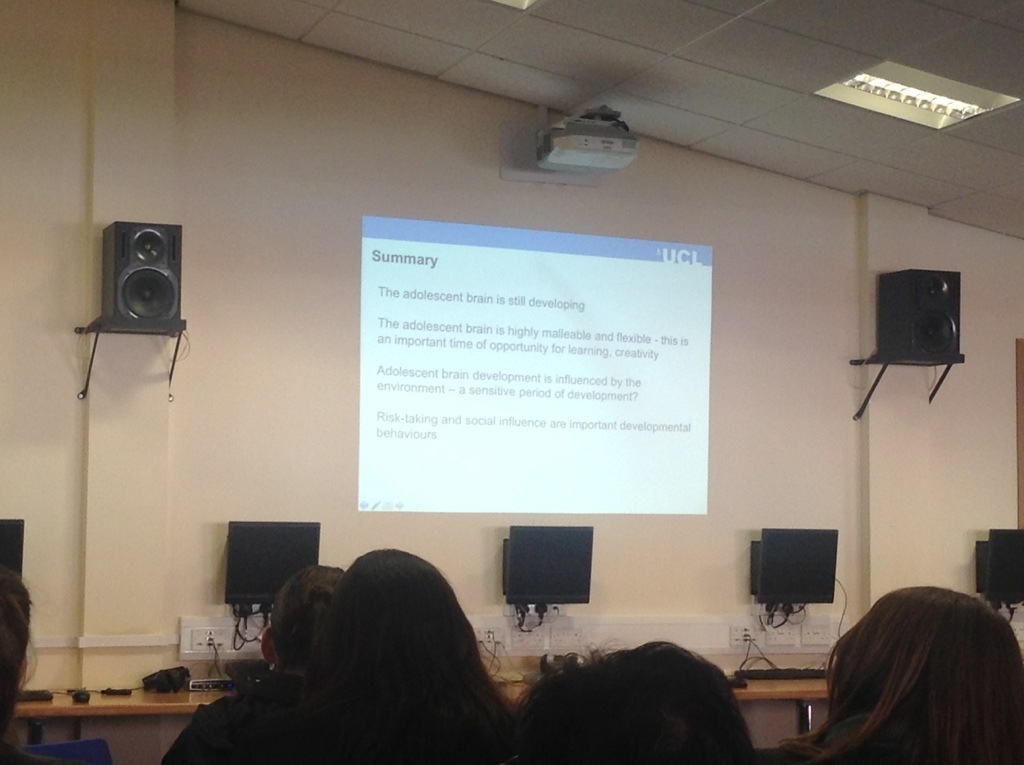
She begins by explaining that adolescence can go on for a long time and in this country that is considered to be very normal. Other cultures have different ideas about when adolescence should come to an end, but the same behaviours are exhibited – increase in risk taking, peer influence and being self conscious.

Teenagers take more risks than adults; they are at the peak of their health here, too. Sarah Jayne shares the results of a study on peer influence on risk raking. It shows that adolescents and adults take about the same number of risks when they’re alone, but that the graph massively spikes when they’re with friends, with adolescents having nearly double the number of accidents that adults do.

Sarah Jayne is interested to understand why. They use a game called Cyberball where participants choose to include or exclude other players from a cartoon game and changes in mood are tracked. For adults, being excluded led to a significant decrease in mood. For adolescents, this decrease was much greater: they don’t like being socially excluded. She goes on to explain her work in adolescent decision making: weighing up the facts happens differently when under social influence. The social factor weighs much more heavily to adolescents than it does to adults. Sarah Jayne uses the example of a 13 year old girl whose friends are all smoking: having a cigarette is the rational choice, to avoid ostracisation. This leads to a discussion about why, and how this could be avoided.

Sarah Jayne moves on to walk about when the human brain stops developing. I remember reading that humans don’t develop their empathy skills until the age of 23 or 24 – looking forward to seeing whether she can confirm this. It has helped me to think about teaching alternative interpretations in History so it would be a shame to discover that it wasn’t true.

Research shows that brain development doesn’t happen uniformly. Sarah Jayne talks about grey matter changes through brain development; it rises through adolescents and the declines. This is possibly due to an excess of synapses during adolescence that are pruned away as the brain matures to adulthood. She uses an example of Japanese people being unable to distinguish between r and l sounds: they are not exposed to these sounds as babies and so the synapses to recognise these sounds it pruned away by the time they reach a year or so, and then it is wildly difficult to get them back. I am really loving this lecture. So interesting!

Pre frontal cortex development happens towards the end of the process. This controls planning, inhibiting inappropriate actions, multi-tasking, social interaction, self awareness, self control, decision making, problem solving, amongst other things. Boys’ brains develop slightly slower than girls’ brains on average, and it is linked closely to puberty, too.

We watch a clip of helping behaviours among toddlers, who can infer intention without use of language in order to provide assistance to adults. Sarah Jayne then explains that teenagers use more of their brain, or work harder, when doing social cognition tasks than adults do…think this means that empathy takes them more effort? Hope I’m not working too hard to make it agree with what I already thought…

20140322-125739.jpg

Sarah Jayne suggests that we need to encourage teenagers to use that risk taking that comes naturally to them to attempt tasks in the classroom where they might not want to get it wrong or might be unsure – ties in very nicely with Beth’s session on arguing. She suggests anything that involves a lot of reasoning or abstract thinking arguably isn’t best taught first thing in the morning to teenagers, who struggle first thing and are more alert as the day goes on.

Ten minutes over time but I could listen to this all day. Great session.

Posted in tlab14 | Leave a comment

Workshop 1: Beth Baker

Beth is talking about improving student ability to argue. We start by considering why students struggle to argue; Beth polled her students and the common responses were not having the words to express themselves, not having the confidence, not being interested enough and not knowing whether it is correct. So, we need to enthuse them first and then give them the tools to be able to do it.

Students need to understand that history is a live subject, constantly being debated, which means they have to learn to deal with a level of uncertainty. They need to create nuanced arguments, avoiding sweeping generalisations; to learn the read critically so they can distinguish between argument and narrative; and to appreciate the wider historiographical debate. These skills should be introduced earlier on and built on as students move through the key stages.

Step one: getting them to be ok with uncertainty. We are given medieval character cards and asked to order ourselves from best to worst quality of life. This got us to discuss and reach a compromise, and make comparisons among different people. Helps to show students hat there’s no right or wrong answer.

Using historians. Beth shares a year 7 exercise where students read a piece from Schama and have to match an opinion with the text, to help them access it. They then write speeches that challenge what Schama said: they had a desire to argue, so this exercise worked as a good hook.

How to maintain this progress at key stage four? Beth bemoans the lack of opportunities for argument at key stage 4. I am reminded again of what Mastin said at SHP last year about getting them to do more than they will be expected to do on the exam: big debates and long essays will help them to develop their arguments and improve their writing skills. Suggestion of working backwards from A-level to help students improve their formal writing by deconstructing texts. ABC questions – answer, build it up or challenge – help to encourage students to listen carefully to each other. Beth gives us some phrase cards to help students construct arguments, and looks at blacklisted words that help students to avoid contradicting themselves in their written responses. Reminds me of a tweet from Richard Kennett last week on nuanced words to show a scale of argument/agreement. Hopefully he’ll blog about that so I can link it.

A-level. Beth explains that adults can more easily pick arguments out of text because we don’t read the lexicon. A-level students can’t do that and this means they struggle to both read and construct argument. Beth gives us a targeted reading sheet and an extract from a political science book. We highlight knowledge, then argument, then where argument is refuted. Beth then talks about getting students to peer and self-assess to add nuance to their arguments, and encouraging them to name and reference historians, rather than just saying “some historians”. Plan a historians’ dinner party, or come up with an argument between two historians. This will help them to humanise the debate.

We finish by sharing what we do in our schools to encourage debate. This was a great session!

Posted in tlab14 | Leave a comment